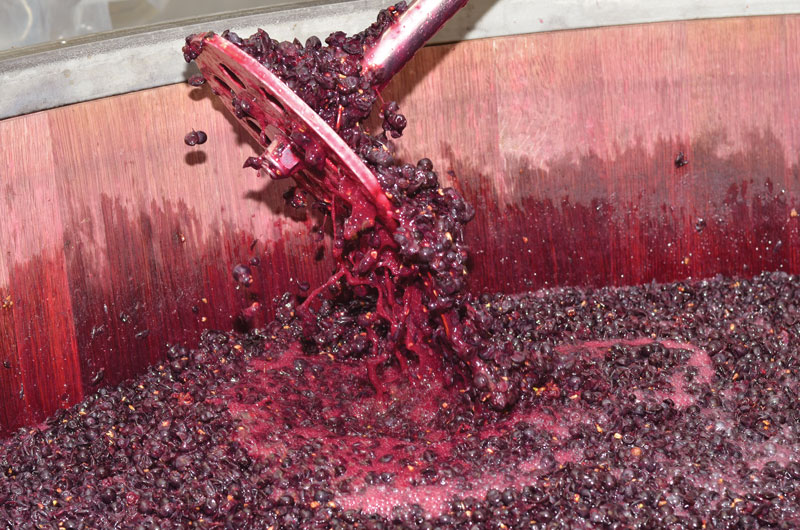
Have you ever been driving down the road and noticed a wild plant wrapping itself around a telephone pole and then stretching itself across the street on the wire? Chances are, it was a wild grapevine, serendipitously planted by a passing bird only a few years prior. What you’re seeing on your way to the local wine shop has serious historical significance. It’s how wild vines got started. They would climb trees, bushes, and rocky ledges until they could produce millions of (extremely unripe, with very low Brix) berries. Our nomadic predecessors, frustrated by the out-of-reach food source, figured out that if they grabbed a branch from a wild vine and stuck it in the ground, the next year, when they passed the same place, the grapes it produced would be low enough to grab.
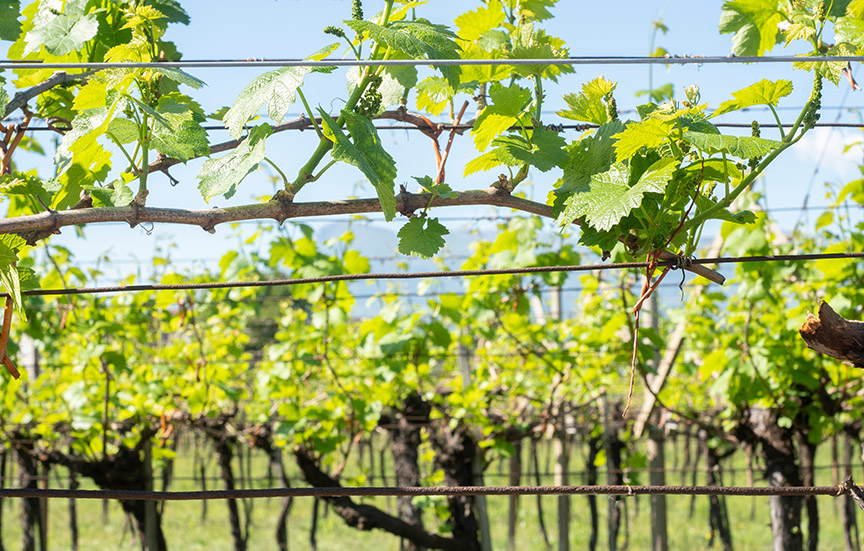
Eventually, vines were cultivated in fields without any trellising. We call this ancient and absolutely beautiful way of farming “head trained,” or “goblet” for better imagery. It consists of just a single trunk with a spur-pruned head or renewal zone, so that in the spring, all of the emerging shoots with clusters on them will spread out from the center like the spokes of an umbrella. In dry, arid climates such as northern Spain and Southern California, high-quality grapes are still lovingly grown this way.
Let’s assume you’re not in a desert and you’d like to have your vine shoots off the floor. The simplest trellising method is called the high wire, which has also been nicknamed the “California sprawl.” A wire is strung between two posts about 6 feet (2 m) high, the trunk is trained up to it, and two arms are tied to this wire (called the fruit wire), going in opposite directions from the trunk. This is very low maintenance since there’s really nowhere to train the shoots to go, except for trying to prevent them from crawling along the top wire. All of the fruit is congregated up high near the top wire.
The most popular and widely used method of trellising is called “Vertical Shoot Positioning,” or VSP. Instead of the arms being on top of the trellis and each year’s shoots hanging down off them, the trunk is only 2–3 feet (up to one meter) high. Shoots growing off the arms are trained upwards into “catch” wires and clipped when they are as tall as the posts themselves. In this example, the fruit wire (and thus the fruit itself) is around the same height as where the trunk stops and the arms begin: 2–3 feet (up to a meter) from the ground.

Choose the Trellis System That’s Right for You
Now that we have a description of these two most common trellising methods, let’s explore the following list of factors that will influence what’s planned before the planting itself happens next spring.
The perfect trellis system for your site will do the following:
- Balance vigor
- Balance crop load
- Control sun exposure
- Increase tractor and equipment accessibility
- Facilitate harvesting
- Mitigate disease, insect, and animal pressure
To get a clear picture of how a trellis system can help mitigate vigor, consider our ancient vines climbing and strangling trees. As a vine reaches out with its tendrils and grabs yet another branch higher up the unfortunate host tree, the vine is stimulated, sending hormones to the roots and other parts of the vine, which say, “Guys, I’m doing great up here. We are one step closer to sunshine.” The vine responds in turn with a new flush, or growth, on the roots. Maybe some more lateral branches are encouraged by their big brother’s success. So, although it may seem counterintuitive, a grapevine is most vigorous when its shoots are trained upwards, against gravity. Therefore, the simplest way to compare these two trellises when speaking about controlling vigor is that the high-wire system will decrease vigor, and the VSP will encourage vigor. On a high wire, the shoots begin at the top of the trellis, have nothing to climb, and are trained (or, by default, allowed to fall) downwards. Whereas on VSP, the vine’s shoots begin halfway up the trellis and grow upwards through 2–3 pairs of catch wires. This upwards growth habit reminds them of their prehistoric tree-climbing days. Excitement and nostalgia spur them upwards!
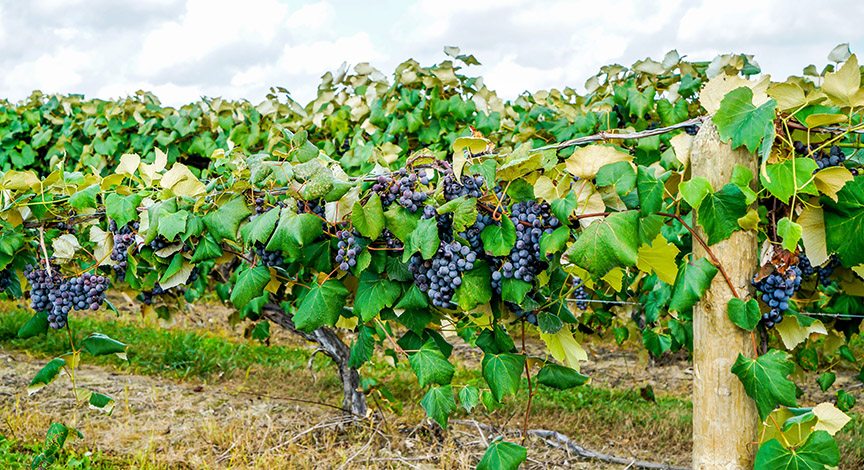
Now we must consider what grape varieties we will be growing. Most native varieties and hybrids already have a naturally ingrained downward, or “trailing,” growth habit. If you try to plant Concord or Catawba on VSP, you will be constantly engaged in a physical (and verbal) altercation with each of your vines. Imagine trying to crochet with a wet noodle. About a decade ago, I took over a small half-acre plot of Marquette. Year after year, I worked to train the shoots upward to allow more sun exposure to the whole vine, trying not only to manage the canopy but increase the productivity of the vines by decreasing the amount of shade that all the crazy, crisscrossing shoots caused on each other. I once hedged three times in one month. One year, around veraison, I was introduced to the little green rage monster that dwelt within. As I was leaf-pulling the fruit zone and constantly being whacked by 8-foot-long (2-m) laterals sticking out of the trellis, I grabbed a nearby pencil rod and started swinging. Picture a Tarantino film about agriculture. The most I ever harvested from that plot was 1,500 pounds (680 kg). Getting 1.5 tons per acre is simply not economically viable.
The low-yielding vines did create incredible wine, but the vines had to be grafted over. Right now, we have a mixed field of Albariño and Cabernet Franc, both of which are doing quite well. There was nothing wrong with the site, and nothing (very) wrong with the farmer; I just had an excellent variety on the wrong trellis. The question you should be asking is, “Well, Stephen, why didn’t you just retrofit the trellis to be a high wire?” Great question. The vineyard I was caring for is in the backyard of my friend’s very upscale bed and breakfast. Growing Marquette on a high wire on somewhat heavy, nutrient-rich soils may have resulted in a lot of fruit, and surely a crazy, unrecognizable mess. The owner, Dave, (and Dave’s guests) wanted a better view. The other consideration is that the rows are planted 8 feet (2.5 m) apart. Certainly not enough room for the monster named Marquette to be at liberty. You’d have to mow the grass with one hand and hold a machete in the other.
Speaking of crop load, without going into too much detail about the how and why (once again, it all has to do with plant hormones: Vines get triggered too), in general, vines will always yield more (sometimes double) in a high-wire situation. Think about it this way: If a shoot is trained downwards, it is devigorated. This means that, since it is not “thinking” in a vegetative way (“Must find sunlight! Must climb tree!”), it’s thinking in a reproductive way. This means it is more bent on allocating resources and energy towards more and bigger clusters.
But remember! If you are going to retrofit a trellis, don’t expect these results in one season. The shoots you are growing this year are the ones setting up the buds for the following year. For example, picture my wildly growing Marquette on VSP the year that I lost my cool, 2013. That was a deep and densely shaded canopy where even the shoots that made it to the outside of the trellis were eclipsed by their own lateral branches. A canopy so dense, the inside leaves were turning yellow because the plants had deemed them useless and shut them down. Sad. Let’s say the following year, 2014, I retrofit the trellis, pruned the vines, and trained two canes along the top wire. The resulting shoots that came out were going to have all the genetic information they were programmed with the previous year. And what was that information? “Too shady, don’t bother making clusters; they’ll never get ripe, and birds will never find them. You must grow as long and leggy and weedy as possible to achieve your ultimate goal: Find the sunlight!” In short, if I were to pursue a high-wire system for that Marquette, I would have had to wait until 2015 to start to reap the rewards. The 2014 growing season would have been the first year they grew downwards and were de-vigorated enough to catch some sunlight and create fruitful buds for the following year.
“What if you trained the Cabernet Franc or Albariño onto a high-wire trellis system?” Another great question. You’re on a roll. In theory, although both varieties would obstinately want to grow upwards, this would increase yields. That would be bad news for the quality of the Cab Franc. Where I farm in Long Island, New York, it is considered a coolish climate. We have a short, somewhat cool, and sometimes wet and rainy harvest period in September and October. This means that getting the appropriate Brix (sugar levels) in a longer-ripening grape, such as Cabernet Franc, would be almost impossible with a higher crop load: Too much work for each vine. And even more troublesome to ripen under more and more leaf layers on a high-wire system, where no leaf pulling is done.
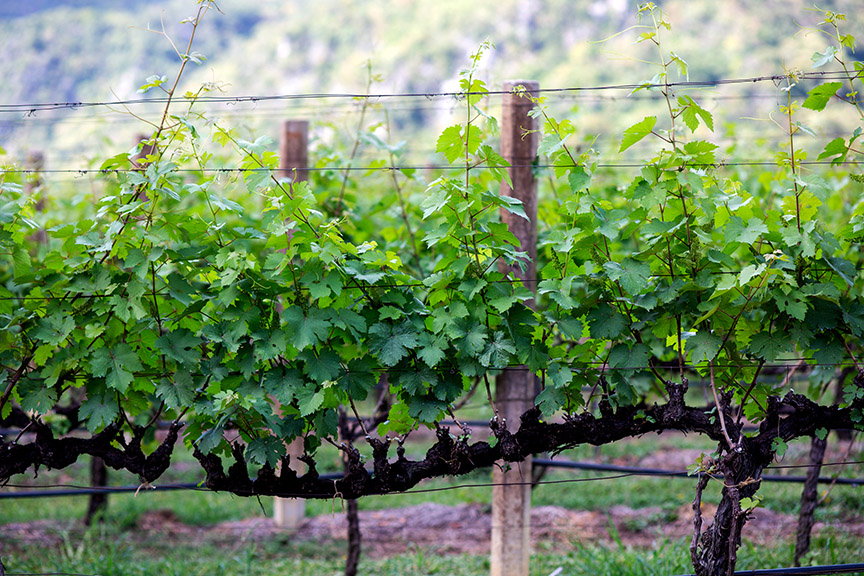
Remember the head-trained or “goblet” vines mentioned earlier in the article? The reason that it works so well in certain regions is due to the shade the vine itself offers to the clusters. Some of us who grow in cooler regions with a shorter season and not as much or as intense sunlight can’t imagine our grapes getting sunburnt. For cooler regions, prioritizing sun exposure of the clusters is paramount to high quality. Between set (when the minuscule, pinhead-sized berries have just completed flowering, aka bloom) and veraison (when the berries begin to soften, turn color, and increase in sugar), those green berries are actually able to photosynthesize. On the other hand, the success of the “California sprawl,” besides its ease of management, was that it shaded the grapes from the intensity of the sun. But for most growers growing on VSP, one of the most important advantages is the ability to remove the leaves around the middle portion of the trellis to expose the fruit to the sun. This also exposes the clusters to airflow and pesticides, thus decreasing disease pressure.
Getting tractors into the vineyard in order to perform these tasks can save even a smaller farm a lot of man-hours, and the trellis system with the most ease of accessibility is the VSP. VSP works well on even a single row or a few dozen vines. It’s often the best solution for not compromising on quality and manageability, offering relatively easy hand-pruning. If you can pay your neighbor to come over and run his equipment instead of having to spend your time leaf-pulling — when there are so many other tasks to do — you’ll save yourself a lot of time.
Most of the tractor attachments, including pre-pruners, sprayers, leaf blowers, and rollers (which remove leaves from the fruit zone), hedgers, weed sprayers, under-the-vine cultivators, de-suckering implements, etc., are most compatible and easiest to use when the trellis, trunks, arms, and shoots are organized in the VSP pattern. Even harvesting is easily accomplished by machines that can gently (the harvested berries look almost picked by hand) knock the berries off the rachis while the tractor straddles the row; one set of tires in one alley and another in the adjacent alley. It’s a big machine – with a beautiful view over all the vineyard rows.
If disease pressure – especially fruit rots such as Botrytis, sour rot, powdery mildew, etc. — is a concern, you must plan your vineyard so that equipment can have space to navigate the rows. The calibration on these newer pieces of equipment — especially the leaf blowers, which open up the fruit zone — is such that they can do an amazing job even right after bloom. Exposing the fruit to sunlight, air, and pesticides that early in the season is going to send your quality through the roof.
Statistically, VSP has two other advantages. Because this system allows the fruit to be uniformly exposed, all the clusters receive the maximum amount of sun, air, and spray, resulting in even ripening and less disease pressure. This is unlike high wire, where it’s more likely to have a few clusters on each vine hidden behind shoots or leaves, while others are closer to the top, receiving an unobstructed view of the outside world. The other advantage is decreased bird pressure. As you can imagine, it is far easier to net a tighter, narrower, neater row of VSP than a larger, sprawling high wire. As you’re planning your vineyard, consider the ease of netting as well.
Other Trellis Systems
Now that we’ve spent so much time dissecting the pros and cons of both, let’s talk about some of the more unusual trellis systems from around the world. Trellis design on hard mode — you’re ready for this.

One of my favorites (I’m proud to say I’m the only one in my region that uses this) is the lyre trellis system. This is when one trunk divides into two. Each division then has two arms coming out of it. After that, the shoots are trained upwards like in VSP. So, one vine now has four arms: Two on one side and two on the other. This is a great technique for vines that are very vigorous, comfortably high-yielding, or grown on heavy, nutrient-rich soils. Because a tractor can only access it from one side (and working by hand inside the trellis isn’t too much fun either), it isn’t highly favored by many commercial farms. There are a lot of fun variations of this design in Napa and Sonoma, California. The most important aspect of this design is keeping the center shape of the lyre open so sunlight can get into that side of the canopy, and hot, humid air can more easily be whisked out. Lyre can be complex to set up but is rewarding for enthusiastic home winemakers growing vigorous, sun-loving varieties.
Another popular and “old school” method is the beloved pergola in which the trunk is trained up legs and the cordons and shoots create a table above. It’s a great aesthetic option for home growers who love to entertain. Most table grapes are grown this way. Table grapes thrive in hot, arid climates, and shoots growing on pergolas perfectly shade the fruit below. There is also something very economical and efficient about growing on a pergola, since every single inch of the farm is a green sugar-making machine. I have always wanted to see what it looks like from above. Albarino in Spain is often grown in this manner, and there are still many farms in Italy growing very interesting and obscure grape varieties on rocky mountainsides using pergolas. These small-batch wines are hard to find. You have to know a guy.
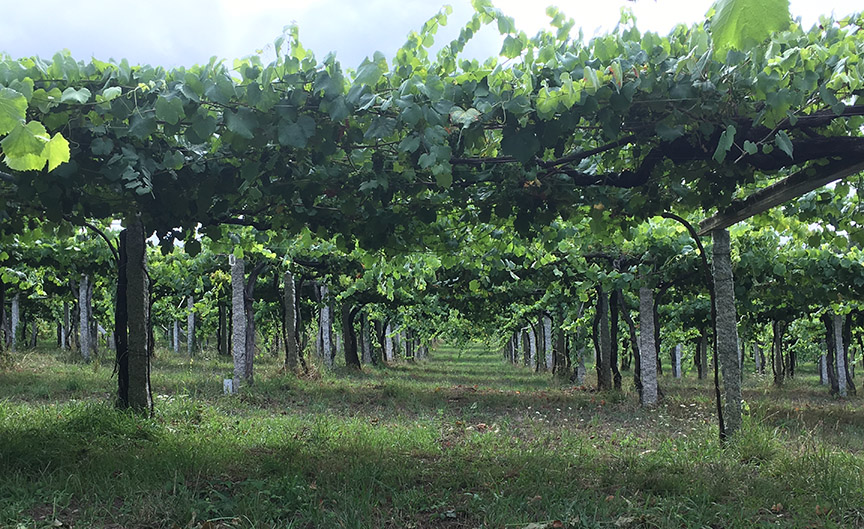
This in no way is a comprehensive synopsis of trellising methods. We have barely scratched the surface. I owe almost everything to what I think is the most important book that every grape grower (from 1 vine to 1,000 acres) needs to re-read once a year: Sunlight into Wine by Richard Smart. In a smaller way, like Mr. Smart’s book, I hope I have opened up your mind to understand how your vines really want to grow deep down and how you can steer them towards the greatest success as you choose a trellising method for them. When you choose correctly and understand how to balance each part of the vine, you cannot help but grow the finest grapes. Here’s to the resulting wine!

Once you have your site selected, soil figured out, as well as irrigation; it’s time to start planning things like row and vine spacing, what type of wine grapes you are going to grow, and then finally what trellis system will best support those vines.
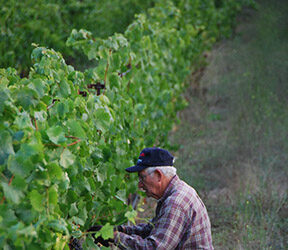
Summer in the vineyard means it is time to manage your vines’ canopy. Spraying, suckering, leaf removal, adjusting lateral shoots, and eventually fruit sampling and netting your vines all need to be done long before you start picking grapes. Keep up with your vineyard work throughout summer to make harvest easy.