Situated at the intersection of the Lot and Garonne Rivers, Saint-Léon has a moderate climate and rich tapestry of soil types — a dream setting for harvesting grapes and learning about French winemaking. This was my home for a week this past fall thanks to Jacques Rejalot, my host and teacher during an eye-opening organic grape harvest internship.
After visiting a Chablis winery in 2024, I was enthralled by French wine culture and inspired to find a way to participate in the next harvest. Having made fruit wine for the past four years, and recently starting the WSET Level 2 Course, I sought out a hands-on experience with traditional grape varieties, techniques, and European growing regions. Regardless of how transferable these skills may, or may not, be to making blueberry wine in my home state of Georgia, my curiosity peaked and, like any true winemaker, I became fixated on the prospects of learning more about my favorite craft. It is not enough to just taste a wine from the Dordogne region; I needed to actually participate in its creation to get the full experience.
The first question I needed to answer was how to make connections to get this hands-on experience. Through an online deep dive, I stumbled upon Worldwide Opportunities on Organic Farms (WWOOF), a program that connects curious travelers with organic farmers to promote ecological farming practices and intercultural community. Similar to other work exchange programs, WWOOFers trade labor for free housing, three meals a day, and a plethora of knowledge and memories — a perfect scenario for a curious person needing to travel on a budget!
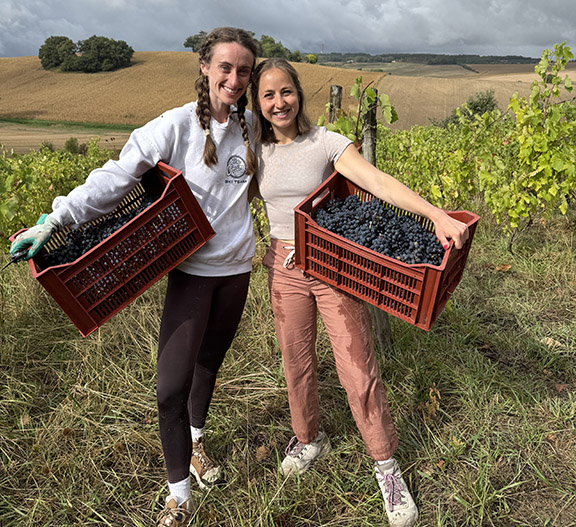
In exchange for a $25 annual membership, I gained access to the profiles of hundreds of organic farmers, many specializing in wine, who could approve my application for work based on their availability. Jacques Rejalot was the first of five hosts I applied to work with and my requested dates aligned well with harvest on his southerly vineyards. He also had space in his home for two people, which meant my best friend, Mary Banks Shelander (that’s her on the left in the photo below, and me on the right), could join. Once he approved our application, we communicated sparingly, mainly to figure out logistics like transportation to the vineyard and the best time to arrive.

On September 3, Mary Banks and I parked our rental car in a small field next to the large white château, feeling a bit unprepared yet very excited. Jacques made us feel right at home by giving us a tour of the house, vineyard, and cellar, as well as providing a loose schedule for the week — everything, of course, dependent on weather.
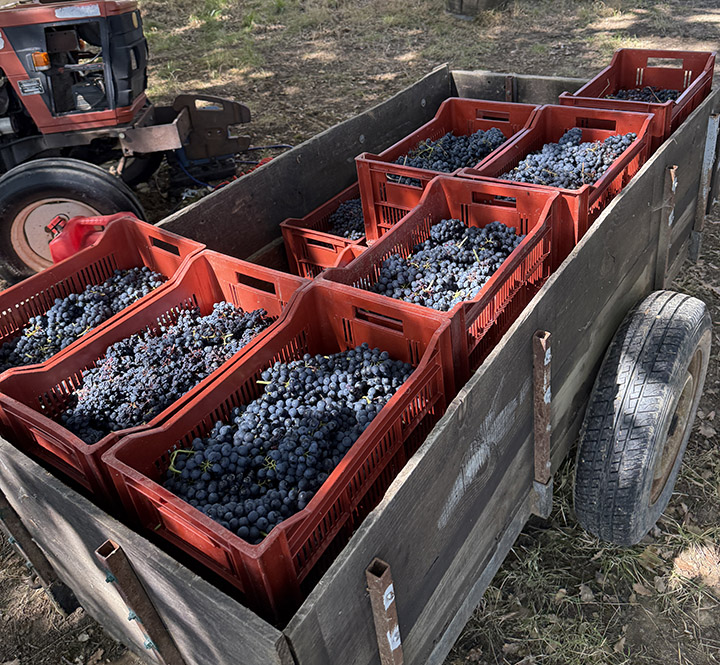
Our first morning started at 8 a.m. with fresh bread, local honey, and organic coffee before walking to the first harvest site where we picked Syrah and Abouriou, a variety native to the Lot-et-Garonne. With shears in hand, we picked mainly shriveled grape clusters, but included some plump grapes, as well — each necessary for carbonic maceration, a pre-fermentation technique for extracting color and tannin. Time flew by as we crouched between rows of vines, enjoying the beaming sun, fresh air, and smell of fresh dew on the grass.
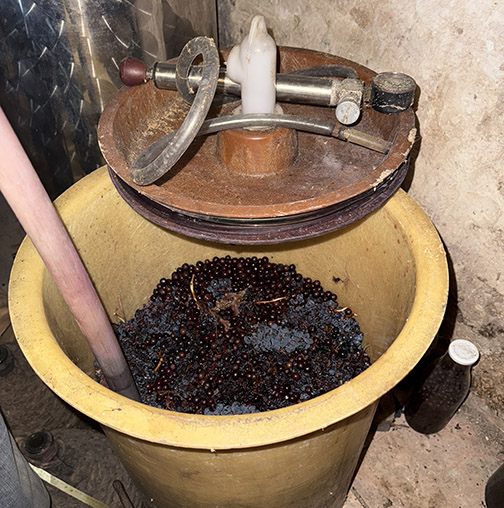
Fifteen buckets of grapes later, we loaded up the trailer attached to a tractor and headed to the cellar where we transferred whole bunches to the old French oak barrels. Jacques, taking breaks from lunch preparation, pumped carbon dioxide into the barrels to create the anaerobic environment that triggers intracellular fermentation within the whole, uncrushed grapes we just picked.
Our morning labor was rewarded with a 2020 Muskatellar from Germany, made in the trocken style, paired with a soft truffle cheese and fresh bread. Following this simple, yet delicious aperitif, we devoured locally sourced sausage with fresh zucchini and squash, pan fried in basilic citron sirop (lemon basil syrup). Everything we ate was regional, in season, and artisanal, reflecting Jacques’ alliance with regional farmers and passion for organic agriculture.
The next morning, at the Agen market, we had the pleasure of meeting some of the artisans who baked our morning breads and the farmers who picked the tomatoes we enjoyed with dinner. While he often shopped at this market, it was Jacques’ first time selling wine here, so most of our time was spent building relationships with locals, meeting vendors, and spreading the word about Jacques’ natural, biodynamic wines. Everyone was excited to see two young Americans diving into the world of organic farming, enology, and small-town French culture.

One woman, Christine, who spoke and understood English, invited Mary Banks and me to her home for lunch following the market. She taught us about the local architecture, town history, and her family’s life in Agen. Her son, who previously studied at Clemson University, managed two departments in the Institut National de l’Origine et de la Qualité (INAO), focusing on educating the public on organic farming and geographical indications. Now he works in the Wine Department of the French Ministry of Agriculture, dealing primarily with EU level legislation and enforcement.
Whether they were government administrators, organic farmers, or eco-friendly locals, everyone we met sought to reduce waste, preserve nature, and support local agribusiness. Sustainability and wine were steeped into the very essence of the region; they were the lifeblood of the Lot-et-Garonne. Everyone was bound by a shared desire to be stewards of the land — and of the vine.
The rest of our mornings were spent harvesting Syrah, Abouriou, and Merlot, while our afternoons were dedicated to cellar work, whether carbonic maceration, destemming, or quality control checking grapes as they went into the press. In between our work, we dined on Lot-et-Garonne specialties like duck pâté and tuna-stuffed bell peppers on the front patio overlooking the rolling vineyard slopes. Sitting around the table, Jacques shared stories of his past work in the wine industry, participating in blind tastings, traveling to American wineries, and making his own corks. It was apparent that winemaking was more than a passion for Jacques; it was a family tradition and a way of life.
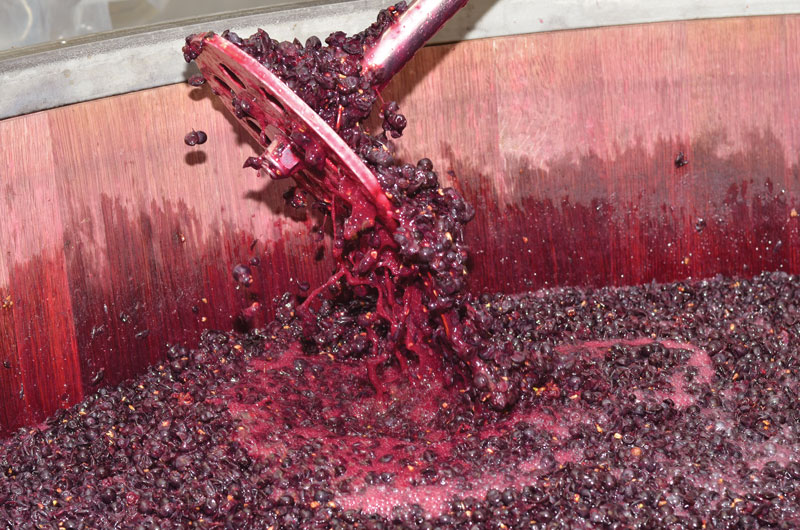
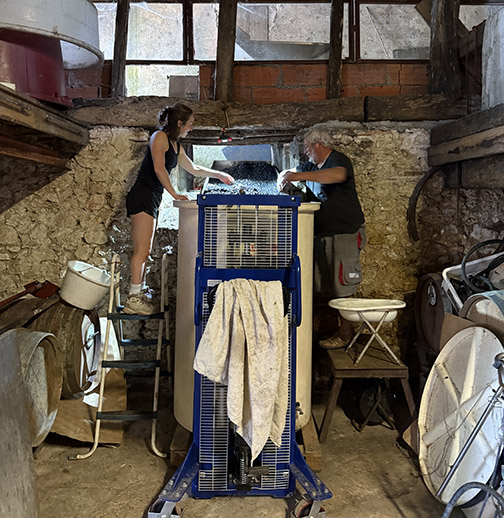
In the cellar, we poured baskets of grapes into a machine that sorted through the clusters, removing stems, rocks, and the occasional snail, before dropping individual grapes onto a slanted trough. Mary Banks and I picked through the grapes, manually removing stems that slipped through the cracks of the machine, ensuring only whole grapes made it into the giant stainless steel vat below. While we wouldn’t see the next steps of the process, Jacques explained that these grapes would undergo fermentation by natural yeasts in the cellar, before transforming into a well-rounded, balanced blend.
Each night, we prepared a big dinner and raised our glasses to a day of rewarding work, beautiful weather, and good company. Jacques let Mary Banks and me help in the kitchen, utilizing the fireplace to grill chorizo, lamb, and duck over a kindled fire. Whether it was ratatouille or duck neck, each meal was natural, unprocessed, and served with a loaf of bread and bottle of wine.
Jacques would send us to the dining room so he could secretly open and pour glasses for a blind tasting where wines ranged from Rhine Rieslings to Puglia Primitivo. The last night, Jacques pulled out a 2000 Baron d’Ardeuil from Buzet, Croatia, so we could taste a wine only one year younger than us. Jacques’ expertise was obvious as he swirled, sniffed, and identified each subtle aroma and nuanced flavor in the glass. Not only is he a humble expert, he is also a wine educator, eager to share the art of wine and the importance of sustainability with the younger generation.
The farm-to-table meals, organic wines, and indoor compositing system made it clear that Jacques practiced what he preached. We dried laundry on clothes lines in the courtyard, cooked meat on an open fire, and relied on natural sunlight during the day. Sustainability was more than a buzz-word or marketing ploy to Jacques — it was a lifestyle in which he was conscious of the environmental impact each decision would make. Not only is his wine an expression of terroir, but his very being is a reflection of allowing natural environmental factors to influence how you eat, cook, farm, and manage your estate.
Pulling out of the driveway on our last day, Mary Banks and I couldn’t help but feel a sense of urgency to book our next trip. Not only did we get to harvest on a French vineyard, learning about biodynamic winemaking techniques and grape varieties, we also had the pleasure of reconnecting with the land and meeting kind, genuine locals who embraced us with open arms and warm smiles — even when we butchered the French language.
During just one week abroad, I was fortunate to experience, and participate in, all types of wine fermentation, from semi-carbonic maceration to fermenting in oak to fermenting in stainless steel to full carbonic maceration! And now we have friends to visit and places to stay when we return to Saint Léon. And the beauty of it all is that each time we return, our trip will be as unique and different as that
year’s vintage.
Seeing so many brambly hedges of fresh blackberries along a dirt road, a woman with a stubborn curiosity and desire to create something herself decided to try her hand at her first batch of wine. She shares the excitement that ran through her during the process, issues that arose, and how deeply rewarding the experience was.
Though its reputation may have been tarnished by a certain movie after the turn of the century, Merlot continues to be one of the most popular wine grapes in the world. Winemakers from France, Italy, and the United States share advice on crafting a memorable Merlot at home.