Lookin’ Back
Columbus Day in the 1950s was quite the holiday. There was no work, no school, and all the stores were closed. There were parades and festivals. It was also the day Grampa made wine.
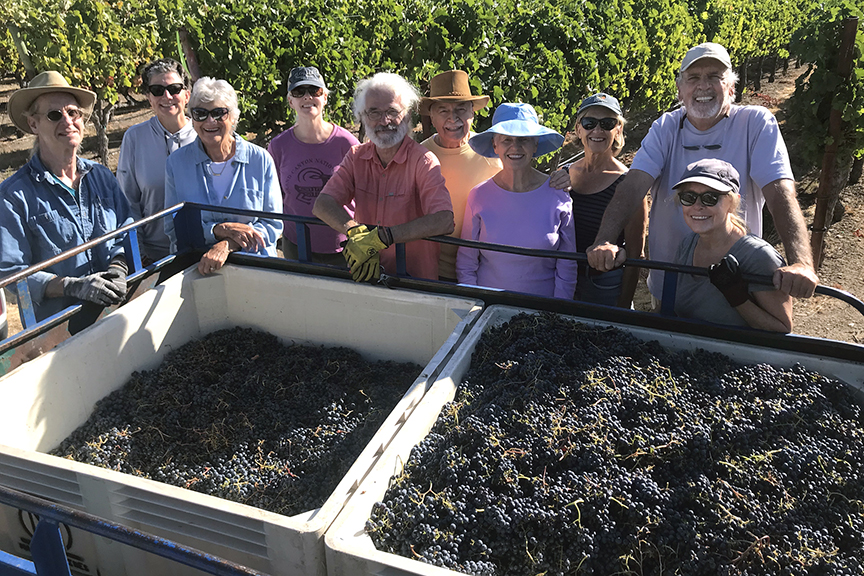
The day would start early. My father would drive Grampa to the produce center, which was located on the Everett, Chelsea, Boston line in Massachusetts. I had to go along. There were rows of boxcars full of fresh, fragrant grapes. Zinfandel, Muscatel, and Concord, all of which came in from California.
Grampa would go from one boxcar to another, chatting in Italian with the vendors. He’d examine the grapes, taste some, and rub a berry on the side of the crate. This would tell him how juicy the grape was. Sometimes there would be bunches of raisins in the bushel. This was an added bonus, he’d say, because the raisins were already half fermented.
When he found the grapes he wanted, usually Zinfandel, Grampa would bargain with the vendor. The bushels were generally from 28–42 pounds (13–19 kg), depending on the grower, and priced at a dollar or two per bushel. Grampa would hire a truck and driver to bring the grapes home. We’d get home and unload, my older brother would help. It seemed like the bushels would never end. When done unloading, Grampa would pay the driver and give him a gallon (3.8 L) of wine from last year’s press.

My brother would open the crates and we’d dump the grapes into the hand-cranked crusher. We’d take turns with the crusher — it wasn’t easy turning that crank by hand. Everything went in, grape, stems, leaves, probably a few bugs too.
At the start of the day it was Grampa, my father, my brother and me. Then my uncle would show up. Grampa’s paisans would appear and so would the neighbors. Now it’s like a winemaking party. There’s probably 10 of us and we’re all taking turns opening the crates, dumping them, and turning the crank on the crusher. Everybody’s talking and smoking. Grampa is, of course, supervising the whole operation.
The crushed grapes go directly into a 50-gallon (190-L) barrel with the top removed. When that barrel is full we start another. Over the course of two weeks in which the grapes remain in the barrel the wine settles to the bottom and the grapes sort of float on top. Little at a time, it starts to fizz while small bubbles form. The bubbles burst and form again. The contents transform from crushed grapes to smelling like wine.
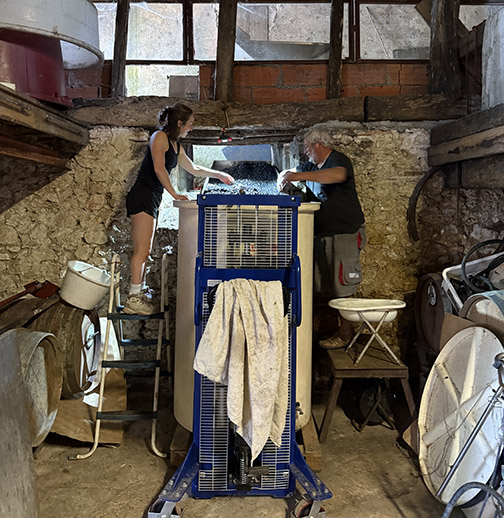
After about two weeks, it’s time to press the grapes. Grampa made the press himself out of 8-inch (20-cm) I-beams and concrete. There was no other like it. He used a 50-ton railroad jack to press the grapes. Everybody who was there on Columbus Day for the crushing came back for the pressing and they’d all have to sample the fresh, new wine. Grandma would cook and everybody would eat. It was beautiful. The wine was then barreled and left to finish fermenting and age. It would be ready at Christmas.
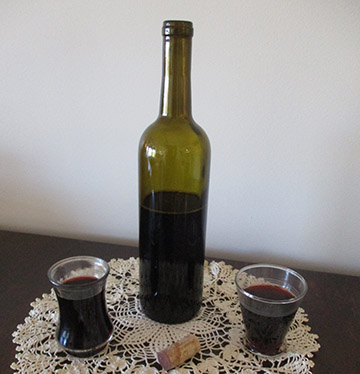
Occasionally, Grampa would pour a bottle of whiskey into one of the barrels to boost the alcohol content of that barrel. Hydrometers were nowhere to be found . . . to check the alcohol level, Grampa would put a shot glass of wine into the freezer and let it sit for a couple of days. Whatever was not frozen would be pure alcohol. From what I remember, half the glass would remain unfrozen. In total, Grampa made 300 gallons (1,135 L) a year, the same way he learned how to make it as a youngster in Italy. Ah, Salud!