Dark, firm, earthy, spicy, supple, complex . . . these are all common descriptors for the enigmatic grape that is known as Syrah. A wine that I can find polarizing on palates, with folks either savoring the peppery, sometimes vegetal notes, or finding the wine overly tannic, harsh, and lacking fruit for their palate.
I began my journey with Syrah (or Shiraz, as it is called in Australia) like many do: Trying out value-priced bottles of Australian Shiraz with an adorable kangaroo on the label in my early 20s. These bottles fit in my meager budget and had a cork, so obviously they were “fancy.” Lots of dark fruit, firm tannins, that while I may not have fallen in love with at the time, grew on me and I began to understand how the firm tannins would complement my Sunday charcuterie boards and pasta dinners after a long weekend of bartending.
As time progressed and I matured in my wine journey, I started to explore cost-effective French Rhône blends, now with a chicken on the label rather than a kangaroo, and really started to enjoy the complex fruit and tannic structure. Over time, I came to relish the wide array of flavors in Syrah and appreciate the variations between dark fruits, spices, and earthy notes found in every bottle.
Fast forward a decade or more, now I find Syrah to often be an incredible expression of the terroir it is grown in. Cooler climates are generating more of the vegetable and peppery notes that intrigue me, while hotter climates create the pronounced black fruit backbone that my palate craves.

Syrah originated in France on the northwest bank of the Rhône, as a cross of Dureza and Mondeuse Blanche. Ancient texts written by Pliny the Elder discuss the Romans planting vines in a region then dubbed “Vienne,” which is now known as Côte-Rôtie. It has since traveled the world with colonial conquest and become the sixth most widely planted grape variety in the world.
Scottish viticulturalist James Busby brought Syrah to Australia in the 1830s. As a young Scot, he traveled to northern France and stayed in a small cottage in Cadillac, near Sauternes, studying viticulture. When his family decided to relocate to Australia a year later, James joined them and wrote his first book, A Treatise on the Culture of the Vine, and the Art of Making Wine, which was published in Sydney less than a year after his arrival at the ripe age of 22. He brought along Syrah vines from France and his family eventually established a vineyard in the Hunter River Valley. The “Busby’s Vineyard” at Kirkton is regarded as the cradle of Australian viticulture. Shiraz has been the crown jewel of Australian winemaking ever since with the vine flourishing in the dry Australian heat and coastal breezes.
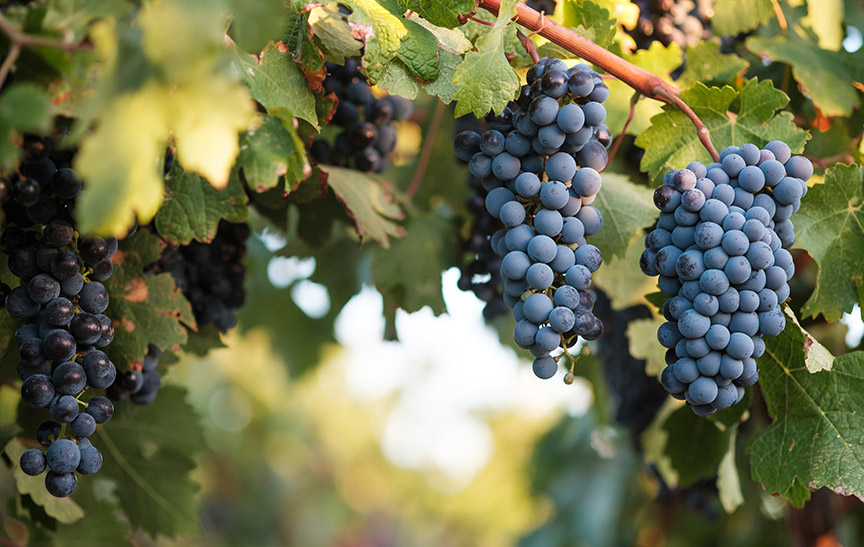
Syrah was brought to California in the 1800s but was quickly devastated by phylloxera. It rose to prominence again in the late 20th century, popular as both a single varietal and blending grape in California’s booming wine culture. Syrah flourishes in warmer climates but also tolerates some cooler weather, with its preferred growing degree days falling between 1,400–1,600. Warmer-climate Syrah will have more of a fruit-forward flavor profile, showcasing blackberry, plum, and blueberry notes with elements of cooked fruit and a spicy finish, as in the Shiraz of Australia. Cooler-climate Syrah, such as those grown in France, will have more tart fruit flavors of tart raspberry and blackberry, with vegetal notes of green and black pepper and savory herbs such as sage and white pepper.
In the Vineyard
Syrah does very well at high altitudes that provide warm days and cooler nights, helping to preserve acidity throughout the ripening process and create a more balanced fruit at harvest. This results in a beautiful complexity of the fruit, highlighting fruity as well as savory characteristics, well displayed in some of the higher-altitude wines of Argentina, Chile, Australia, and the U.S.
Like most grapes, Syrah prefers rocky, well-drained soils. It flourishes in areas with higher concentrations of limestone and granite in the soil composition. These areas of stony, metamorphic terroir tend to generate more concentrated, structured, tannic wines. Whereas clay and sandstone terroir tend to produce a more delicate, lighter, and aromatic wine. Light rainfall, by most standards, of 24–32 inches (600–800 millimeters) per year is sufficient for the vines, although due to their tendency to flourish in more arid, rocky climates, irrigation is often utilized.
Syrah vines may be trellised in a variety of styles. Exceptionally large commercial vineyards tend to utilize vertical shoot positioning, bilateral cordon style of training as it is easier and efficient to use machinery in this style of trellising, such as mechanized pruners or harvesters. In areas of particularly rough terrain or severe weather, growers may utilize a head training and spur pruning style, which is referred to as the goblet method. In this style, emphasis is placed on development of a hardy trunk and shorter canes with more vertical than lateral growth. This often produces a lower yield but a very concentrated, premium fruit. This style is seen in steep slopes of France and around the Mediterranean.
In the Winery
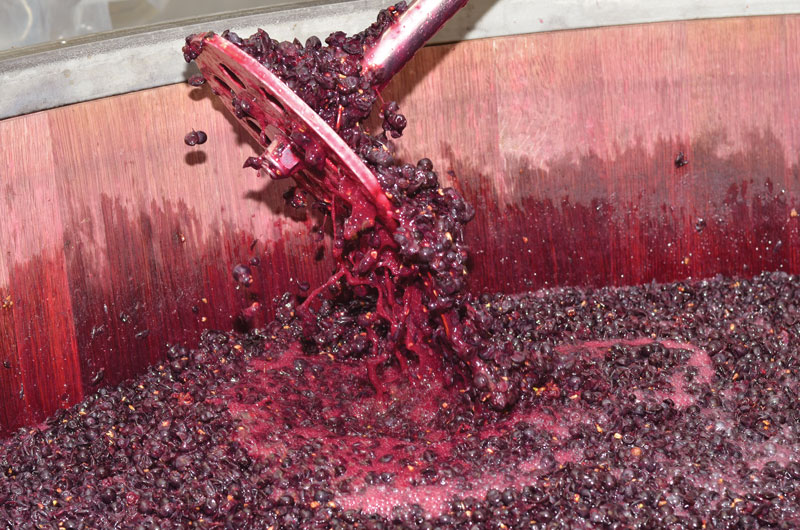
Syrah yields a smaller, black berry with thicker skin, impacting the skin-to-pulp ratio of the grape. Having thicker skins yields higher tannins in the resulting soak before and during fermentation. Most winemakers will employ an extended maceration on Syrah, allowing the wine to sit on the skins to dryness, usually past the point of -1 °Brix. This allows for the full extraction of the tannins from the skins. A winemaker may also choose a cold soak wherein they soak the crushed berries with 50 ppm of SO2 added below 40 °F (4 °C) for a few days to get excellent extraction of anthocyanins and long-chain tannins. I typically do a combination of both techniques. My fruit arrives to Connecticut from California refrigerated and is often at 38 °F (3 °C) after crush. I allow the must to warm up over a few days before pitching yeast, which provides a cold soak to the grapes. Cold soaks should always be conducted with SO2 added to prevent volatile acidity or a wild fermentation from developing.
There are different yeast strains that work well on Syrah and can influence the resulting flavor profile very heavily. If the winemaker prefers a more full-bodied wine with longer aging potential, RP15 yeast will help to extract full tannins and create a wine that will be enjoyable with some long-term aging. If the winemaker prefers a softer style Syrah with more fruit-forward flavor and less vegetal or herbaceous notes, strains NT202 and EnoFerm CSM will produce lovely flavors of blackberry, licorice, and plum. I also find these strains useful if the grapes are slightly underripe. EnoFerm Syrah and Rhône 2226 are two strains that really embrace the balance of all of the complex flavors of Syrah from black fruits, to violets, anise, black pepper, and notes of green pepper. Both strains complement the grape beautifully and showcase its wide array of flavors.
Scott Labs has also released a specialty nutrient that enhances the grapes’ flavor potentials in the resulting wine. Stimula Syrah is a yeast nutrient that is added after 2–3 degrees drop in Brix, early on in fermentation. The product is composed of a mixture of small peptides, amino acids, magnesium, vitamins, and sterols that are utilized by the yeast to use aromatic precursors and convert them into odor-active compounds that are savored by the drinker. This nutrient also provides an important source of yeast assimilable nitrogen (YAN) that fortifies the yeast in a strong fermentation and helps prevent the development of off-aromas such as hydrogen sulfide.
Syrah is traditionally aged with oak, either in barrel or with staves and/or chips. The reduction aspect of barrel aging will help to create a richer, creamier mouthfeel and allow tannins to link up over time, creating a smoother tannic structure on the palate. Due to the high levels of tannins, prolonged aging is recommended to smooth out the structure and eliminate too much coarseness on the palate. I prefer French oak aging for Syrah as I find the cocoa notes and finer grain melds nicely with the dark fruit flavors.
Syrah has a long history and is one of the most widely traveled and planted varieties of grape in the world. From its origins in France to plantings on six continents, it has ingrained itself as one of the most popular and elegant red wines in the world. Popularized by the French and later Australians, classic representations may be found by these nations at all price points, from highly cost effective, to rare collectibles that are available only at auction. New, unique offerings of Syrah may be sourced from South Africa, Chile, Israel, and Croatia. All of them feature a varying flavor profile with different balances achieved of fruit, herbs, spice, and leather. I look forward to continuing my exploration of Syrah and savoring all of the earthy complexities that it offers.
Syrah Recipe Yield 5 gallons (19 L)
Ingredients
125 lbs. (57 kg) Syrah grapes
Sanitizing solution of potassium metabisulfite (KMBS)
KMBS powder and citric acid powder
5 g yeast (RP15, NT202, or similar)
Liquid pectic enzyme
7.5 g Go-Ferm Sterol Flash
7.5 g Fermaid O
5 g Fermaid K
5 g Opti-Red (optional but helps)
5 g Booster Rouge (optional but helps)
5 g oak dust, French medium+ toast
MLF bacteria (Wyeast liquid cultures)
Distilled water
Table sugar (if Brix is low)
French medium oak chips
Equipment
Crusher/destemmer
Wine press
15-gallon (57-L) fermentation bucket
5-gallon (19-L) carboy
Airlock and bung
Auto-siphon and tubing
Stir paddle
Spray bottle
Punch down tool
pH meter
Hydrometer
Thermometer (digital preferred)
Step by step
1. Ensure all your equipment is clean and in proper working order. Make a fresh batch of KMBS sanitizing solution using 1 Tbsp. of KMBS powder and 1 Tbsp. of citric acid mixed into 1 gallon (3.8 L) of clean water. Fill a spray bottle with the KMBS/citric acid solution and spray down your processing equipment, but ensure there is no pooling of sanitizer in bins or press basins.
2. Crush and destem grapes and transfer immediately into a sanitized 15-gallon (57-L) fermenter bucket.
3. Add 50 ppm of KMBS to kill off natural yeast. Utilize our sulfite calculator to assist in your calculations. Throw a cover on the must bucket and allow to sit overnight to kill negative microbes and allow the must to come to a temperature of 60 °F (16 °C).
4. If a cold soak is desired, you may submerge frozen 1-gallon (3.8-L) jugs of water into the must. Make sure the jugs are well sealed and spray with sanitizer before submerging. Soak for 2–3 days.
5. The next morning (at least 12 hours after the addition of KMBS), add five drops of pectic enzyme per gallon (3.8 L) of must and stir well. Add the oak dust and stir well.
6. Take measurements of your juice, including volume, Brix, pH and TA. Adjust the juice to a starting Brix of at least 24, a pH ~3.5, and TA of 6 –7 g/L. Utilize tartaric acid if needed to increase acidity. www.wineadds.com has helpful calculators for adjusting acidity in must.
7. To prepare the yeast, warm 50 mL of distilled water to 60 °F (16 °C) and add to the mixing bowl. Then stir in the Go-Ferm Sterol Flash and add five grams of yeast while stirring. Allow to sit for 15 minutes. Then mix in thoroughly to the must with a sanitized stir paddle.
8. Place a lid on the fermentation pail loosely and wait 24 hours to observe yeast activity. Take Brix measurements twice daily via a hydrometer to ensure the start of fermentation. When obtaining samples strain the solids out of a sample of must using a sanitized strainer and pour the liquid only into your hydrometer jar or beaker. Using the thermometer, take temperature measurements daily. Try to keep the fermentation temperatures between 70–85 °F (21–29 °C) to help secure color and avoid off-aromas. To do this, you may need to put the fermentation bin in a cool area or in a larger bin (garbage pail) filled with ice water.
9. After one or two days of fermentation, check the Brix and when it has dropped by a degree or two, add 100 mL of distilled water to a mixing bowl and add 7.5 g of Fermaid O and the Opti-Red and Booster Rouge if you choose to use them. Mix well to create a slurry and then stir into the fermenting juice with a sanitized stir paddle.
10. Continue to monitor Brix and temperatures daily (twice daily would be preferred). When the Brix have declined to between 15–11 °Brix, add the Fermaid K in the same way you added the Fermaid O.
11. With the temperature between 75–80 °F (24–27 °C) and alcoholic fermentation well underway, wipe the Wyeast MLF packet of bacteria with a cloth wetted with sanitizing solution. Open and pour it over the must. Stir to punch down the skins and incorporate the bacterial cultures.
12. Continue to ferment as close to 80 °F (27 °C) as possible until the wine has fermented to dryness (-1 to -2 °Brix). This may take 7–21 days.
13. Press out the wine in a sanitized press and pour all of the wine into a 5- or 6-gallon (19- or 23-L) carboy with an airlock to complete MLF.
14. After 5–7 days, rack off the lees into a clean, sanitized carboy. If you have an air gap after racking, either top off with a complementary wine such as Syrah or Zinfandel, or add sanitized glass marbles to displace the headspace.
15. Monitor the MLF via paper chromatography or measure the reduction of malic acid via a meter to track the progression of the fermentation. When the MLF is complete, rack the wine and add 50 ppm KMBS.
16. One month after the initial racking and addition of KMBS, rack it again into a sanitized carboy and add another 50 ppm KMBS. Consider degassing at this point, briskly stirring with a wine whip during a racking session. Do not use this tool in a glass carboy. Rack it into a food-grade bucket and degas in that. Never put a glass carboy under suction or negative pressure.
17. While the wine is aging, consider the addition of oak chips, cubes, or staves to add a bit of oak to enhance the wine. French oak works well with Syrah and the variety can tolerate a good amount of oak, 1–2 g/L.
18. Allow the wine to sit and age, maintaining a free SO2 level appropriate for the pH. WineMaker’s sulfite calculator will help you determine the proper dosage given the parameters of pH and volume. You can filter the wine after eight months of aging if you choose. At this point, it should have been racked four times and have completed its oak aging.
19. Consider cold stabilizing or acquiring a cold stabilizing product such as Zenith Color.
20. Once cold stability has been achieved via physical or chemical means, taste the wine and consider if it is ready to bottle. Fining agents such as Super Kleer or mouthfeel enhancers such as gum arabic may help improve mouthfeel and clarity.
21. Bottle wine once you are content with its flavor and stability. Always add a small amount of sulfite before bottling, 10 ppm beyond the sulfite calculator’s recommended value, to account for oxygen uptake during the bottling process.

With its home along the shores of the Mediterranean Sea, this white grape is starting to find its way to the U.S. for good reason. Learn about the history, viticultural tips, and winemaking styles of Vermentino grapes.
Sangiovese is the ultimate wine to pair with food due to the variety’s ability to hold its acidity as it ripens and generous amounts of ripe red fruit flavor. Learn more about this Italian variety that is planted worldwide.