Protein Stabilization
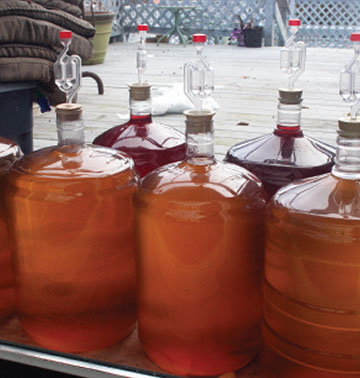
If you’ve ever grabbed a bottle of your white wine and let out a loud gasp as you notice what was a crystal clear wine upon bottling has turned into a hazy concoction that looks more like a New England-style IPA than wine, you have probably experienced protein haze firsthand. It’s not an uncommon fault, especially for those without temperature-controlled wine cellars or who travel with their wines, exposing them to temperature swings. Protein haze is a natural occurrence when wines are subjected to warmer temperatures, and can occur even if the wine has been fined and filtered if it is not protected against.
Fortunately, protein haze can be prevented. In the “Beginner’s Block” from the June-July 2015 issue we explained how to cold stabilize your wine — protecting it from the natural chemical reaction that leads to the formation of tartrate crystals if a wine is subjected to cold temperatures — and in this edition we are going to go over hot stabilization — also known as protein stabilization — to protect your wine from going hazy if subjected to temperatures on the other end of the spectrum.
During fermentation, proteins that aren’t visible to the naked eye are extracted from the grapes into the juice. However, when exposed to warmer temperatures these proteins attach to each other (polymerize) and become more insoluble (depending on the pH of the wine) and remain in suspension to cause a haze. The warmer the temperature the wine is exposed to, the faster this reaction takes place. This phenomenon generally only affects white and rosé wines, as red wines contain phenolic compounds (tannins, mostly) that bind to and cause the proteins to precipitate out of the wine during winemaking. Because white and blush wines do not contain these phenolics, these wines require an additional step to remove the excess proteins.
Not all white wines have the same protein content —Sauvignon Blanc and Gewürztraminer are two varieties known to have very high protein concentrations — so they are more susceptible to protein haze when exposed to warmer temperatures. These wines are considered heat or protein unstable and must always be treated for protein stabilization. However, it is good practice to treat all white wines to avoid the risk.

To insure against protein haze, prevention is the best defense. Once you have noticed a haze, it becomes harder to eliminate it completely through fining/filtration. The best method to protect against protein haze is the addition of a suitable fining agent; bentonite is most effective. Bentonite can be added prior to, during, or after fermentation at a rate of 25–100 g/hL (1–4 g/gal) of juice as per the manufacturer’s instructions. Store the treated wine at a temperature between 59–77 °F (15–25 °C) during the fining period and rack when the wine is completely clear.
You can test whether your wine is heat stable through a simple process developed by Ribéreau-Gayon and Peynaud (from The Handbook of Enology: Volume 2, The Chemistry of Wine, Stabilisation and Treatments). After filtering your wine, heat a sample to 176 °F
(80 °C) in a cooking pot and maintain that temperature for 10 minutes. Remove the pot and allow to cool to room temperature (or put it in the refrigerator to speed up the cooling process). Compare the sample to a control sample. If the tested sample is clear, then your wine is considered heat stable. If a haze forms, then it is unstable and an additional bentonite addition is necessary. Test your wine again a few days after this addition, and repeat as necessary.
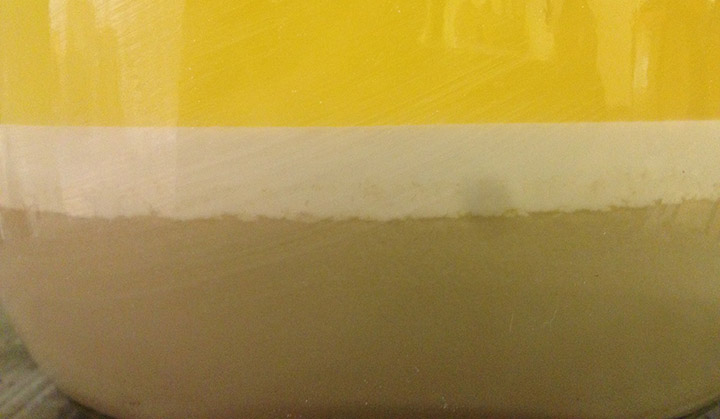
If you did not add bentonite prior to fining, another way to determine how much bentonite to add at this point is to test multiple samples using the process described above with different bentonite addition rates. See which sample is clear, and then treat the entire batch of wine at the same rate, but never exceed the 100 g/hL (4 g/gal) maximum as excessive bentonite can strip aromas.
With treatment, you will never have to worry about what that clear wine will look like once it arrives at its destination. Now that, is a clear benefit!