Preparing for Your Backyard Harvest
We maintain a vineyard that spans about an acre of our backyard, in which we grow five varieties we make wine from each year. One may think the busiest time in the vineyard is just prior to harvest, but the truth is most of the work is done by then. When asked what we do in the vineyard 30 days prior to harvest, the answer is simple: We wait.
Planning for harvest begins at pruning. Throughout the growing season, decisions are all made towards the outcome of the quality of grapes and harvest’s yield. As we all know, “Good wine begins with good grapes.” The better quality of grapes one is fortunate to work with, the less additions and intervention is required in winemaking. Clean vineyards provide good vines for those good wines. No matter where your vineyard is, the tasks are the same — only the timing of harvest may differ.
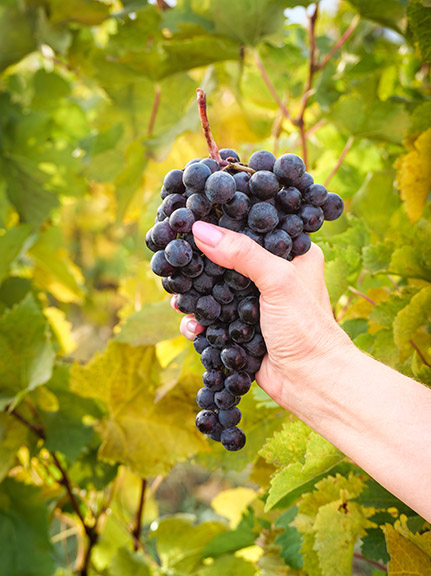
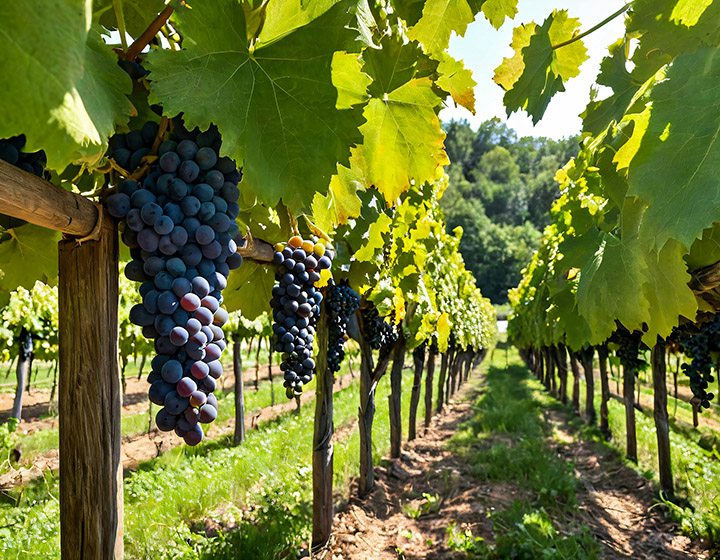
The first clue that harvest time is approaching is veraison. If the varieties are white, this is harder to notice at a glance. Walking the vineyard helps keep an eye on green turning yellow, and pinkish deepening into red. Canopy management has begun by this time. Canopy management is a lengthy discussion of its own, and Wes Hagen has shared good advice to follow for canopy management. The takeaway here is if previous actions have not been taken throughout the growing season, it’s not too late to start when the grapes are ripe. Think of the canopy as filtered light giving these grapes a “base tan.” Starting with a base tan prevents sunburning, as well as preventing green aromas from settling into certain red varieties. If grapes sunburn, harsher tannins develop in the skins and will press out into the wine. The more sunshine that reaches the grape skins helps to facilitate maturation speed of the grapes, thus stepping closer to the desired Brix or acid levels and date of harvest.
Monitoring the Numbers
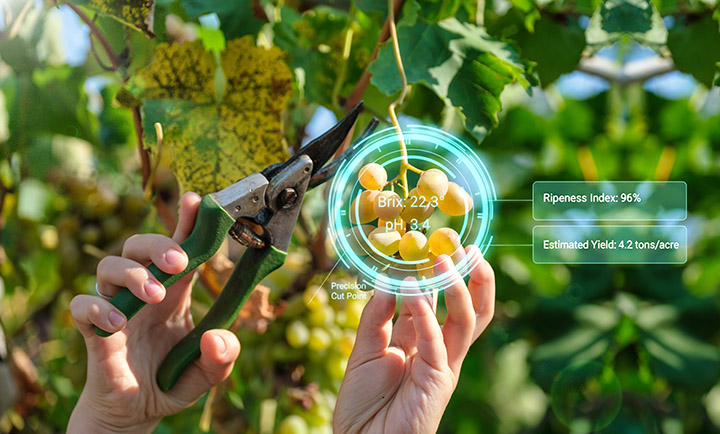
Brix is a commonly used indicator for harvest date (though one must consider phenolic ripeness as well). Using a refractometer is the simplest way to monitor berries for the sugar levels. For reds, a desired Brix range is often 22–26. Whites can be harvested by measuring acid levels and a lower Brix level of around 20–24 to reserve natural acid levels, which will provide a more balanced wine requiring fewer tartaric acid additions post-fermentation. Natural grape acids include tartaric and malic acids of the berries. These natural acids differ from that which is created during fermentation and are best measured by titration. Of the two natural acids, the malic acid will decrease as the Brix level rises during grape maturation. Tartaric acid rises with the sugar levels as it is a byproduct of the sugar production inside the berry, which is why white grapes may be harvested at lower Brix to ensure appropriate acid levels to create bright, flavorful wines. Some reds, like Barbera and Cabernet Sauvignon, may be harvested based on acid levels instead of Brix as well.

To keep current with these numbers in the weeks leading up to the targeted harvest time, one wanders the vineyard, tasting a sample of berries throughout the vineyard, and collecting berries to mush up and confirm readings with titrations. Tasting the grapes is a wonderful indicator of desired outcomes from harvest. Learn more about the proper way to collect grape samples for analyzing in this issue’s “Backyard Vines” column.
Heat in a growing region causes internal enzymes to catabolize malic acid more quickly. Tartaric acid is more stable as long as the vine’s root tips remain moist. Free tartaric acid forms with calcium tartrate, which will elevate pH and exaggerate the lower total acidity in the pre-fermentation readings. Therefore, in warm regions, high pH and low titratable acidity (TA) frequently occur. A lower acid is easier to correct. But if maintaining acid levels is the harvest goal, one must be vigilant in taking measurements, keeping in mind that a warm day can really screw this plan up. Volatile acidic wines are becoming a common issue for warm climate regions because the high Brix raises the pH level in the must, while grape acid levels rapidly drop. It’s why pick time is a waiting game. This is not controllable, but being ready for harvest is.
Measure Brix with a refractometer and make a spreadsheet tracking the Brix as it climbs, which will help in predicting when it will reach the desired number, particularly with years of harvest data. With the exception of rain close to harvest that will dilute the sugar, the weather won’t affect Brix unless it is really hot. “Heat summation,” often referred to as “degree days” and measured using the Winkler Index (GDD), classifies wine regions by accumulating daily average temperatures above 50 °F (10 °C) from April 1 to October 31. The heat summation can push the harvest date out.
As Harvest Date Nears
When it gets hot at the end of summer, giving the vineyard a drink of water is important leading up to harvest. Keeping the root tips of the vines moist is critical. If you have a date for harvest established from the calculations of inclining Brix levels, refrain from deep watering the final two weeks prior to harvest. Too much watering decreases the grapes’ flavor characteristics and aromas. But water-stressed vines create their own “taint” smell of wet towels. This flaw is not only aromatic but interferes with the natural aging of wine once bottled.
A clean vineyard is optimal for harvest. Make sure that under vines and the middle rows are cleared of debris and tall grass. This prevents excess bugs from climbing into your harvest bins and subsequently affecting the must with methoxypyrazines as beetles can synthesize or the grape berry moth that is east of the Mississippi River. Another reason to keep the middle rows clear is for ease of walking during harvesting. Lugging filled bins to the end of the rows is challenging enough. It is also more inviting to friends to come back the following year if they haven’t had to machete through a jungle or fight off bugs and wasps to harvest the fruit.

Another consideration for harvest date is time of day. The time of day is something that can be played with to your advantage. The earlier in the morning you pick, the higher the acid levels and lower the Brix are in the clusters, vs. at the middle of the day and its heat. So if grapes are reading too high of Brix, then harvesting before sunup might make a difference.
When bird netting has been used, it will need to be unhooked the night or morning before harvest. Then, as the row is approached, it is simply folded from the sides and rests on the crown of the vines. To drop netting in the middle of the row invites entanglement with debris, and damage. Poor quality grapes may be table sorted before hitting the crusher/destemmer or dropped in the middle of the vineyard row. Avoid dropping any fruit under the vines as this can introduce mildew and other issues despite the vines about to go dormant. All fruit needs to be harvested/removed as this signals the healthy vine that it is time to go to sleep and finish the cycle until the next spring.
Get a Crew
Start contacting those dear friends and family members that think harvest is fun to provide free labor for harvest. Or if not for free, for a pizza party, a BBQ at the end of the day, or pay them in grapes for their own wine. If you are a commercial vineyard, a harvest crew is most likely hired. If this is done, you know your harvest date, whether the grapes are ready or not.
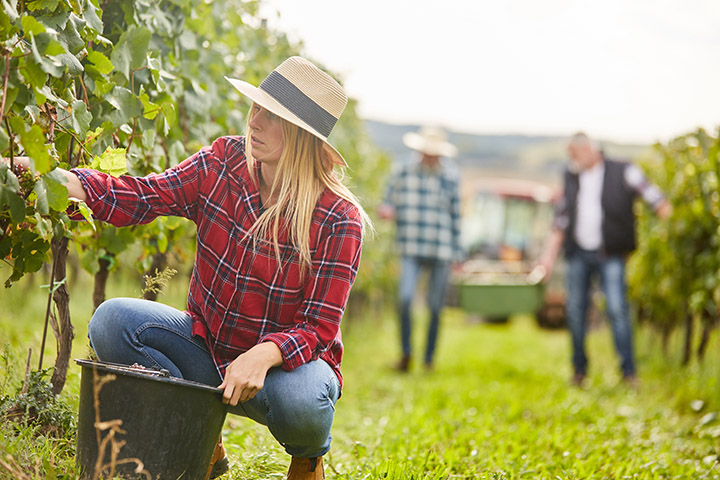
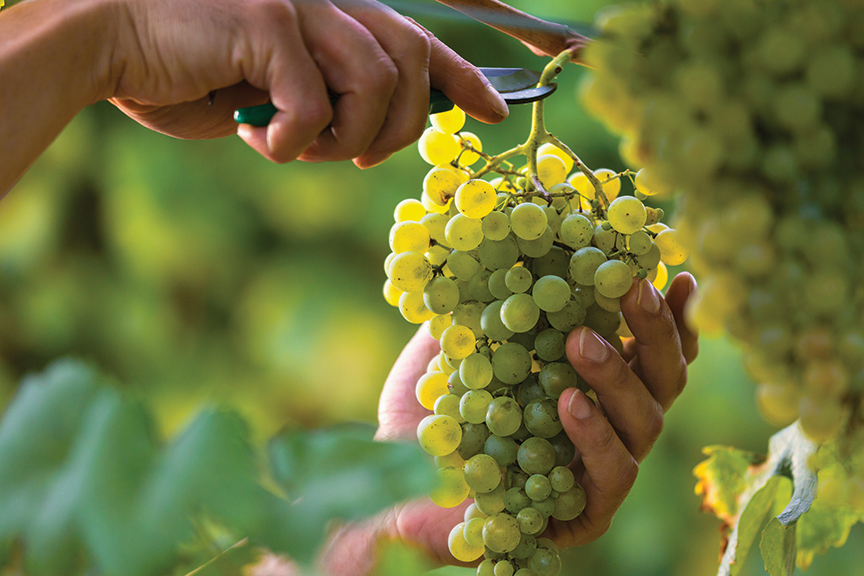
Harvesting is not rocket science. It’s a task easy to teach — but it must be taught to each picker before they begin. These are some recommendations we provide to our crew of volunteers before they come:
1. Wear dark colors (bright colors attract bugs), long-sleeved shirts and pants for protection from sun and bugs. Avoid buttons, as the buttons will hang up in the bird netting.
2. Wear hats and sunglasses.
3. Wear gloves — white cotton gloves are inexpensive and will help one see fingers so as to not snip one by mistake. They’re also washable.
Other considerations for the crew include providing cold drinking water and a restroom. Being friends, we offer the household restroom. Renting a port-a-potty can be a big expense. It is not sanitary to permit relieving oneself in the vineyard. A bucket of water in the vineyard is handy to rinse off hands, shears, or even
sticky gloves.
Equipment
Most importantly, you’re going to need harvesting shears for each picker. Prior to the day of harvest, ensure that all pruning shears are sharp and in good working order.
If harvesters bring their own shears, the blades should be wiped down at the beginning of the day with rubbing alcohol for protection from cross contamination. Hand grape harvest hooks are a cheap investment that work well, are easy to clean, but challenging to keep sharpened. Bypass pruning shears can be utilized in cane and spur pruning as well as harvest. Select brands have the capability of replacing the blades. We have found that blades can last about two years, even with constant sharpening throughout the day. As harvest progresses, the sugary juices will dull blades. Corona brand makes a handy sharpener that fits in your pocket and we have found to be useful in the vineyard.
In March 2019, “FDA issued guidance stating it intends to exercise enforcement discretion with respect to the Produce Safety Rule for entities growing, harvesting, packing, or holding hops, wine grapes, pulse crops, and almonds.” This means commercial growers of these commodities are not expected to meet the Produce Safety Rule requirements. And yet, there is scientific evidence that oxidation is not only caused by exposure to air or heat, but chemicals too, including chemicals that can leach out of inappropriate containers. The phenolic components of the grapes and tannins of the skins will act like a catalyst and can leach out chemicals of plastic or galvanized metal. Utilizing food-grade containers will prevent this, and I highly recommend it.
As far as prepping the equipment goes, tools are always kept clean, sharpened and ready for use. After harvest, vigilant care includes taking the blades out of bypass shears and then cleaning and wiping with mineral oil to prevent stiffness or corrosion. Mineral oil is food-safe, whereas other oil-based products for lubrication will potentially introduce off-flavors into wine. Also added to the list of items to clean is the other equipment used on harvest day, such as harvest lugs, bins, and the crusher/destemmer. If any skins, grape juice, pedicels, or seeds get stuck to the sides of bins it can spread mold and bacteria, contaminating future grapes or juice. Even with clean equipment, a spritz of sanitizer (we use StarSan) is sprayed on all of our harvest equipment that morning.
If you don’t own the equipment, you can often rent a crusher/destemmer from a winemaking shop. Other options are to look at amateur winemaking club members if you are part of a club, or around at your favorite small winery to learn of their harvest/crush date and see if a deal can be negotiated.
Owning your own crusher/destemmer makes everything easier and the day shorter, as we had tired of cleaning equipment prior to using it in the borrowed scenario.
Getting Grapes to the Crusher/Destemmer
Getting the grapes crushed before the clusters heat up has a huge impact on the final wine. If you have to drive to the crush pad or wait in line at a club or community situation, then dry ice can help keep the grapes cool, deterring further rise in Brix or berry deterioration after harvest. The release of CO2 from the dry ice will also help prevent oxidation. Dry ice needs to be ordered beforehand. It is not always easy to find nor readily available. For us, we order it two weeks in advance from a local grocer and pick it up the day before. Another place to find it is at specialty gas suppliers, such as Airgas, which has locations across the United States. Dry ice is better than plain ice as plain ice will melt and water down the juice. Dry ice evaporates as it “melts,” and provides an additional protective gas layer over the grapes in a closed bin. Be sure if you are transporting grapes and dry ice in a vehicle you have windows open so the CO2 gas is not filling up the inside of your vehicle.
On harvest day, at our house, the grapes rest in the shade under pop-up canopies at the crush pad. With planning, one can crush/destem immediately to improve the outcome desired, but it can make for a very long day. If you have enough volunteers, you can even have a couple of people working the crusher/destemmer as harvesters bring bins of grapes in from the vineyard.
After veraison, harvest is a waiting game. Walking the vineyard, watching the grapes, and taking statistics on Brix or acid levels becomes a weekly task. This often begins sooner than 30 days prior to harvest. To fill in the gap of time, everything else is checked, cleaned, and sanitized for harvest, but not much is needed to be done if a vineyard is kept clean throughout the growth phase of the vintage.
Further Reading . . .
• “Backyard Vines” columnist Wes Hagen shares his 10 Tips for a Successful Harvest Day, which includes responsibilities on the day of harvest and the week leading up to it.