The Pearson Square
Blending can be a great way to bring new complexities to a wine, turn your table wine into a fortified wine, or correct imperfections. If you have an understanding of what you want a certain characteristic (such as total acidity or alcohol by volume) of your resultant blend to consist of, then the best way to go about your blending is using the Pearson Square.
The Pearson Square is a tool to calculate the number of parts of two different solutions with different concentrations that are required to bring one of the solutions to a desired concentration. The Pearson Square can be intimidating to newbies, but when dissecting it piece by piece it is relatively straight-forward, and understanding it will pay dividends.
To create a Pearson Square, divide a square into nine equal parts (dividing it into thirds both vertically and horizontally). The upper left corner is labeled A, the lower left B, the middle C, the top right D and the bottom right E.
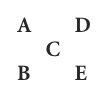
If, for example, you want to adjust the acidity of a wine, those letters represent:

A: Acidity of the wine to be used to correct
B: Acidity of the wine to be corrected
C: Desired acidity
D: Parts of wine correcting wine to be used (C-B)
E: Parts of the wine to be corrected (A-C)
The equation yields your answer in “parts” (shown in D and E), which is the number of units of each component to add (whether it be ounces, milliliters, liters, or whatever unit you wish to use).
Let’s plug some real numbers in here and give it a try. If you have a wine with a total acidity (TA) of 6.0 g/L that you want to bring up to 7.0 g/L, and you have a second wine with a TA of 7.5 g/L, using the Pearson Square you have:
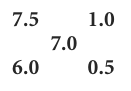
This shows that you need 1 part (7.0-6.0) of the correcting wine for every 1⁄2 part (7.5-7.0) of wine that you are correcting. So, if you have 5 gallons (19 L) of wine at 6.0 g/L that you want to bring up to 7.0 g/L, then you will need to blend it with 10 gallons (38 L) of wine at 7.5 g/L for it to result in a blended wine with a TA of 7.0 g/L.
Here is another example of how you can use the Pearson Square, this time to make a fortified wine. Let’s say you have a Merlot with an ABV of 12% and you want to make a fortified wine that is 18% ABV using a brandy that is 40% ABV. In this case:

A: ABV of the spirit
B: ABV of the wine
C: Desired ABV
D: Parts of spirit (C-B)
E: Parts of the wine (A-C)
Using the Pearson Square, it looks like:
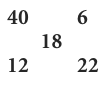
So, for every 22 parts (40-18) of Merlot you will need to add 6 parts (18-12) of brandy. Adding these two together you get a total of 28 parts. This means approximately 21% of your fortified wine will be brandy (6/28) and the remaining 79 percent will be your Merlot (22/28). If you want to make 2 gallons (7.6 L) of fortified wine, that is equivalent to 256 fl. oz. So:
256 x 0.21 = 54 fl. oz. brandy
256 x 0.79 = 202 fl. oz. Merlot
And there you have it, a fortified wine at 18% ABV using the Pearson Square. That wasn’t too hard, was it?