Tips for Grape/Non-Grape Blends
Wine can be made from practically anything edible if you are willing to add enough water, sugar, acid, and other additives to tweak the chemistry to work for a healthy fermentation and stable wine. There are many country wines made from fruits, vegetables, and roots that have plenty of flavor but little of the other things necessary to make wine. That’s where grape juice comes in handy, as the chemistry of grape juice is naturally a perfect fit to be made into wine (which is why we do it!). With a grape juice base, the winemaker is required to manipulate the final wine less and can also create a more complex wine with vinous character in addition to the character of the other fermentable. To better understand how to do it, we asked for advice from a winemaker who creates many grape wines, non-grape wines, as well as grape/non-grape blended wines.
Justin Ortel leads production and growth initiatives across multiple wineries in New York and Pennsylvania.
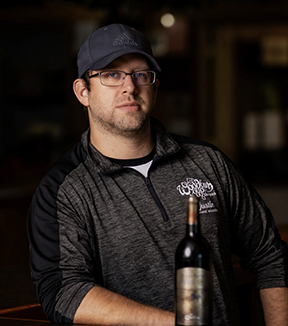
We make a number of non-grape and grape wines at Woodbury Vineyards, in Fredonia, New York, where I am the President and Head Winemaker. Let’s use cranberry as an example — we make a sweeter cranberry wine as well as a semi-sweet Cranberry Riesling. The level of sweetness is driven almost entirely by customer feedback. At the end of the day, we’re not trying to make something just because it fits a category, we’re trying to make something people actually want to drink. Our straight cranberry wine has a very loyal following, but it leans quite sweet. We wanted to create a version that could bridge the gap — something a dry wine drinker could enjoy, especially in the summer, while still being approachable for someone who prefers sweeter styles.
We ferment everything as single varieties and blend post-fermentation, which gives us much more control of the final flavor profile. We can evaluate each component at its best and then blend to achieve consistency across vintages. It also allows us to make small adjustments to hit the exact profile we want every time, rather than being locked into a single co-fermented result. Similarly, the residual sugar of the Cranberry Riesling is achieved through backsweetening just prior to bottling, using pure cane sugar. That allows us to dial in the exact balance we’re looking for without compromising fermentation quality.
Cranberries are naturally very low in sugar, so they’re not suitable for fermentation without adjustment. For consistency, we work with a juice supplier who standardizes the cranberry juice to about 21 °Brix before it reaches us. This allows us to focus on fermentation and blending rather than major corrections. With the sugar worked out, the biggest challenge with cranberry is acidity. Cranberry is naturally very high in acid and can be pretty aggressive on its own. I try to keep adjustments minimal, but in most cases we do need to chemically deacidify to bring it into a more balanced range.

For Riesling, we typically like to work in the 19–22 °Brix range depending on the style we’re targeting. That gives us enough flexibility to balance alcohol, acidity, and residual sugar in the final blend. This is all vineyard-driven. We’re working with Vertical Shoot Positioned (VSP) fruit, and we let ripeness dictate picking decisions. If we land in that 19–22 °Brix window, we’re exactly where we want to be without needing much adjustment.
In most cases, working with a grape base is easier when making wines with non-grape fruits. Grapes are naturally well-suited for fermentation. They already have the balance of sugar, acid, nutrients, and structure that yeast needs to perform well. When you’re working with non-grape fruit, you’re often building that environment from the ground up. Using a grape wine as a base simplifies a lot of that and tends to produce a more stable and balanced result with less intervention.
For example, if you’re making a straight cranberry wine with sugar and water, you’re essentially building structure from scratch, so you often need more intervention to get balance right. By contrast, blending with Riesling gives you a head start. The grape wine already has a natural balance of sugar, acid, and body, so you’re not fighting the matrix as much. It reduces how much you need to manipulate the cranberry component and results in a more integrated final wine.
Riesling brings a lot to the table when it comes to selecting grapes to pair with cranberry, especially minerality, structure, and mid-palate weight that cranberry lacks on its own. It helps round out the wine and makes it feel more complete rather than just bright and acidic. Other varieties could work too. I think something like Chardonel or Traminette could create interesting variations. They’d each push the wine in a slightly different direction aromatically and texturally, which is part of the fun with these blends.
My best advice for home winemakers looking to create grape/non-grape blends is to stop treating the rulebook like scripture. Some of the best wines I’ve made came from ignoring what a style “should” be and asking what the wine actually needs. That said, fundamentals aren’t rules — they’re science. Acid, sugar, alcohol, and structure have to work together whether you’re making a Bordeaux blend or a Cranberry Riesling wine. You can break conventions all day, but you can’t break chemistry.

The other thing I’d say: Stop apologizing for fruit wines. There’s this weird hierarchy where grape wine is “real” wine and everything else is a novelty. That’s nonsense. A well-made cranberry wine takes just as much skill as a well-made Chardonnay, arguably more, because you don’t have the grape doing half the work for you.
Make the wine you want to drink. If other people want to drink it too, even better.