Bottle Deposits
Q. I have noticed colored deposits forming on the inside of my bottles. Sometimes they appear after a year of bottling, but most of my aged wine has a heavy deposit. I opened a bottle of 9-year-old Petite Sirah recently and found its color, usually quite dark, had faded, and the bottle was heavily coated. My reds are usually two years old when I bottle them, having spent a year in neutral barrels as part of the bulk aging. What’s going on?
Brian Aziz
Via email
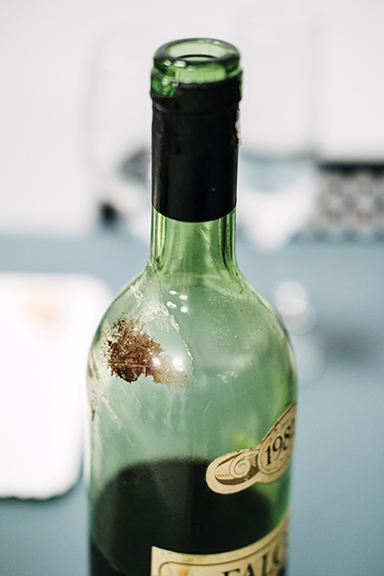
A. What you’re seeing is, at least to some extent, a very normal part of red wine aging. In fact, a nine-year-old Petite Sirah that has lightened in color and thrown a substantial deposit is giving you a pretty good demonstration of what happens to red wine phenolics over time.
Red wine color comes largely from anthocyanins, the pigments extracted from grape skins during fermentation. Tannins also come from the skins, seeds, and, depending on your winemaking, stems and oak. When a wine is young, many of these compounds exist as
relatively small molecules suspended or dissolved in the wine. As the wine ages, however, they don’t simply sit there unchanged.
Anthocyanins and tannins gradually react with one another and form larger, more complex molecules. Some of these reactions help stabilize color, soften tannin perception, and create the textural evolution we associate with mature red wine. Eventually, some of those increasingly large molecules become too large or insoluble to remain suspended. Gravity wins, they precipitate, and that material ultimately ends up as sediment.

In an older red wine, the deposit you see is usually a mixture rather than one substance. There may be polymerized tannins and anthocyanins, other phenolic material, and often potassium bitartrate crystals as well. All of these can become mish-mashed into a dark-colored sediment that settles on the bottom of the bottle or, sometimes rather impressively, coats the lowest-lying inside surface of the glass.
Your Petite Sirah is an especially good candidate for this kind of behavior. Petite Sirah is generally a deeply colored, highly phenolic variety, so there is a lot of pigment and tannin available to participate in these reactions. Over nine years, I would absolutely expect some loss of youthful color intensity and some development of sediment, so part of what you are seeing is simply aging.
The more interesting part of your question is why your wines seem to be developing such heavy deposits, and whether you can reduce them. The fact that you’re aging your reds for about two years before bottling, including a year in neutral barrels, means they already have a fair amount of time to evolve before bottling. But time alone does not guarantee that all potentially unstable phenolic material will fall out beforehand.
Some wines simply carry a larger load of tannin, pigment, and other colloidal material than others. That can depend on grape variety, vineyard site, growing conditions, maturity at harvest, extraction during fermentation, maceration length, fermentation temperature, and many other factors. A wine from one vineyard may settle beautifully while another, made using essentially the same cellar practices, may continue throwing sediment for years.
This is where fining can become useful. Fining is the process of adding a material to the wine that reacts with or adsorbs unwanted or excessive components and helps carry them out of solution. In your case, I would be thinking primarily about protein-based fining agents that can react with excess tannins and other phenolic material.
Traditional protein fining agents include gelatin, egg albumin, isinglass, and casein-based products, although there are also modern products made from pea or potato protein that can be extremely effective. The goal is not to strip the wine of all its tannin or color. Quite the opposite: You want to remove only enough unstable or excessive material to improve future stability while preserving structure, flavor, and aging potential. Petite Sirah without enough tannin would be a very different animal indeed.
As with almost every additive I talk about in this column, I would never recommend simply adding a fining agent to an entire barrel based on the package directions and hoping for the best. This is bench-trial territory. Pull several representative samples and treat them with increasing fining rates, keeping an untreated control alongside them. After the fining agent has reacted and settled, taste carefully and look not only at clarity, but also color intensity, aroma, tannin structure, body, and finish. Often the lowest effective fining rate is the best one.
Timing matters too. I like to make significant changes well before bottling rather than immediately beforehand. If you know approximately when you plan to bottle, consider doing your fining trials and any resulting treatment three to four months ahead of time. That gives the wine time to settle and, equally importantly, lets you see how it responds.
Fining is not just a mechanical operation. Any time you remove phenolic material, you may subtly change the wine’s balance, so giving it some breathing room afterward lets you reassess before committing it to bottle. Once the fining treatment has settled, rack the wine cleanly off the lees and sediment.
This is also a good point to evaluate whether the wine is adequately tartrate stable. Potassium bitartrate can contribute significantly to bottle deposits, and if you’re seeing crystalline material mixed into the colored sediment, cold stabilization may also deserve attention.
Filtration can help with clarity, but filtration and fining solve somewhat different problems. Filtration is very good at removing suspended particles already present, but it cannot necessarily prevent dissolved tannins and pigments from polymerizing and precipitating years later. Fining, on the other hand, can reduce some of the phenolic material that might otherwise contribute to future sediment.
Even after doing all of this correctly, I wouldn’t promise you a completely sediment-free nine-year-old Petite Sirah, nor would I necessarily want one. Part of the natural evolution of serious red wine is that color changes, tannins evolve, and sediment forms. That’s one reason old bottles are often stood upright before serving and decanted carefully. Sediment is not automatically evidence that something went wrong; you’re really trying to manage the degree of sediment rather than eliminate aging itself.
For your next few bottlings, start keeping track of which varieties and vineyard sources produce the heaviest deposits. If certain wines consistently throw more sediment, experiment with modest protein fining trials three or four months before bottling, allow plenty of settling time, rack carefully, and evaluate tartrate stability as well. I’d also keep one untreated bottle whenever you can, because opening those wines five or ten years later can teach you more about your own grapes and cellar than almost anything else.