Innovative Wine Products
My favorite aspect of winemaking as a career is that the field has made a promise to me to ever be evolving and developing, providing me with a lifelong classroom in which to learn about my craft. The wine developments over the past 20 years, since I have entered professional winemaking, have grown by leaps and bounds annually, with newer, better products emerging to help us craft more delicious wines. Each year, we all hope to improve over our former vintages, always only in true competition with ourselves. But how do we improve? Part of that answer is with new products that hit the market.
Through this article, I hope to introduce to you to some of the more recently developed enological and viticultural products that I have found to assist making each vintage the best yet. As a professional winemaker, I have the luxury of trying out new products and making wine twice a year, utilizing the North and South American harvests. This allows me to try new products and have the ability to use them in two batches annually and see results faster in the turnaround of wines that they produce.
Vineyard Products
Let us start where every great bottle of wine begins: In the vineyard. In recent decades, consumers and farmers alike are more conscientious of the sprays and agricultural inputs that go into their consumed products. Compounding this effect for many grape growers are the often-precarious timing of such sprays and their re-entry intervals to the vineyard as well as their pre-harvest interval timing. Some anti-fungal sprays can keep viticulturalists out of their vineyards for up to four days after application. This can cost a farmer their most precious resource: Time. We all know that grapes can grow prolifically in the heat of the summer. Being restricted from the vineyard for the better part of a week is a gap in labor that many farmers do not want to take. The stop in vineyard work, along with the potential exposure to unhealthy chemicals in the vineyard sprays have growers seeking a healthier and more user-friendly alternative.
LifeGard WG is a biological activator spray of helpful Bacillus mycoides isolate bacterial cells that, when applied to grapevines, help to trigger the plant’s natural defense system. All plants have natural defense systems built into them in some form, either physical (thorns or rough bark) or chemical (bitter taste or poisonous effects). By applying the bacteria, the plant’s defense system is triggered and will start to combat foreign cell populations such as mildews. The plant will be more resistant to the attack of mildew and the application will help to keep the mildew population in check as the season progresses.


LifeGard WG comes in granular form in 1-lb. (0.45-kg) bags. The granules are to be mixed with water and applied to the ground or the foliage early in the growing season. The application rate is 1–4 oz./acre in a sprayer. The spray can be applied as a prophylactic spray early in the season, or as a partial curative later in the season if mildew seems to come back. It may be applied every 7–14 days and has a re-entry period of only four hours. This can be a tremendous timesaver for growers. It also has a pre-harvest interval of zero days, so application can go right up until harvest time. Traditional application rules such as not spraying before or after a significant rainfall, in heat above 85 °F (29 °C), and in winds over 10 mph, do apply to this spray.
LifeGard WG is approved for organic use in vineyards by the Organic Materials Review Institute (OMRI) and is manufactured in the United States. A 1-lb. (0.45 kg) bag will cost approximately $140 and will last most home viticulturists more than one season. To store the chemical for the next season, roll up the top of the bag and wrap the package in plastic wrap so that air may not permeate the package. Then place in a sealable container such as a plastic tub or large jar. Exposure to moisture can degrade the bacterial populations. LifeGard WG is helpful in combating Botrytis, powdery mildew, downy mildew, Phomopsis, and black rot. Applications can begin as early as two weeks pre-bloom to act
as prophylactic.
In the Winery
Next, let’s highlight some products that will increase yield and decrease workload in the winery, where I spend most of my time.
A common question in rosé production is, “How long should I allow the must to sit on the skins?” While I do sometimes flinch at this very varietal- and growing season-contingent question, there is a new product to help increase yield and extraction, while decreasing the amount of time spent on the skins.
Rapidase Extra Press is a pectinase enzyme that works very quickly to help break down skins and pulp and pull out the valuable aromatic precursor compounds that are found in grape skins. Rapidase Extra Press can be applied at the crusher and works well at low temperatures, which can be helpful when working with white or rosé grapes that have been refrigerated at a vineyard or grape brokerage awaiting pickup. It works well in a wide variety of pH ranges and is also tolerant of SO2 within normal ranges. It works quickly to break down the must, giving a much better juice yield in the press. In trials using Sauvignon Blanc, Rapidase Extra Press was shown to increase the free run juice by 15% and the total juice production by 6% over a commonly used pectic enzyme. This can lead to more bottles of wine for you to consume in the end!

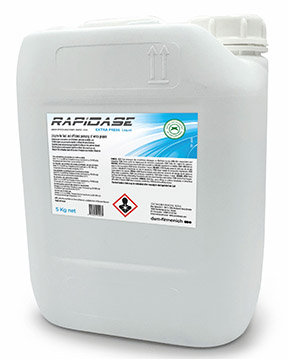
In addition to increasing yield, Rapidase Extra Press also helps with clarification earlier in the winemaking process. A study of Chardonnay and Viognier juice after pressing with Rapidase Extra Press showed tremendous drops in NTU (Nephelometric Turbidity Units) over untreated juice. Chardonnay and Viognier that went untreated had NTU’s of 200 and 160, respectively. To compare, the juice treated with Rapidase Extra Press had an NTU of below 50 for both varieties. This can improve racking and clarification timing throughout the working life of the wine. It also improves the quality of the juice. Because the enzyme works quickly, it reduces the time in the press or in a bin on skins, reducing the oxidation of the must. It also saves time while requiring less pressure in the press, which reduces the extraction of bitter phenolics and compounds.
I have had some frustrating rosé cold soaks in which the color came out more slowly than I would have preferred. Going to work at 2 a.m. to see if the color extraction is correct and then having to wait if unsatisfied with the results can be very frustrating during the hectic harvest season. Rapidase Extra Press will give you better and more predictable results once you become familiar with the product.
The smallest packaging size for Rapidase Extra Press is in 2.2-lb. (1-kg) bottles, which cost around $100. This cost could be defrayed by splitting or sharing a bottle with other winemaking friends, or it can be used over multiple vintages. It can be good for up to three years in refrigeration with a reported 5% decrease in effectiveness annually. Rapidase Extra Press should be applied in a 10% solution at the rate of 15 mL/ton for destemmed grapes and 20–30 mL/ton for whole cluster pressing. The enzyme should never be used in red wine production as it will break down the skins too severely and result in muddy, frustrating pressing.
Quite possibly my favorite new product that has saved me hours during harvest season is Go-Ferm Sterol Flash yeast hydration nutrient. Previous rehydration nutrients required the water to be at a specific temperature, the addition of the nutrient into the water, waiting for the temperature to drop to be able to set yeast, then lengthy acclimatization steps. The process could easily take over an hour for a larger batch of wine along with precarious timing and temperature evaluations. Sterol Flash takes a direct and very user-friendly approach of merely adding the product to 60 °F (16 °C) water, adding yeast, allowing to sit for 15 minutes, stirring, and then adding the mixture directly to the must. This saves so much time for the busy vintner who may be fermenting numerous vessels of wine or the less experienced vintner who is intimidated by the many steps of traditional yeast rehydration.
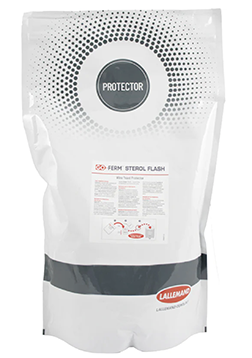
Along with ease of use and timesaving measures, Go-Ferm Sterol Flash also uses 50% less water than the previous incarnations of yeast rehydration nutrients, while still providing all the fatty acids and sterols needed to protect and promote a healthy fermentation. I also find it the most helpful in inoculating red wine musts coming off a cold soak. It allows me to get the yeast in a bit faster while the must is warming up after the soak compared to previous protocols. For premium Petite Sirah warming up after a 48-hour cold soak, this can mean getting the yeast in 24 hours earlier and reducing competition from wild microflora.
Go-Ferm Sterol Flash is sold in 2.2-lb. (1-kg) bags for $56, though some retailers offer it in broken down smaller quantities, including MoreWine! that has it in as small as 10-g packages. While it is slightly more expensive than traditional Go-Ferm, an assessment of labor and time value can be made to justify the added expense. The application rate is 30 g/hL of must, with the standard yeast application rate of 25 g/hL of must. A package should be wrapped up after use and stored in an airtight container. When stored properly, it has a shelf life of four years, making it a reasonable acquisition for even a home winemaker making smaller batches divided over multiple vintages.
This past harvest I was able to try a new strain of malolactic bacteria that had me doing a little happy dance in my office while reading about its special features. When working with home winemakers, I often find that malolactic fermentation can be a mystifying and worrisome topic. With so many limiting factors to traditional Oenococcus oeni strains, Scott Labs has isolated a new strain of bacteria that is faster and more effective than Oenococcus oeni with less of the risk factors. ML Prime is a new strain of Lactiplantibacillus plantarum bacteria that also consumes malic acid and converts it to lactic acid and carbon dioxide. It completes the fermentation in 3–10 days, rather than weeks with traditional bacteria. It trumps over the Oenococcus strains with its ability to produce little to no diacetyl and also its inability to produce volatile acidity from metabolizing citric acid. This product is also an excellent choice for wines with residual sugar, as it will not interact with the sugar, avoiding potential volatile acidity production. Both of these issues are common to inexperienced winemakers who try malolactic fermentation and allow it to ferment for too long or have risky conditions that stall out the bacterial fermentation. ML Prime is ideal for wines with less than 3 g/L of malic acid.
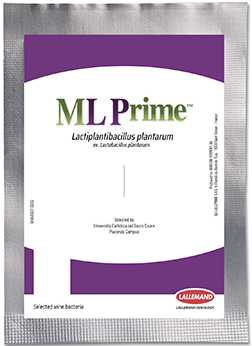
I used it on my Frontenac as well as vinifera wines last harvest with great results. All fermentations completed within a week of inoculation. ML Prime bacteria should be added the day after the yeast inoculation. It does not reproduce like Oenococcus oeni bacteria, demanding a higher inoculation rate of 10 g/hL, compared to the 1 g/hL rate of the Oenococcus strains. Because the ML Prime bacteria does not reproduce, it is imperative to add the full inoculation rate and ensure that the wine has less than 3 g/L of malic acid. This may be a challenge for some wines created from cool-climate varieties.
It is easier to apply as no rehydration is necessary; simply open the sachet, add to the must, and stir well. ML Prime does have some limiting factors that should be considered before application. The pH of the must should be above 3.4, temperature above 68 °F (20 °C), and total SO2 no higher than 50 ppm. Considering it is applied the day after yeast inoculation, it greatly reduces the wine’s fermentation time even after pressing, allowing the winemaker to add sulfites earlier, protecting the wine against oxidation and microbial contamination.
It is applicable to both red and white wines with the same inoculation rate for both types of wine. It is suitable for restarting stuck malolactic fermentations and lower pH whites and rosé. For white and rosé production, it will reduce the malic acid concentration and soften the organoleptic qualities of the acidity of the wine; however, it does not generate the delicious buttery character that Oenococcus oeni strains such as Beta add to a Chardonnay. If being utilized to soften the perception of acidity in whites, it can be ideal, but for the vintners trying to enhance or manipulate flavors of their whites, it may not be the ideal choice. It is ideal for red production as it increases red fruit character and also helps create structure and mouthfeel. It forms a beautiful feeling of roundness and mid-palate volume in reds by its generation of lactic acid, reducing sharp or tart characters. This can be ideal for hybrid winemakers and vinifera winemakers alike. The current smallest dose available is for a 66-gallon (250-L) batch of wine and retails for $35. As with all MLF bacteria, once the packet is opened, it should be used quickly and any remainder after the fermentation season is complete should be thrown out. All bacterial cultures should be stored in the freezer.
As I said earlier, I used it this past year and will use it again in future vintages as an effective time saver in the winery. After aging, I am incredibly curious to see its effects upon the resulting quality of the wines. I believe this product can be an excellent tool for the newer winemaker who has trepidation regarding malolactic fermentation, though the batch size limitations may make it out of reach for those making less than a barrel of wine at a time unless they share with a group.
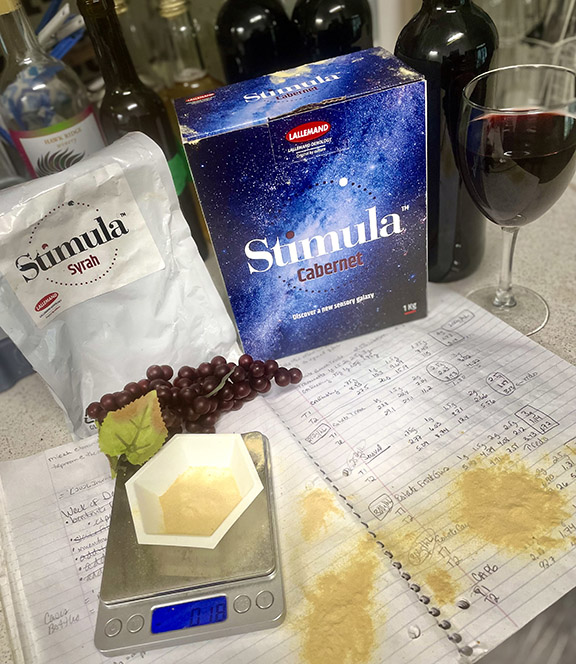
Like humans, yeast cannot survive on sugar alone! They need a complex array of nutrients and amino acids in order to complete their life cycle and fermentation. Many winemakers utilize the traditional organic and inorganic nitrogen blends of nutrients to secure their fermentation and ensure its completion. In recent years, Scott Labs has developed a line of yeast-derivative nutrients under the Stimula name that are tailored specifically to enhance varietal characteristics of five noble varieties: Cabernet Sauvignon, Syrah, Pinot Noir, Chardonnay, and Sauvignon Blanc. Each blend has a precise dosage of amino acids, vitamins, and minerals to help secure fermentation along with providing aromatic precursors to help enhance aroma and varietal character. For example, Stimula Sauvignon Blanc increased the production of two different fruity thiols within a trail batch of Sauvignon Blanc wine by 25% and 42%, also with an increase of grassy thiols by 30% in comparison to fermentations with traditional yeast nutrients.
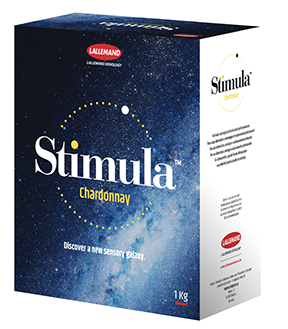
These nutrients help to create a bigger nose and aroma to their wines and help to produce enticing esters earlier in the aging process, which can be helpful for early-drinking styles. These nutrients can be beneficial to other varieties of grapes other than the ones mentioned in their name, such as Stimula Syrah, also helping to bolster fruity aromas in Tempranillo and Merlot. In the case of Stimula Syrah, it has another benefit of decreasing hydrogen sulfide production in these varieties that can be susceptible to it.
These nutrients are easy to use, like other yeast-derived nutrients. The ideal application timing is at 2–3 °Brix drop, shortly after inoculation. The application rate is 40 g/hL, to be mixed into a slurry and thoroughly mixed into the must either via a
pumpover or manually stirring/punching down. If the winemaker has the ability to measure yeast assimilable nitrogen (YAN), the 40 g/hL dose will add approximately 64 ppm of YAN to the fermentation. I have used all of these nutrients with the exception of Stimula Pinot Noir (which I plan to use in the spring on my Chilean Pinot Noir) and seen great results. Wines exhibited more fruit character earlier after fermentation and the esters were more long withstanding, satisfying drinkers out of the bottle. I find it the most beneficial with my Cabernet Sauvignon and Sauvignon Blanc ferments, really promoting an abundance of cherry character in my Cabernets and excellent grapefruit and citrus character in my Sauvignon Blanc. A 2.2-lb (1-kg) package is priced at $54, and is viable for up to 4 years if stored properly in an airtight container after opening.
In the Cellar
Continuing on to the cellaring of our wines, aging or finishing tannins are often needed to help round out a wine’s structure and flavor. If a wine lacks character or feels a bit thin in the mouthfeel, a wide array of aging and finishing tannins are available to achieve balance and effectively repair the wine. The aging tannins can be especially helpful in the creation of structure and palate volume in juice-based wines. But without spending a small fortune on the wide line of tannin products, how does one effectively select a tannin for their wine?
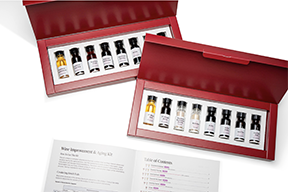
Scott Labs has answered this dilemma with their Wine Cellaring and Aging Kit and Wine Finishing Bench Trial Kit.The Wine Cellaring and Aging Kit (pictured at the top of this page) costs $125 and contains 16 different aging tannins that can help to boost desired varietal character and mouthfeel in wines throughout the aging process. All the tannins come pre-mixed in 5% solution vials, with a booklet of instructions on how to apply them in bench trial formulas. The winemaker will need to have a micropipette to apply small amounts of these tannins to the wine samples. These kits offer a small amount of product to utilize for bench trials. You can then feel confident in ordering a larger quantity of a tannin that you favor, already having tested it. This kit will allow the winemaker to try any different tannins or combinations thereof to enhance their wine and counteract some negative aromas and flavors derived from underripe grapes or problematic ferments.
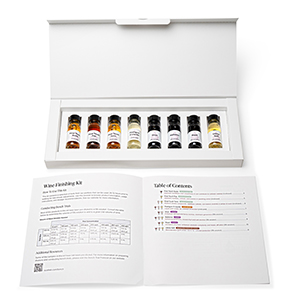
The Wine Finishing Bench Trial Kit (bottom picture) retails for $66 and contains eight different finishing products that can provide last-minute tweaks to wine that seems lacking. They cannot correct major flaws and are not a substitute for sound winemaking practices, but can provide the slight adjustments needed to take a wine from nicely made to outstanding. From tannins to mannoprotein blends, to gum arabic formulations, this kit provides a wide array of various ingredients that can smooth out aggressive tannins, add tannins to a weak wine, reduce bitterness, and enhance fruit aroma, all within a few weeks of bottling. A micropipette will also be needed to use this kit and instructions for application of all products is included. I find these kits very helpful when getting close to bottling a wine and I’m a bit unsure if the wine can be improved upon or not. Sometimes the wine truly is in its best form, and sometimes just a little dab of “pixie dust” or finishing tannin will make the wine shine brighter than ever before.
Conclusion
While some of the products highlighted in this article are intended more for commercial or larger-scale home winemakers, none are out of reach for any winemaker who wishes to improve what they’re making. Those sold in packages too large for a single home winemaker to use given their annual volumes may look to do group purchases with other winemakers who may wish to try out a new product as well. Yet another reason being a part of a home winemaking club is such an advantage!