Delestage Demystified
Young, richly extracted red wines can be overly astringent and may require years of aging to tame their tannins. If your preference is not to make a super tannic wine for long cellaring, but instead a younger, fruit-forward, more approachable red wine, delestage offers a powerful alternative. This fermentation technique can produce wines with brighter fruit, softer tannins, a rounder mouthfeel, and deeper color.
It’s not a widely known technique in home winemaking, likely because it can be more complicated to implement without specialized tanks and pumps. But with some adaptation, delestage can be applied at the amateur level — and the benefits are well worth adding to your winemaking toolkit.
What is Delestage?
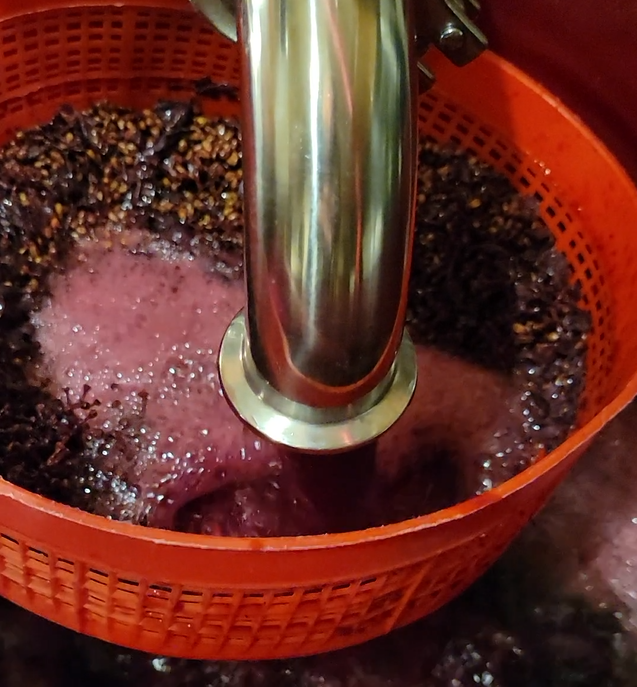
Delestage (from the French délestage meaning “lightening” or “unloading,” pronounced day-leh-staj) is a multi-step “rack-and-return” technique in which fermenting red wine is separated from grape solids and seeds by gravity racking, partially removing seeds. The wine is then returned to the fermenter to flood and thoroughly re-soak the cap. This process is repeated during fermentation according to the desired style.
The two defining features of delestage are seed removal and controlled oxygen exposure. Seeds contain harsh tannins that can impart a very astringent character, while oxygen addition can help soften grape skin tannins and produce a rounder mouthfeel. Unlike the harsher tannins extracted from seeds, skin tannins differ somewhat in composition and generally produce a smoother, more integrated structure.

As fermentation becomes vigorous and carbon dioxide (CO2) production increases, seeds are slowly released from grapes and fall to the bottom of the fermenter and can be partially removed during the gravity racking operation. As fermentation progresses, additional seeds are released and can be expelled with each racking. As many seeds as possible should be removed to minimize extraction of harsh seed tannins.
Racking during fermentation also aerates the wine and adds oxygen, which softens the astringent tannins through oxidation and stabilizes the red color. This timing and aeration are what distinguish delestage from traditional winemaking where the wine ferments under a layer of CO2 gas and is seldom aerated until racked at the end of fermentation. Pumpover (the recirculation of wine from the bottom of the fermentation vat to the top to soak the grape solids) is commonly used in commercial operations to aerate the wine but does not provide the same effects as delestage because the wine is never separated entirely from the grape solids.
Delestage favors anthocyanin (color pigment) extraction while gently extracting phenolic compounds through controlled oxygenation, producing wines with softer tannins, greater fruit expression, and deeper color. Dr. Bruce Zoecklein’s research at Virginia Tech has demonstrated that delestage-fermented wines have a lower concentration of tannins and a higher concentration of esters — key compounds that contribute fruitiness.1
Given the lower concentration of tannins, delestage-fermented wines are generally not intended to age as long as traditionally fermented, tannin-rich, oak-aged wines.
A Brief History
Delestage was not an invention, per se, but rather an evolution of a process into a winemaking tool to deal with overly astringent wines and make them more approachable earlier. It took root half a century ago in the Languedoc-Roussillon region in Southern France where wines from thick-skinned, tannic grape varieties often required many years of cellaring to soften the effects of over-extraction using punchdowns and especially pumpovers.

Winemakers observed, before modern phenolic chemistry was well understood, that when tanks were emptied and refilled, the resulting wines were deemed more palatable earlier and better integrated, particularly when seeds were removed during the process.
This launched much experimentation and research that illuminated the role of oxygen in stabilizing color and the importance of phenol polymerization, and specifically, the importance of acetaldehyde in polymerization reactions. Let’s take a look at what that means and why it’s important.
Why it Works — the Chemistry
Oxygen absorbed during delestage promotes the formation of large polymeric pigments as tannins and anthocyanins polymerize into larger and more stable complexes, often aided by acetaldehyde, resulting in more stable color and softer tannins. More stable color translates into less color loss during aging. During oxygen exposure, small amounts of ethanol oxidize into acetaldehyde. Additional acetaldehyde is also produced and released by yeast during fermentation. This acetaldehyde then acts as a bridge molecule between tannins and anthocyanins.
Recent advances in phenolic chemistry and redox or oxidation–reduction potential control (ORP) in wines now explain and support the benefits of controlled oxidation in delestage. Whereas punchdowns and pumpovers repeatedly inject small bursts of oxygen throughout fermentation, delestage delivers infrequent but larger amounts of oxygen that can maintain a higher redox potential and improve fermentation kinetics.
A study demonstrated that delestage wines had more color derived from large polymeric pigments compared to cap-punched wines and also confirmed higher concentrations of esters along with lower levels of long-chain, or fusel, alcohols that can mask fruit aromas or contribute undesirable notes at elevated concentrations.2
The idea here is that anthocyanins are more favorably extracted earlier owing to their greater solubility in water in the maceration and fermentation phases compared to seed tannins, which are more soluble in alcohol and therefore extracted later during fermentation.
Splashing vigor and oxygen absorption can be controlled more or less depending on the desired style, that is, for example, minimal splashing will promote a more reductive style of wine to preserve volatile esters that contribute fruity aromas, although this can also result in an accumulation of (reduced) volatile sulfur compounds, such as hydrogen sulfide (H2S), which may become detectable above very low thresholds.
Delestage Vs. Pumpovers and Punchdowns
Compared to other cap management techniques, delestage differs primarily in how oxygen is introduced and how solids are handled. The table below summarizes the key differences between delestage, pumpovers, and punchdowns in terms of oxygen absorption, phenolic extraction, and tannin profile.
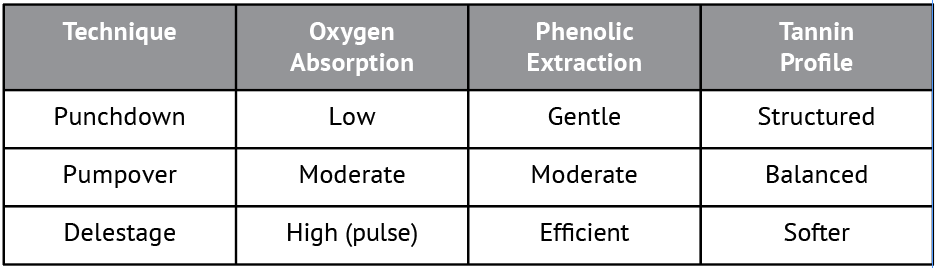
In practice, these differences allow delestage to achieve faster color extraction and softer tannin integration than traditional cap management techniques.
The Delestage Process
The delestage process can be divided into three steps, repeated according to the intended wine style:
1. Drain (rack)
2. Hold and settle
3. Return (flood the cap)
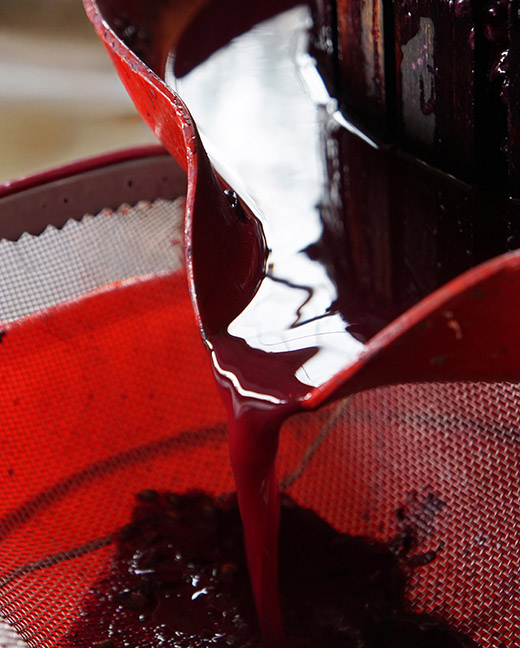
The first delestage operation is typically performed after a 5–8 °Brix drop. In Step 1, wine in the tank or vat is allowed to drain completely by gravity racking from the bottom discharge or racking valve and allowed to splash into a clean, shallow receiving vessel. As free-run wine drains, the cap collapses and slowly settles to the bottom of the vat under the weight of the grape solids, and seeds are partially expelled out of the bottom valve where they are intercepted in a sieve and discarded. Only so many seeds will be expelled with each racking; you cannot expect to remove all seeds.
In Step 2, the grape solids are allowed to settle at the bottom of the tank separately from the fermenting wine for 1–2 hours or more depending on the size of the fermenting vat, all the while yeast continues fermenting and the wine is exposed to controlled oxygen.
In Step 3, the fermenting wine is returned to the vat over the cap using a high-volume transfer pump and spray ball or open hose to rapidly flood and completely soak the grape solids. This rapid flooding further enhances color and flavor extraction while minimizing the extraction of harsh phenols.
The most important aspect of the return operation to maximize the effects of delestage is pumping or transferring the wine back into the receiving tank or vessel faster than the cap rises. This mechanical processing also helps release additional seeds and allows them to settle to the bottom.
The process is repeated once daily for the first 3–4 days during the vigorous phase of fermentation, and this negates the need to do additional pumpovers or punchdowns.
Sensory Monitoring
During delestage, sensory monitoring becomes an important decision-making tool. Taste the seeds to assess their evolution from bitter and green to a more nutty character to determine how aggressively seeds should be removed and how many delestage operations are warranted.
Watch the cap closely and cease delestage once the cap becomes looser as fermentation slows and nears completion.
As usual, monitor temperature and maintain uniformity in the tank to avoid fermentation deviations; watch for early signs of reduction, such as hydrogen sulfide (H2S).
Benefits of Delestage
The advantages of delestage are significant:
• Softer tannins due to reduced seed extraction and polymerization.
• Enhanced color due to polymeric pigment formation.
• Increased fruit due to increased ester retention.
An important advantage of delestage is that the rack-and- return operations favor juice extraction from grape solids and increase free-run yield, therefore requiring less pressing of the solids at the end of fermentation. Macerating enzymes can also be used to help break down cell walls of red grapes for a gentler extraction of phenolic compounds, thereby enhancing the effects of delestage. Macerating enzymes are added to the must at crushing, i.e., before the start of fermentation, otherwise they will be inhibited by the presence of alcohol.
Delestage also improves fermentation kinetics by redistributing heat for greater temperature homogeneity compared to a simple pumpover or punchdown.
When Should You Use Delestage?
The technique is best suited for thick-skinned, high-phenolic varieties such as Cabernet Sauvignon, Malbec, and Syrah that contain abundant anthocyanins and tannins to support polymerization reactions. Varieties with poor color and low amounts of anthocyanins will not benefit from delestage, but richly colored varieties with low tannins can easily be compensated with a grape-skin tannin addition.
Delestage is also well-suited when working with underripe fruit where it can help soften green tannins. It is particularly useful in vintages where tannin maturity lags behind sugar ripeness.
Use cautiously with delicate varieties, such as Pinot Noir and Gamay, low phenolic musts, and already soft wines.
Risks, Drawbacks, and Common Mistakes
Delestage has risks and drawbacks if not performed diligently or if done excessively.
• Over-oxygenation can lead to loss of fruity aroma and premature oxidation.
• Poor control can encourage acetic acid bacteria and increase volatile acidity (VA).
• Temporary separation increases microbial exposure and risk, which requires excellent hygiene.
• Pumping can shear skins and seeds, increasing tannin extraction if overdone.
Common mistakes that can lead to undesirable or unexpected results include:
• Performing delestage too late.
• Performing delestage too frequently.
• Allowing too much splashing.
• Poor sanitation practices.
Delestage for Small Batches
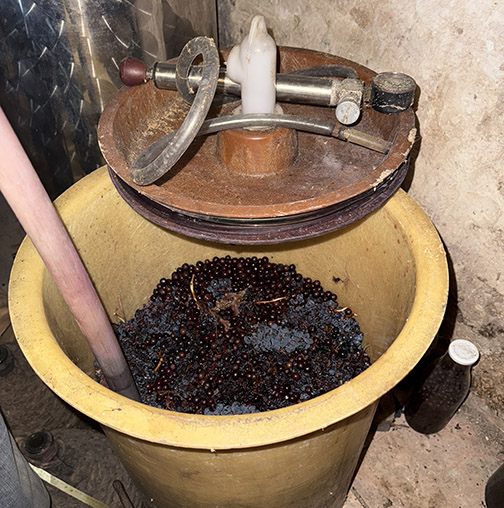
Delestage is best performed with large batches and the proper equipment. For small-scale home winemakers using small tubs or tall plastic containers for fermentation, there are two important adaptations, perhaps challenges: 1) the ability to remove seeds while draining the container, and 2) the ability to pump over or quickly transfer wine onto the cap.
For draining wine and removing seeds, you will need to adapt your tub or other container with a 1.5-inch/4-cm or larger bottom valve. Anything smaller will clog very quickly. A ball valve is best as it has a full-bore (full-port) opening when fully open and therefore there are no obstructions or narrow passages allowing seeds and skins to pass through with minimal resistance and much lower risk of clogging or bridging compared to a butterfly valve. Install a plastic screen or similar device behind the valve (inside the container) to minimize clogging.
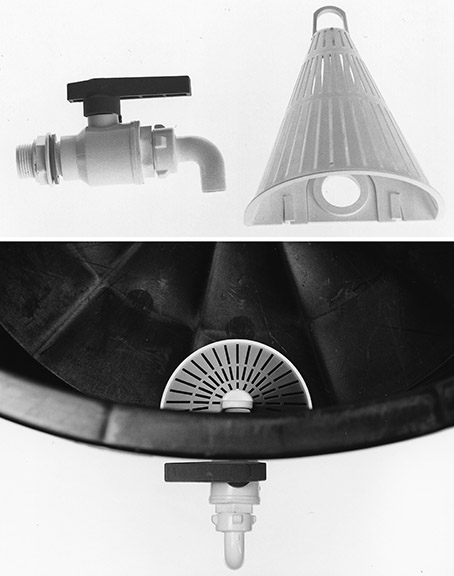
Use a plastic or stainless steel sieve below the valve to catch seeds during the racking step. Use a sieve with sufficiently large holes that will not clog from lees and other fragmented grape solids.
Before crushing, position the container as high as possible so that the bottom valve is just above the receiving vessel and in a slanted position to improve wine draining and seed extraction from the valve during the racking step. You may need multiple receiving vessels depending on wine volume.
Be sure to protect the must and wine from the elements and fruit flies during the hold-and-settle period. Allow all vessels to ventilate properly as both musts and wine are actively fermenting and releasing CO2.
For transferring wine back into the tank, a good impeller pump with 1.5-inch/4-cm or bigger diameter tubing to allow rapid and abundant flooding of the cap; remember, the idea is to refill the container faster than the cap is rising.
If you do not have a pump for transferring wine back, use 5- or 6-gallon (19- or 23-L) pails or something smaller for racking wine into, that you can lift for the transfer step. Do not be tempted to use, for example, a small diaphragm pump or one with smaller ports; these pumps are not suited for moving grape fragments or solids and will clog immediately and be damaged.
Bottom Line
Delestage is not just a mixing technique — it’s a targeted phenolic and oxygen management tool. Done well, it enhances color stability, produces rounder tannins, improves fermentation performance, and enhances overall balance. Done poorly, it can push the wine toward oxidation and harsh structure.
References
1 Leahy R. 2000. Délestage Fermentation: From bitter to better reds. Vineyard and Winery Management 26:101–104.
2 Zoecklein BW, Pélanne LM, Birkenmaier SS, Reed K. 2014. Impact of délestage with partial seed removal. Practical Winery & Vineyard Journal 95:45–53.
Further Reading
Click below for more délestage fermentation techniques and how to put those skills into practice to make bold, blockbuster reds.