North American Grüner Veltliner Tips
Terroir plays a role in how winemakers approach making wine from all grape varieties. We’re going in depth with how Austrians make wine from Grüner Veltliner in this story, though it’s likely most readers will encounter this Austrian variety with grapes grown in North America. So we asked winemakers at four American wineries how they approach this high-acid grape when it’s grown closer to home.
Camins 2 Dreams is a Lompoc, California, winery founded in 2017 by the wife winemaking duo, Tara Gomez and Mireia Taribó
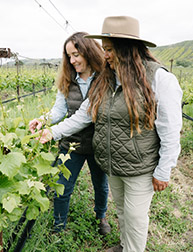
We make three different styles of Grüner Veltliner. Our most popular is the most traditional still wine that we have been making since we started Camins 2 Dreams. The first time we worked with Grüner we realized it really retained acidity and also had great citrus and mineral aromatics that we thought would be a good option for sparkling wine. We made our first batch of sparkling Grüner in 2019 using the ancestral method. That wine is kept on the lees for 18 months before disgorging, and we love it.
In 2024 we decided to play a little more with Grüner and made a skin-contact version with two weeks on the skins. The result was greater fruit and texture. We decided to use our last pick (riper grapes) for the skin-contact version to minimize the harsh tannins. We wanted to be sure the stems were ripe and we didn’t have to worry about higher pH or less acid because we get lots of acid with this variety.

All our Grüner comes from Sta. Rita Hills AVA, which is on the western edge of California’s Santa Barbara County. It is a cooler region with foggy mornings and evenings, which benefits the grapes with longer hanging fruit times. The grapes ripen really slowly with lots of time to develop aromatics, but they also retain the acid. Because we also have good sun exposure we definitely get more stonefruit character and texture than with Austrian-grown Grüners.
We normally pick our Grüner for still wine in at least two picks — a first pick where we focus on retaining acidity and a second pick where we look to get more aromatics and texture. All our wines are fermented with wild yeast (not commercial strains) and no additions, so being able to have an early pick to retain acid is crucial for our style of wine. We do create a pied de cuve (a natural yeast starter) to inoculate. So every time we sample before harvesting we save all the juice and start a small fermentation to later inoculate with.
For our popular still version, we ferment in stainless steel tanks and then age between 6–10 months in neutral French oak. After fermentation is complete, we’ll rack to barrel, just leaving behind the really heavy lees and then we keep the wine on the lees until bottling. We use the barrels to soften up the tannins and help build texture through the lees contact, but we don’t want the wine to take on any oak aromatics.
Grüner has great aging potential. For white wine to have that potential you need juice with a low pH and high acid, and Grüner from Sta. Rita Hills AVA gives us that naturally. I actually enjoy our Grüners better after at least a year or two in bottle.
There are a lot of different styles of Grüner Veltliner, from leaner and straightforward to more complex textured wines. They are all delicious. Grüner is a great variety to play around with — try to make different styles and find what you like most.

Chik Brenneman is the Winemaker and Managing Partner for Baker Family Wines in West Sacramento, California
We’ve made Grüner Veltliner just once when we were able to buy grapes from a grower in Lodi, California. The first thing that comes to mind when comparing those grapes to ones grown in Austria is the wines’ structure with respect to acidity and flavor components. Austrian wines are higher in acidity, given their country being 45–47 °North in latitude. Those wines have been described as age-worthy, stunningly concentrated, typically dry and full-bodied with peppery perfume and firm, mineral, citrus, and sometimes spicy flavors. Whereas Lodi is about 37 °North latitude. This lower latitude leads to a longer growing season and wines with lower acidity that are more fruit-forward. One caveat, it is all about the right variety on the right site.
I found Grüner grown in both Davis, California, and Lodi stopped maturing. Sugars never got above 22 °Brix (they had been at 22 °Brix for three weeks when they were finally harvested) and we may have missed the optimal aromatics possible.
Also known as ‘Gru-vee,’ it is a member of the Traminer family of grapes. Thus, distinct characters of this family are spice, typically what you would taste in a nice Gewürztraminer and Traminette. One of my predecessors at UC-Davis had a phrase, “If you want to make good (Gewürz)traminer in California, you have to sleep in the vineyard.” In retrospect, I think we should have been tasting the fruit when the sugar was approaching 19 °Brix instead of waiting to harvest.
We did not do any skin contact with this grape. I have a philosophy that the grape will give you what it wants to give — it’s one of the reasons I do not use enzymes either. Using skin contact and enzymes can lead to an increase in skin phenolics, which results in more oxidizable phenolics in the wine.
We used Lallemand’s QA23, which is my yeast of choice for whites, and fermented in stainless steel. No oak was involved at any stage as I felt we had to preserve the aromatics.
The wine quickly sold out. Our customers and fellow business partners loved it once we released it!
Hans Peter Weis is the Founder and Winemaker of Weis Vineyards in New York’s Finger Lakes region
We make our Grüner Veltliner in a crisp style, but still with enough weight and body. I’d describe it as similar in style to some Austrian examples — dry with zesty citrus, apple, and white pepper notes.
With Grüner grown in the cooler climate of the Finger Lakes, there is no reason to rush harvest. Unless there is concern with health or deer pressure, let them get fully ripe and into the golden color. Then our focus is always on harvesting the highest quality fruit possible. I go more by flavor and color of the berries when deciding when to harvest, looking for yellow golden color on the berries and crunchy seeds. Most of the time it will end up being between 21.5 to 22.5 °Brix with an acidity around 6.5 g/L. When vineyard conditions are ideal, we are comfortable machine harvesting. If conditions are less than optimal, we selectively hand harvest to ensure only the best fruit is brought in.
We go straight to the press and skip any skin contact with this variety. I see yeast selection as only a small piece in the whole puzzle. I use mainly cultured yeast, but I only have a couple. If I want to keep a wine sweeter, to keep residual sugar, I use a less attenuative yeast. If I want the wine drier, I use a more attenuative yeast.
After fermentation, which finishes around October, the juice will stay undisturbed on the gross lees until
we rack it for the first time or blend it for bottling, which is typically in March or April.
Our Grüner can age 5–10 years. That said, it does not yet match the long-term aging capacity of our Rieslings. Grüner is still relatively young in the Finger Lakes, with the first plantings dating back to around 2007. Younger vines can be more difficult to balance, as they tend to overproduce if not carefully managed.
Timothy Milos is the Winemaker at Napa’s RD Winery and also consults for numerous wineries along the West Coast
We make two styles of Grüner Veltliner at RD Winery, although both emphasize the vibrant fresh qualities of the grape variety. Our Fifth Moon bottling emphasizes bright fruit, thirst-quenching acidity, and the distinct white pepper and wasabi herbal notes of Grüner, while our Hundred Knot frames these flavors with a richer texture and hints of spice. The primary difference is in elevage: The Fifth Moon ferments entirely in stainless steel — though it may age on the lees in steel or neutral French or Austrian oak — while our Hundred Knot ferments and ages on lees in Austrian puncheons and barriques, with a small portion being new wood. If I intend to integrate any new wood, I will be sure to ferment in the vessel.
Grapes for both wines come from a vineyard in the Edna Valley in San Luis Obispo, California, about four and a half miles (7 km) from the Pacific Ocean. It sits on a low rolling hill facing southeast, surrounded by Pinot Noir and Chardonnay. The styles of Grüner Veltliner vary widely even in Austria, but I’d say our wines are somewhere in the middle range of style. Similar to Austrian examples, ours are relatively low in alcohol, bright with acidity, but balanced and refreshing with or without food. Being grown in California, they have a juicier, riper profile without the intense green vegetal fragrance of some Austrian wines, nor the density of some of their old-vine vineyards.
Grüner develops flavor early in ripening, and loses the vegetal character as it ripens. It also has quite bitter skins early on, which diminishes with ripening. Each of these variables develops independently and differently depending on the growing season. To achieve our style, I look to balance preservation of acidity and retention of herbal character, but also development of fruit and limited tannin. I pick entirely by taste, and the Brix at harvest has ranged from 18.8 to 21.3, with pH ranging from 3.1 to 3.4. Notably, the highest pH harvest was also our lowest Brix. The most important piece of advice for making wine from Grüner is to taste it in the vineyard often, as what you taste can change very quickly.
We do very limited skin contact. I will foot tread some of the bins, usually no more than 10%, and allow them to soak a few hours before pressing. My goal with our wines is freshness rather than weight, and skin contact brings both weight and tannin, often at the expense of freshness. But I do some as it does amplify the aromatic character of the variety.
I have used a number of yeasts over the years, but so far have preferred Lalvin Rhône 4600 co-fermented with both Torulaspora delbrueckii and Lachancea thermotolerans.
We typically age 8 to 10 months on lees, whether in tank or barrel. I use the lees mostly for its reductive potential to protect the wine during aging. If I want to add body, we will stir prior to monthly topping, but I generally do not stir the lees.
Grüner Veltliner can stand up to some age, so it does not need to be drank fresh. Our oldest vintages are now seven years old and they are drinking beautifully and remain fresh and vibrant. Controlling and limiting oxidation is the main variable in preserving any wine’s longevity.