The DAVENRICH Winery
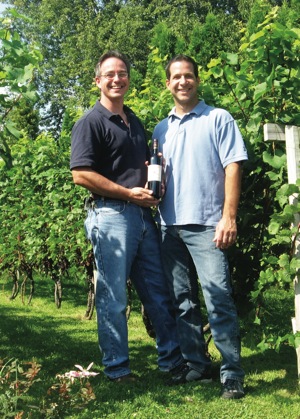
In the fall of 1992 Rich Schell noticed a heavily-laden Concord grapevine in the backyard of his best friend, Dave Ruzzo’s house. He casually remarked, “We should make wine with these grapes.” Thus “DAVENRICH WINERY” (say Dave n’ Rich) was born. Little did we know just how monumental those words would prove to be.
Our wine tastes at that time had progressed from white Zinfandels to jug reds and cheap Bordeauxs. We figured grapes equal wine, how hard can it be? All we needed to do was learn the process. We bought books, picked minds and read everything one could read in the days before the Internet, to find out how to make wine. Finally, Rich found a want ad for “everything needed to make your own wine.” We took a drive and met an elderly gentleman who showed us the motherload of winemaking equipment. He had bottles, testing equipment, recipes and an amazing little device known as a tabletop screw press. We were sold! We paid $85.00 and drove away loaded up with everything we needed to make Chateau Mouton Rothschild — or so we thought.
Using the new equipment, and Dave’s Concord grapes, our first batch of wine was underway. More importantly a winemaking obsession had begun. Not satisfied with having just one batch of wine in the making, that same year Dave found a local importer of California grapes. We purchased 70 lbs. (32 kg) of “mixed black,” the cheapest grapes they had, and we began batch number two. We instantly noticed the difference in the grapes. They were sweeter and much less acidic. They also didn’t taste like Welch’s grape juice. Unable to be patient, we began tasting the wines shortly after fermentation ended. The Concord wine was horrible and the California wine was less horrible. We figured it all needed to age, so we let it. The Concord wine was eventually dumped out but the California wine turned out to be fairly decent — not great but drinkable and fairly pleasant. This winemaking thing was tougher than we thought but that was all the encouragement we needed. Unwilling to give up, we learned that none of the wines we enjoyed were made from Concord grapes. Every year since then we’ve made many vintages during our “yearly ritual.” The two of us have been making wine now for more than 16 years.

Rich’s casual suggestion also led to an unexpected genetic awakening in Dave. It brought to mind memories of his grandfather (aka, Papa), an Italian immigrant, who used to make wine in the “traditional Italian” way every year. Meanwhile, Dave’s uncle heard about our endeavors and called to see if we wanted Papa’s torcietti (winepress) and other equipment, which was sitting in his basement gathering dust. We had no idea it still existed, but immediately picked it up and were impressed by its 5’ (1.5 m) height. We rebuilt the plate with so many bolts we named it “Frankenplate,” but it still works great.
After purchasing a fixer-upper home in 1999 Dave was surprised to find out that an overgrown extra plot of land came with it. He eventually cleared up the thickets and planted a large tomato garden. One day as he stood looking at his garden, he noticed how much sun it received and it suddenly hit him. “I think I’ll plant a few grapevines here to make wine.” Another oversimplification of terms! Living in the Northeast in upstate New York, he had no idea about what varieties grew and where. How many vines would be needed, what types of wine were made from which grapes, and the word terroir, huh? As he began to research viticulture, he slowly realized he’d bitten off more than he could chew in a big way! Nevertheless, he persisted and successfully planted 40 vines in the spring of 2001. “VillaRuzzo Vineyards” was officially underway, paving the way for DAVENRICH “VillaRuzzo Estate” wines.
Since the initial planting, 50 more vines have been added and two of the original four varieties have been replaced. We’ve learned a lot, lost a lot and poured a lot of bad wine down the drain. Each year we harvest more than two hundred pounds of estate-grown Cabernet Franc, Riesling, Regent and Marechal Foch and it’s getting better with each vintage. We still make wine with imported California grapes and our annual production has increased to nearly 300 bottles. Dave has also created a blog www.backyardvineyardandwinery.com to detail our progress. We invite other home grape growers and winemakers to share their failures, successes and tasting notes there with us.
Not wanting to be unchallenged, Rich recently purchased a home with 11 acres of land, a perfect setup for Dave to say, “you should plant some vines here . . .” And so the 300-vine “Schell Meadow Vineyard” is being planed for planting in the spring of 2009!