Precision Winemaking at Your Fingertips
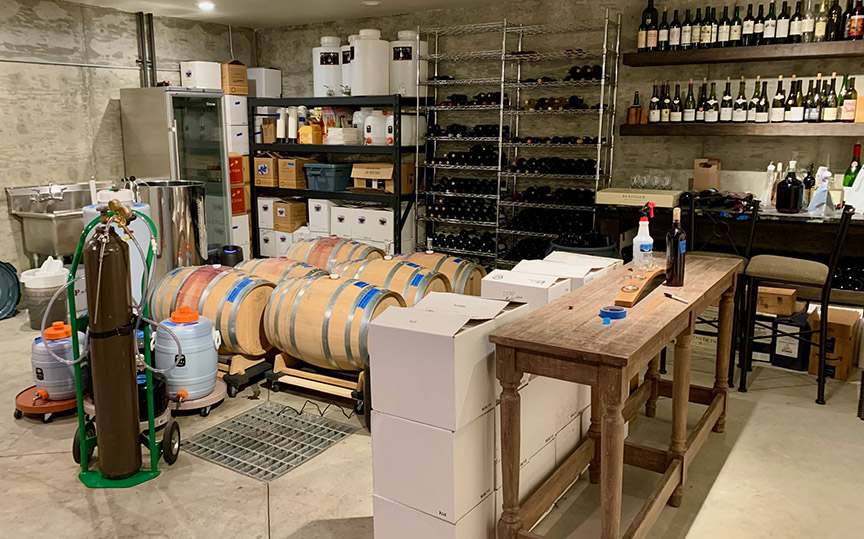
For over 30 years, my wife and I have lived and breathed the science and art of winemaking. From managing our own vineyard for more than a decade to producing everything from robust Bordeaux styles and Rhône blends to delicate white, sparkling, and dessert wines, the journey has been one of constant refinement.
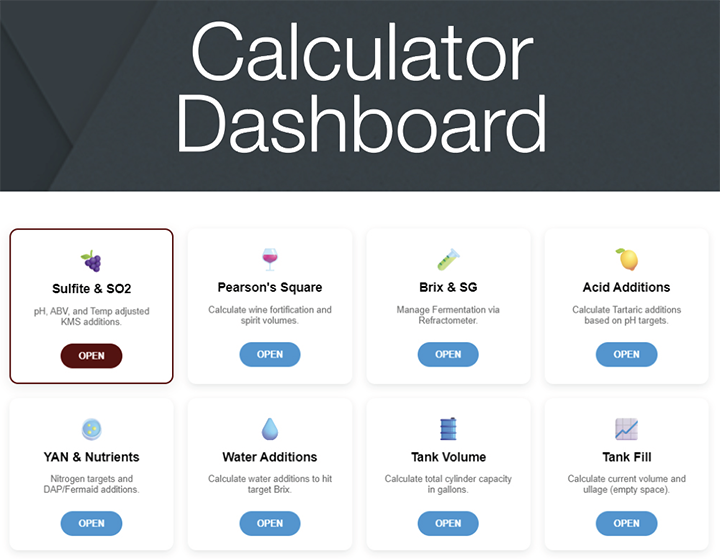
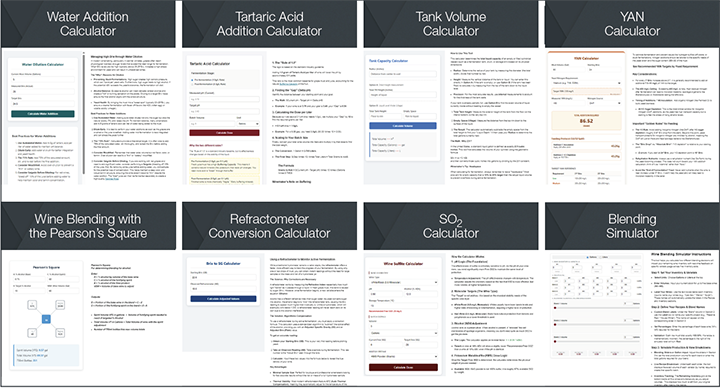
The secret to consistency in this craft isn’t just a good palate; it is accurate data. In support of our winemaking community, we’ve spent the last year migrating our personal cellar tools into a user-friendly, web-based dashboard. These nine apps are now live and free for all winemakers, amateurs and pros alike, at The Winemaking Calculator Dashboard.
Nine Essential Tools for Your Cellar
The dashboard provides a comprehensive suite for every stage of the winemaking process with nine different winemaking tools:
1. SO2 Calculator: pH and temperature-adjusted potassium metabisulfite (KMS) additions.

2. Pearson’s Square: Easy math for fortification and blending.
3. Brix & SG: Manage fermentations accurately using a refractometer.
4. Acid Additions: Target specific pH levels with tartaric acid additions.
5. Yeast Nutrients & Yeast Assimilable Nitrogen (YAN): Calculate nitrogen targets and diammonium phosphate (DAP), Fermaid O, or Fermaid K needs.
6. Water Additions: Hit your target Brix every time when water is required to bring the Brix down.

7. Tank Volume: Calculate total cylinder capacity in gallons.
8. Tank Fill: Calculate current volume and ullage (headspace).
9. Blending Simulator: Run “what-if” scenarios across your inventory.
The “Big Zin” Challenge: A Case Study in Precision
To illustrate how all of these tools can be used in a given wine cycle, I will share details from last year’s Zinfandel harvest. A friend offered 500 lbs. (225 kg) of surplus grapes, but when we arrived at the vineyard, that “500 lbs./225 kg” had blossomed into over 1,000 lbs. (450 kg). To make matters more challenging, while we were assured the Brix were under 24, the fruit “soaked out” to over 28 °Brix once in the bin.
We needed a strategy fast! We decided to split the vintage into a full-bodied Zin, a crisp rosé, and to take advantage of the high Brix, a deep ruby dessert wine (can’t call it Port anymore, but in that vein). First, we split the must into two 500-lb. (225-kg) batches. Our plan was to saignée (bleed off) some of the primary Zinfandel and use that for a rosé, and then adjust the remaining concentrated portion of Zin to 24 °Brix. We would then ferment the other 500 lbs. (225 kg) of Zin as a dessert wine. Based on an estimated yield of 35 gallons per 500 lbs. (132 L/225 kg), here’s how the dashboard calculators were used to manage the math:
Water & Acid Adjustments
The Water Additions app showed that we needed 5.8 gallons (22 L) of water to bring an estimated 35 gallons (132 L) of 28 °Brix juice down to 24 °Brix. Simultaneously, the Acid Additions app determined we needed 394.4 grams of tartaric acid to shift our pH from a dangerous 3.85 to a stable 3.55 for the same yielded volume. Before adding the water, we pulled our rosé from the free-run crushed must and recalculated the water and acid additions based on the balance after the saignée reduction.
Precision Saignée
Ordinarily for our full-bodied reds we like to bleed off 10% of the free-run juice, but to avoid watering down our wine we decided to pull 5.8 gallons (22 L) of free-run, thus balancing the Brix-reducing water addition. Using the Tank Fill calculator, we entered our 100-L tank dimensions (16.25” D x 29.5” H). The app told us when to stop: We pumped juice over until we filled the tank up 6.4 inches (16.3 cm) from the bottom or 23 inches (58.4 cm) from the top, to hit our 5.8-gallon (22-L) target. Then we adjusted the Brix and acid on the saignée to 24 °Brix and 3.45 pH. The Water Additions app calculated 0.97 gallons (3.7 L), and the Acid Additions tool determined 102.5 grams tartaric for the new rosé volume of 6.77 gallons/25.6 L (5.8 gallons plus the 0.97-gallon water addition).
Nutrient Management
Using the YAN & Nutrients calculator, we determined the nutrient additions needed for our yeast selection. For the primary Zin we chose EC-1118, a low-nitrogen yeast. We chose another low-nitrogen yeast — QA23 — for the rosé. For the dessert wine, we used D254, which has a medium-nutrient requirement. We guessed the grapes’ YAN at 80 ppm (we didn’t have time to send a sample out to a lab and the vineyard didn’t know, but thought this was a safe estimate) and went with the YAN calculator’s recommendations of ensuring a healthy fermentation despite the high initial sugar.
Fortification
To create a dessert wine with 10% residual sugar and 18% ABV, we used the Brix & SG calculator to monitor the fermentation via refractometer. When the refractometer measured 17.4 °Brix (equates to 10.1 °Brix adjusted, or roughly 10.1% residual sugar), we pressed the 500 lbs. (225 kg) of must and used the Pearson’s Square app to calculate that we needed 3.3 gallons (12.5 L) of 95% spirits to stop the yeast in its tracks, resulting in approximately 18% ABV. Based on results from the app, we know we fermented from 28 °Brix to 10.1 adjusted (per alcohol effect on the refractometer), 28 – 10.1 = 17.9 °Brix were fermented, and at an estimated 60% conversion factor, the resulting base wine should be around 10.74% ABV. (see: “Refractometer vs. Hydrometer – Comparing tools and managing fermentation accuracy” on the dashboard reference guide section for more on this).
Aging
We then used the Sulfite & SO2 Calculator app to manage sulfite levels throughout the aging and cellaring process. Unlike basic charts, this app calculates required KMS additions based on a wine’s specific pH, ABV, and temperature to hit precise molecular SO2 targets (0.8 mg/L for reds or 0.5 mg/L for whites). By accounting for the percentage of “free” SO2 that is actually effective at your specific pH, the calculator ensures your wine is microbiologically stable without over-sulfiting.
Why We Built This
We believe that better tools make for better wine. Whether you are a hobbyist or a seasoned pro, these apps are designed to provide the same lab-grade precision we use in our own cellar in Lincoln, California. We invite you to explore the dashboard and make these tools a part of your next vintage. They’re free to use. We know they’ve helped us, and believe they can help others too.