Carboy Calibration
Over the years I have noticed the volume of similar-sized carboys is not identical. For example, not all 5-gallon (19-L) carboys are manufactured to be equal in volume. Have you ever racked a wine and unexpectedly found there to be excessive headspace, or maybe you had to stop siphoning wine into a carboy so it didn’t overflow? Chances are, one of those carboys is larger than the other. Knowing this, I use this strategy to help minimize headspace after racking wine.
When I first started making wine in 2009, I only had a handful of carboys, and I ended up noticing these volume differences, so I marked the handles “small,” “medium,” or “large”. However, since that timeframe, I’ve added many more 5-gallon (19-L) carboys to my collection and decided to get more precise in my labeling.
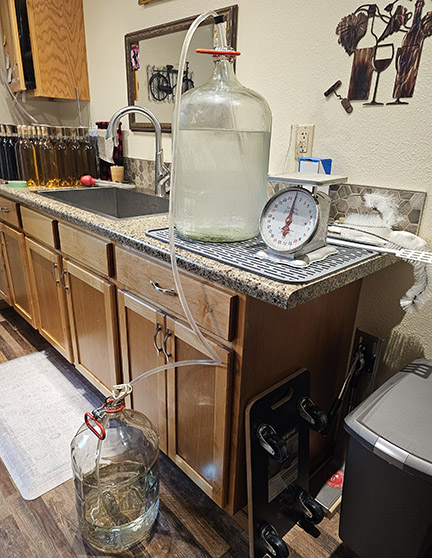
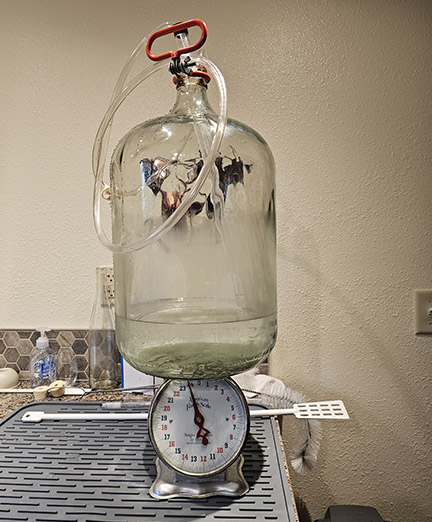
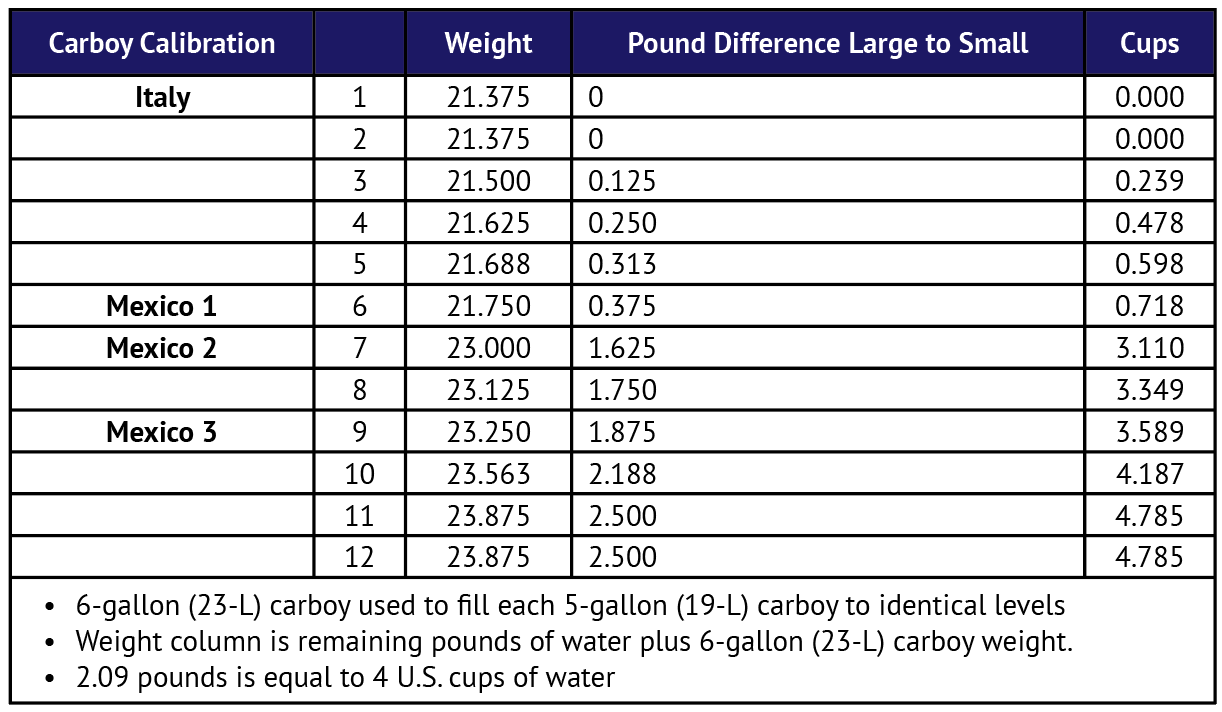
Last fall, I took the extra time to calibrate all 12 of my 5-gallon (19-L) carboys to scientifically determine the volume differences. To do this, I filled a 6-gallon (23-L) carboy to the same level every time. I siphoned water into each 5-gallon (19-L) carboy one at a time to identical levels at the collar. Next, I weighed the 6-gallon (23-L) carboy and remaining water, which allowed me to create a table that lists the differences in capacity of all 12 of my carboys.
I have glass carboys from Italy and Mexico, though even those from the same origin were not exactly the same. I also have carboys with three different Mexican stampings (I’m assuming different manufacturers). That’s why you’ll see Mexico 1, 2, or 3 in the chart at the bottom of this page.

Each manufacturer had some variation. When comparing the largest volume 5-gallon (19-L) carboy to the smallest, I found a difference of 43⁄4 cups of water. This equates to 11⁄2 750-mL wine bottles! Knowing this, you can strategically start your wines in the larger carboys and downsize to the next size smaller to help reduce headspace between rackings.
Why not use topping bottles?
I also like to target an extra 1⁄2-gallon (2-L) carboy for each 3-, 5-, or 6-gallon (11-, 19-, or 23-L) batch I make that serves as a topping bottle. That way, after the initial racking, I slowly downsize my topping bottles from 1⁄2 gallon (2 L) to maybe 1.5 quarts/L, then to one 750-mL wine bottle until it’s empty. I use this strategy plus the carboy size differences to help eliminate headspace after each racking.
In addition, the 1⁄2-gallon (2-L) topping bottle helps when all my larger 5-gallon (19-L) carboys already have wine in them, and I have to use one of my smaller ones. Between the first racking of getting the wine off the lees and next into a larger carboy, it can readily use a 1⁄2-gallon (2-L) topping bottle from that racking alone. By strategizing on which size carboy to start with and having the extra 1⁄2 gallon (2 L) of wine, I’ve got my bases covered to eliminate carboy headspace vs. one method alone.
It’s a painfully slow exercise to calibrate your carboys, but it’s well worth the time.