Carbonic Maceration Techniques
There is a myriad of techniques to use in winemaking — the more we learn and experiment as winemakers, the better we become. One of those techniques is carbonic maceration, a process that uses a carbon dioxide environment to kick off enzymatic intracellular fermentation within the grape itself.
Carbonic maceration can bring fresh fruit into the flavor profile, lower malic acid levels, and change the style from big and tannic to fresh, vibrant, and smooth. Studies have shown the benefits of using this technique with some hybrids or non-vinifera grape varieties, eliminating or toning down “earthiness” and “foxy” flavors, and lowering harsh malic acid levels, making this a very useful technique.
Carbonic maceration was discovered in 1872 by Louis Pasteur; he found that grapes kept in carbon dioxide tasted different than those kept under normal conditions. Michel Flanzy is credited as the inventor, having made wine using carbonic maceration in 1934. Its use has been closely associated with the production of Beaujolais Nouveau wines made from the Gamay grape in the Beaujolais region of France. It was first commercialized in 1951 by Jules Chauvet, who experimented with ways to boost wine aromas. A modified version was patented by Stephen Hickinbotham in 1986, which involves whole grape bunches placed into a plastic bag supported by a pallet box, into which a small quantity of dry ice in an insulated container was placed. The plastic bag is then sealed and sometimes fitted with a one-way valve to allow carbon dioxide to escape while preventing the entry of air.
Terminology
Before we dive into the process of carbonic maceration, let’s take a step back and identify some terminology. Maceration is the process where tannins, anthocyanins (color), and flavor compounds are leached from the grape skins, seeds, and stems in the must and/or wine. This degree of extraction can be affected by temperature, time, alcohol level, and whether it’s aerobic or anaerobic fermentation. There are three types of maceration techniques in winemaking — cold maceration, extended maceration, andcarbonic maceration.

Cold maceration or “cold soaking” is a process that involves holding crushed grapes at a low temperature prior to traditional alcoholic fermentation.
An extended maceration is a winemaking process that involves keeping the grape skins, seeds, and stems in contact with the wine for an extended period after fermentation has been completed. The delay in pressing can be a couple months to almost a year, depending on the grape variety and the growing season.
Carbonic maceration is a red winemaking whole bunch fermentation technique in which the first phase of fermentation is conducted in a completely anaerobic atmosphere, which transforms a small amount of malic acid and sugar in the grapes into ethanol, along with flavorful aromatic compounds without the intervention of yeasts. The process can be broken down into three techniques, each having different outcomes with the resulting wine: A true carbonic maceration, semi-carbonic maceration, or having a percentage of whole berry or whole clusters as part of a traditional fermentation.
Conducting a Carbonic Maceration
For a true carbonic maceration, start with hand-harvested, whole grape clusters void of disease or pest damage. Load your whole clusters into the fermentation vessel carefully, trying not to break the berries. Prior to sealing the fermenter, fill the vessel with carbon dioxide, creating an anaerobic environment. Carbon dioxide is absorbed by the grapes through the skin, which converts from an aerobic respiration to a fermentative anaerobic metabolism. A complex array of processes is conducted by enzymes within the intact grape.
Two forms of dehydrogenase enzymes begin transforming both sugar and malic acid into alcohol, a process known as intracellular fermentation. Polyphenols, tannin, and anthocyanin, migrate from the skin into the pulp, which darkens. These reactions are conducted by enzymes in the complete absence of oxygen and independent of any yeast or microbial activity. For this process to proceed it is critical that there be a void of oxygen and a complete carbon dioxide environment. Wines made using the true carbonic maceration process can be fresh and bright with fruity-floral components, lighter in color, with a smooth tannin mouthfeel. This style of wine is meant to be consumed young; they do not get better with age.

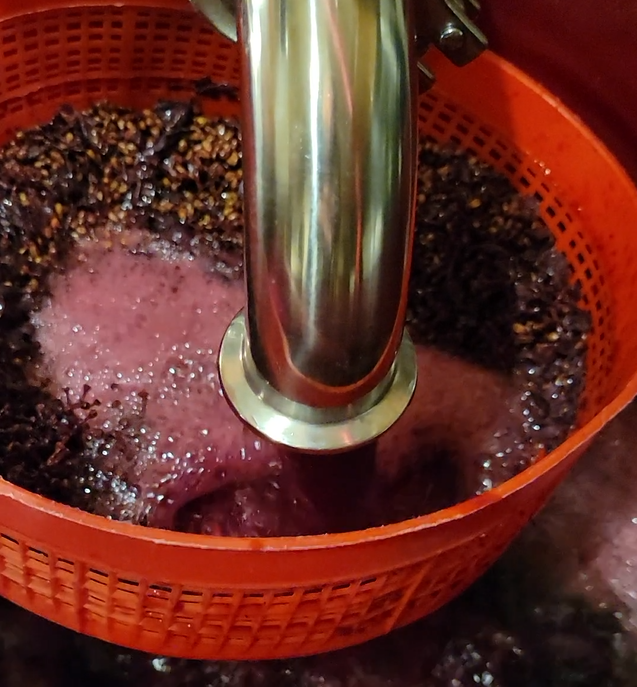
The biggest difference between a true carbonic maceration and a semi-carbonic maceration is the source of carbon dioxide. With semi-carbonic maceration, no carbon dioxide gas is added. This is the most widely used process, especially on a larger scale. Whole grape clusters are loaded into the fermentation vessel, as the mass of grapes presses down upon itself, the bottom level of berries break from the pressure caused by the weight and juice flows out. Traditional fermentation begins thanks to the yeast on the skins of the grapes. On a small-scale, running a portion through a crusher/destemmer will help with creating the juice necessary for the start of fermentation.
With traditional fermentation, yeast plus sugar is converted to alcohol, heat, and carbon dioxide. This carbon dioxide that is produced pushes the oxygen out of the vessel, creating an anaerobic environment. To help speed up this process, winemakers may choose to pump a small amount of fermenting juice into the bottom of the tank. With the anaerobic environment, the intracellular enzymatic process begins in the unbroken berries.
Wines made with a semi-carbonic process can have more structure and complexity compared to those made with a true carbonic maceration. This method can extract more color and tannins due to the fermentation of the crushed grapes, resulting in a slightly more robust wine, while still retaining some of the fruity characteristics typical of carbonic maceration.
The third technique, though not labeled carbonic maceration, is a tool to bring a degree of benefits from the intracellular fermentation while proceeding with traditional fermentation. Adding a percentage of whole clusters back to the must after processing through the crusher/destemmer or choosing to destem only and allowing whole berries to pass through equipment. The inclusion of whole berries or whole clusters in the vessel while proceeding with a traditional fermentation allows the whole berries to go through an intracellular fermentation simultaneously with the traditional fermentation.
Whichever process is used, once the alcohol reaches 2–2.5 percent within the individual grape, splitting of the skin will occur as the alcohol percentage begins to disrupt the cell membrane integrity. Enzymatic activity is inhibited by carbon dioxide, which leads to cessation of the process. The fruit is then destemmed, crushed, and fermented with yeast under normal winemaking conditions or can be pressed off the skins, seeds, and stems and fermented with yeast. Inoculation of yeast starts the traditional aerobic fermentation converting all the sugar to ethanol, which can take a few days to a couple of weeks.
Impact of Carbonic Macerations
Pressing the must after semi-carbonic maceration yields different results than traditionally destemmed and crushed grapes. With traditional fermentation, everything is uniform, and the harder you press the more tannin is extracted as you go along. In semi-carbonic wines, you get tannic, dry wine from the free-run juice. At the beginning of pressure, the juice in the berry is sweeter, bright, and juicy with low tannins. As the pressure increases, extraction from skins and seeds increases and the tannin level increases. Portions of the pressing can also have a lower alcohol level, resulting in an overall lower alcohol level compared to wines made from a traditional fermentation. The free-run portion, 25–35 percent of the total volume, will have a lower alcohol percentage due to a combination of juice that fermented with traditional method at the bottom of the tank and the enzymatic activity that occurred within the berry stopping at around 2–2.5 percent alcohol.
During intracellular fermentation, berries lose 20 percent of the sugar and 50 percent of the malic acid, which is transformed into alcohol, in the range of 2–2.5 percent. The enzyme malic dehydrogenase plays a key role in carbonic maceration, by metabolizing malic acid into ethanol, succinic acid, and aminobutyric acid, without producing any lactic acid. This results in a decrease in titratable acidity and an increase in pH.
Glycerol and shikimic acid are produced, with shikimic acid accumulation within the berry, then degraded to cinnamic acids and further to the three main aroma compounds associated with carbonic maceration: Benzaldehyde, vinylbenzene, and ethyl cinnamate. The flavor profile is different as well, producing fresh, fruit-forward, floral wine with flavors of banana, candied cherry, strawberry, and bubble gum.
The extraction of phenolics, anthocyanins, and tannins from grape skins is different during carbonic maceration compared to standard winemaking. While in both methods ethanol acts as a solvent for the extraction of phenolics, in traditional fermentations a greater proportion of skin and seed contact time occurs at higher alcohol concentration than with carbonic maceration. This results in greater extraction of anthocyanins and tannins compared to carbonic macerations, though overall levels of both are dependent on the grape variety, viticultural practices, and climate. Extraction of any tannin into the pulp at low alcohol concentrations would also be more likely skin tannin rather than seed tannin, which could lead to a perception of softer tannin in the wine.
The enzymatic reactions occur over approximately a week at temperatures up to 95 °F (35 °C) but can last from a few days to over two weeks. Carbonic maceration character and structure occur best if grapes are kept at 86–90 °F (30–32 °C) for 5–8 days. At lower temperatures, more subtle and short-term aromas are produced, but the intensity of the character can vary depending on grape variety or wine style as well.
Traditionally, carbonic maceration is a technique used with red grape varieties, closely associated with Gamay and Pinot Noir. It can be used on other red vinifera varieties like Syrah, Tempranillo, Mourvèdre, and Carignan, when creating a younger, softer, more approachable red is desired. White grape varieties can be added to the fermentation process to enhance the berry aroma and flavor and increase the perceived acidity of the wine. However, the technique is not typically used in white wines due to the potential for funky, earthy flavors, colored hue (pink, gray, orange), and a drop in acidity.
As stated earlier, carbonic maceration can also have positive benefits with hybrid or non-vinifera grape varieties in reducing the herbaceous, earthy, foxy components, allowing fruity character to shine. Several of these grape varieties have higher malic acid levels, so high in some cases that conventional malolactic fermentation cannot commence. Through this process a percentage of malic acid is transformed into alcohol, carbonic maceration has shown to be an effective and low-cost deacidification technique for these varieties. Carbonic is a good technique for hybrids, but do use caution as some of the early hybrids and native varieties can have so much fruitiness that carbonic maceration can be too much of a good thing.
With winemaking it is important to know the risks as well as the benefits. The risk of spoilage by acetic acid bacteria and Brettanomyces yeast is increased during carbonic maceration due to the higher pH, elevated temperatures, and absence of sulfur dioxide. If a carbon dioxide-rich environment is not adequately maintained, aerobic microorganisms can quickly take over, causing wine spoilage.
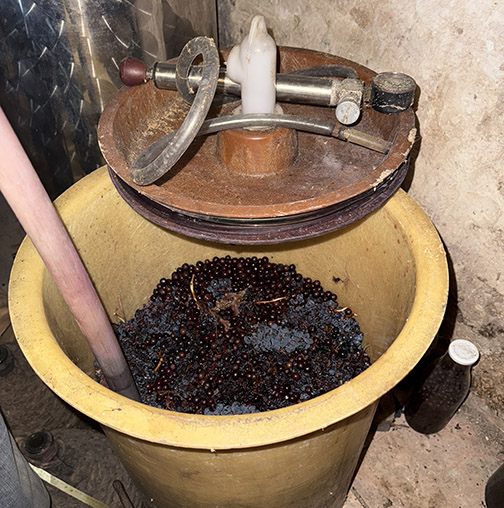
Small-scale winemakers have an advantage as it is a bit easier to work with this process due to the scale. In the wine lab at CMU Tech using 7.6-gallon (29-L) fermenter buckets with lids, we loaded the clusters into the bucket then added a chunk of dry ice. We put the lid on but allowed a small vent so the carbon dioxide can push out the oxygen. We used an airlock bubbler with no water in it to allow this to happen, then once the dry ice had evaporated it was sealed up. We started experimenting with this process as new hybrid grape varieties started coming available in Colorado. The carbonic maceration process was used to help eliminate issues of browning, stabilization of color, and enhancing fruit components in the wine. Grape varieties that were experimented with successfully were Marquette, Baco Noir, Frontenac, and Noiret.
Carbonic maceration is a great tool to have in your tool belt, whether you are looking to make that style of wine, trying to bring out more fruit components in hybrid and non-vinifera grape varieties, or looking for another way to deacidify high malic acid levels. With true carbonic maceration you can also speed up the time it takes to make wine to have it ready to share with friends.