Restarting a Stuck Life
It was still dark when I peered out my bedroom window and spied three vineyard workers assembling in our driveway. I donned my gardening shirt and pants like a gladiator preparing for battle. Less than one week after moving from the Bay Area to our new home in sparsely populated Calaveras County, California, my husband, Dave, and I were on a mission to save our new home vineyard from mildew and thieving birds.
To our urban friends, purchasing the foothills property was a whim, a pandemic buy. They conjectured the romance would soon fade. What they didn’t know was that our Bay Area home of 22 years had lost its allure. We felt stuck in a dream planted two decades previous by younger people at the peak of their high-tech careers. Now on the cusp of retirement, we yearned for the unlikely something that would make us feel young again. After touring a home with a private vineyard, a touristy feel-good message caught my eye.
“Welcome to Happily Ever After.”
I believe in signs.

Growing grapes is hard work, but we had help. The area’s burgeoning wine industry provided access to experienced workers. Social groups for amateur winemakers made for easy friendships. Still, my back and legs felt like they’d been lifting weights in the gym for hours and my mind felt like it had worked weeks of overtime. Complete physical and mental exhaustion made for a good night’s sleep. Ibuprofen helped too.
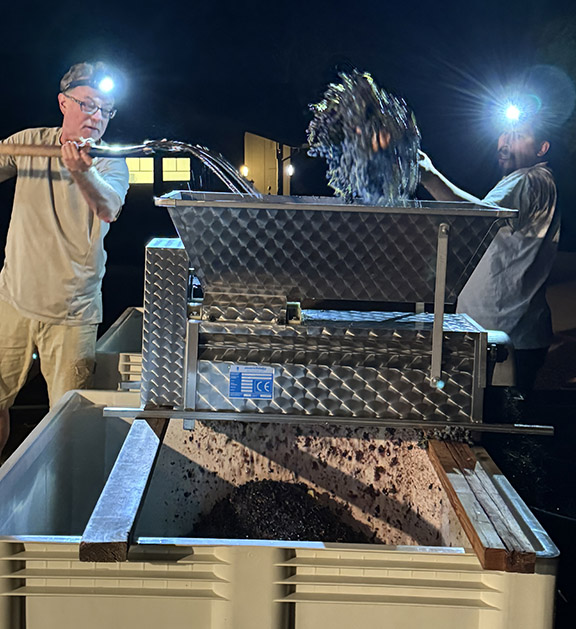
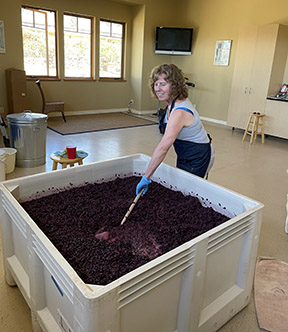
After the harvest and crush, I punched down the grapes to break up bunches missed by the crusher. Dave added yeast and nutrients and within days, the two half-ton (450-kg) bins of must let off fumes that filled the garage with a fruity, earthy smell. Our fingertips turned purple from picking the twigs and stems that made it into the fermenter. Stained fingers are a badge of honor around here.
Winemaking is temperamental. As fermentation got too warm it generated a lot of heat as a byproduct. Fumes from the must set off the smoke detector mounted on our garage’s 12-foot (3.7-m) ceiling. At 3 a.m., we jumped out of bed, ran to the garage, and hit the bleating device with a broom handle until the battery fell to the ground, leaving dangling wires as collateral damage. We stared at each other, mouths gaping. The wine would spoil if we didn’t slow fermentation. Dave stopped adding nutrients. Each morning, I filled a glass cylinder with strained grape liquid and dropped a hydrometer in it. We started with a reading of 28 °Brix, which then lowered several gradients a day. Without nutrients yeast can exhaust like when bread dough refuses to rise. We knew our fermentation was stuck when it took three days for the reading to drop only one °Brix. Fear sunk in. The wine would be so sweet only ants would drink it.
We impatiently waited. Slowly, the level dropped to four, close enough to press. Our traditional Italian basket press gently coaxed the juice from the flesh and skins. We added yeast and nutrients to spark more fermentation.
Restarting fermentation, like restarting our lives, is an art, not a science. Eventually, the hydrometer level dropped to almost zero, but much to our dismay the wine turned cloudy.

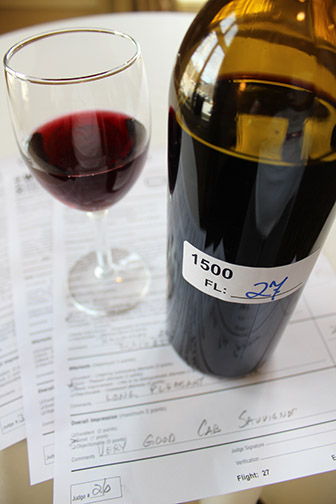
Dave researched techniques to clarify wine. We chose to fine with egg whites because filtering required extra equipment. When the particles had sunk, we siphoned the clarified liquid into an oak barrel. To our delight, the wine was drinkable — very drinkable. After a year of barrel aging, we bottled 25 cases of the Barbera-Primitivo blend, which received a silver medal at the Sonoma County Fair.
It’s true. Nature provides many metaphors. I never suspected that turning grapes into wine would represent restarting a stuck life. And yet, it did.