Dornfelder: Germany’s full-bodied purple grape
In the pantheon of famous international wines, I feel that Germany occasionally gets overshadowed by its famous neighbors, Italy and France. Germany has a long history of making incredible wines, with similar strict standards of quality and regionality, much like those of France, Italy, and Spain. With mountainous regions and deep rivers, specifically the Mosel River, Germany has beautiful terroir to foster cold-hardy Vitis vinifera varieties. The vineyard with the steepest incline in the world (65°), Bremmer Calmont, is found in the Mosel River Valley. A trip down the river will have steeply sloped banks flagged with grapevines for much of the length of the river valley.
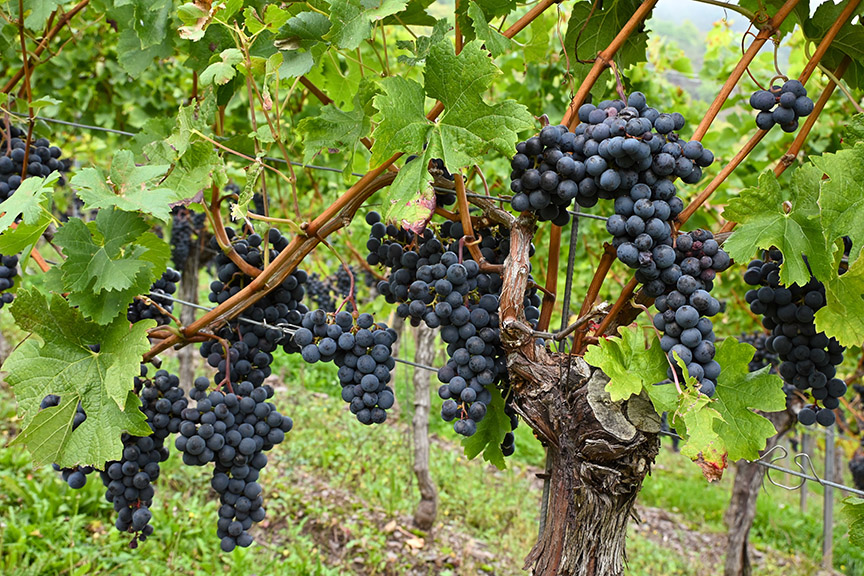
Amongst the more famous varieties that flourish in the Mosel River Valley are Pinot Noir and Riesling, but there is another grape that produces a fuller-bodied red wine and can still withstand the cooler climate. Dornfelder is a Vitis vinifera grape that was originally cross bred by August Herold in Weinsberg, Germany, in 1955. Herold was an experienced viticulturist, running a grape breeding facility in Germany for over 30 years. He originally developed Helfensteiner — a cross of Frühburgunder (a mutation of Pinot Noir) and Trollinger — and Heroldrebe — a cross of Blauer Portugieser and Blaufränkisch (Lemberger). After the development of these two varieties, he went on further to cross them, creating the variety of today’s column — Dornfelder. Herold ultimately named the new variety after a close colleague, Ludwig Dornfeld, who helped form the viticultural school in Weinsberg.
Dornfelder is now the second most popular red grape variety grown in Germany, with 16,800 acres (6,800 ha) under cultivation as of 2022. Germany is not the only nation to grow this beautiful red grape, with plantings now also found in Switzerland, England, Poland, Czech Republic, Canada, and the United States. In North America, it has flourished in climates as warm as the Santa Rita Hills of California to the cooler climates of Virginia, the Finger Lakes region of New York, and Pennsylvania in the U.S. and Vancouver Island in British Columbia. There are also some experimental plantings in Brazil and Japan.
Dornfelder in the Vineyard
The grape has a good crop load, often generating up to 4–8 tons of grapes per acre. If this deeply pigmented grape is used for blending, the vintner may allow the plant to overcrop slightly. If planning on using the grape as a varietal wine, shoot thinning should be employed to concentrate flavors in the smaller crop. The vines do well in well-drained, fertile farm soil as opposed to the stony or sandy soils that are preferred by many vinifera varieties. This makes it a better candidate to plant on former dairy or animal farms with higher nitrogen content in their soil. The plants are easier to work with than some other vinifera, as they have a low amount of side shoots and require less vineyard maintenance to keep the plant growth in check. The clusters can develop Botrytis in rainier climates. The leaves have five lobes, not particularly deep, but are wide and have a finely serrated edge.

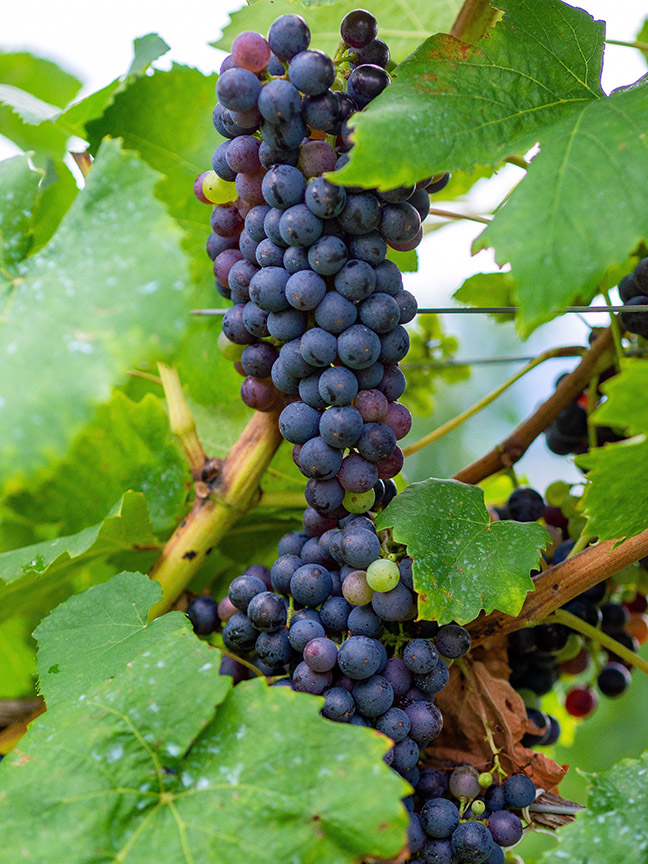
The Dornfelder grapes grow in large, loose clusters, with wide shoulders that taper dramatically. The berries are large with a thick blue-black skin. The variety tends to ripen later in the growing season, usually not until early October in the Northern Hemisphere. Good stalk and pedicel strength allow the grape to hang longer.
Dornfelder in the Winery
In the cellar, the grape is very useful and utilitarian. It has very dark pigmentation, making it an excellent blender for other wines that lack in color. Its deep garnet color can take on some nuances of a tawny brown around the edges as it ages. The thicker skins do create a more pervasive color saturation that will be longstanding in the glass, even if subtle browning does occur. In years of a lighter crop load, flavors of plums, blackberries, violets, and black cherries are very abundant. In cases of overcropping, lighter red cherry and blueberry aromas are observed. The wine is usually higher in acid, making it a good candidate for sweetening. Some vintners prefer a lighter style, embracing the bright fruit character and reinforcing it with some backsweetening. This style is often compared to a French Beaujolais. Due to its dark, thick skin, Dornfelder is rarely used for rosé production.
I spoke with award-winning Winemaker Tom Mannello and Owner/Viticulturist Butch James of Crystal Ridge Winery in Glastonbury, Connecticut, regarding their Dornfelder plantings. Crystal Ridge is a beautiful winery perched on top of one of the highest points in Hartford County, and yields views of rolling orchards, berry farms, and eventually the capital city, Hartford, off in the distance. While the view is awe-inspiring, the wines are even better. I’ve had the pleasure of knowing Tom for years and his wines are among the best in the state. Butch James, the proprietor of Crystal Ridge, painstakingly planted their acres of grapes with his father, Harry, who charms and delights guests in his tasting room today. Butch planted about an acre of Dornfelder as a bit of an experiment to see if vinifera would be sustainable in their cold New England climate.
One could say they had mixed results. While on the viticultural end, Butch grew frustrated with lower yields and disease issues, yet he did yield a crop most years. He found that the fruit would ripen earlier in the fall, and the skin would thin as the grapes ripened, making it susceptible to winged pests such as bees and Drosophila (fruit flies). Eventually, he replaced most of the Dornfelder with greater yield-bearing hybrid varieties, but kept a small plot. Like many other varieties in our often-damp New England climate, Butch found that downy and powdery mildews were often the chief nemeses within the Dornfelder plantings. He found spur pruning beneficial for the plants in controlling yield and prioritizing quality of the crop.
Tom Mannello has worked his magic over the years with Dornfelder, using it as a pigmentation grape in some blends in lower yield years and then as a base for a Port-style wine in better years. Rather than reading Brix accumulations, Tom makes his harvest judgment calls on pH for this variety — waiting until the pH reaches at least 3.2 and then picking. He found the Dornfelder grown at Crystal Ridge to be higher in malic acid, with malolactic fermentation having profound effects upon his grape chemistry, often moving the pH all the way to 3.7 after the secondary fermentation.

Sampling the Port, which was barreled for two years and fortified with brandy made from their own grapes, was incredibly rich and complex. Aromas of stewed prunes, brown sugar, caramel, and dried dark cherries greeted me. Flavors of rum raisin ice cream, dark cherry, blueberry pie, and a touch of crushed violets made each sip a new and interesting moment. Aged in Hungarian oak, the color was a deep ruby with a tawny rim. The color has held up beautifully while in the barrel. It was fortified with brandy distilled from estate-grown grapes by a local distiller. This gem of a wine was a delight to sample and will be a boutique offering in their wine portfolio.
Dornfelder also makes terrific dry red wine. In optimum years and growing locations, the fruit character will deepen, producing the richer notes of plum, prune, fig, and violet. Medium-bodied and with moderate alcohol content, Dornfelder can pack a punch to the drinker’s palate with dark fruit and floral notes and a firm tannin structure. The tannins are not astringent but provide a solid mouthfeel, similar to 2% milk in its viscosity. I have found the wine to have a good mid-palate volume, but to fall off a bit at the end. With a little aging, the tannins elongate and are softer on the palate, creating a smoother, polished sensation on the palate.
In Germany, Dornfelder is commonly blended with their principle red grape, Pinot Noir (Spätburgunder). These two fruit-forward varieties make creative and luscious table wine blends that are often consumed daily with dinner. They have natural acidity and excellent fruit, making them a delightful pairing with unctuous dishes such as schnitzel or sausages. That is not to say these table wines go without recognition or prestige. Many Dornfelder wines (both single varietal and blends) have a rating of over 85, especially from the Pfalz region of Germany.
I find Dornfelder can be a rewarding passion project for a viticulturalist and winemaker when grown in a cool climate. Given the anecdotal experience at Crystal Ridge, I would not plant it hoping for incredible yields to fortify a portfolio in such a climate, however. Instead, this grape is a rarity, for the adventurous and daring. Those who value elegant tannins and deep red fruit, a silkier, less palate-dominating red wine, Dornfelder presents an excellent option for their cellar and dinner table.
Dornfelder Recipe
5 gallons/19 L
Ingredients
125 lbs. (57 kg) Dornfelder grapes
Sanitizing solution of potassium metabisulfite (KMBS)
KMBS powder and citric acid powder
5 g yeast (RC212, Ruby, or BRL97)
Liquid pectic enzyme
7.5 g Go-Ferm Sterol Flash
7.5 g Fermaid O
5 g Fermaid K
7.5 g of FT Rouge tannin
5 g Opti-Red (optional but helps)
5 g Booster Rouge (optional but helps)
5 g oak dust, French medium+ toast
MLF bacteria (Wyeast liquid cultures)
Distilled water
American or French medium oak chips, cubes, or spiral
Equipment needed
Crusher/destemmer
Wine press
15-gallon (57-L) fermentation bucket or bin
5-gallon (19-L) carboy
Airlock and bung
Auto-siphon and tubing
Stir paddle
Spray bottle
Punchdown tool
pH meter
Hydrometer
Thermometer (digital preferred)
Step by step
1. Ensure all your equipment is clean and in proper working order. Make a fresh batch of KMBS sanitizing solution using 1 Tbsp. of KMBS powder and 1 Tbsp. of citric acid mixed into 1 gallon (3.8 L) of clean water. Fill a spray bottle with this solution and spray down your processing equipment. Ensure there is no pooling of sanitizer in bins or press basins.
2. Crush and destem grapes and transfer immediately into a sanitized 15-gallon (57-L) fermenter bucket.
3. Add 50 ppm of KMBS to kill off natural yeast. Utilize the WineMaker sulfite calculator to assist in your calculations. Throw a cover on the must bucket and allow to sit overnight in a cool area. This will kill negative microbes and allow the must to come to a temperature of 60 °F (16 °C).
4. The next morning (at least 12 hours after the addition of KMBS), add five drops of pectic enzyme per gallon (3.8 L) of must and stir well. Add the oak dust and stir well.
5. Take measurements of your juice, including volume, Brix, pH, and TA. Adjust the juice to a starting Brix of at least 24, a pH of 3.3–3.4, and TA of 6–7 g/L. Utilize tartaric acid if needed to increase acidity. www.wineadds.com has helpful calculators for adjusting acidity in must.
6. To prepare the yeast, warm up 50 mL of distilled water to 60 °F (16 °C) and add to a mixing bowl. Then stir in the Go-Ferm Sterol Flash. Then add five grams of yeast and stir well. Allow to sit for 15 minutes. Then mix in thoroughly to the must with a sanitized stir paddle.
7. Place a lid on the fermentation pail loosely and wait 24 hours to observe yeast activity. Take Brix measurements twice daily to ensure the start of fermentation. Take temperature measurements daily. Keep the fermentation temperatures between 70–85 °F (21–29 °C) to help secure color but also avoid off-aromas.
8. Punch down the cap and aerate the must three times a day at a minimum to help avoid reductive characters.
9. When the Brix drops by a degree or two, it is time to add nutrients. Add 100 mL of distilled water to a mixing bowl and add 7.5 g Fermaid O and the FT Rouge tannin, along with Opti-Red and Booster Rouge if you are using them. Mix well to create a slurry and then stir into the fermenting juice.
10. When the Brix is between 15–11 °Brix, add the Fermaid K in the same way you added the Fermaid O.
11. When the temperature is between 75–80 °F (24–27 °C) and the alcoholic fermentation is well underway, pour the Wyeast MLF packet over the must. Stir to punch down the skins and incorporate the bacterial cultures.
12. Continue to ferment as close to 80 °F (27 °C) as possible until the wine has fermented to dryness (-1 to -2 °Brix). This may take 7–21 days.
13. When the wine has achieved dryness, press out the wine in a sanitized press and pour all of the wine into a 5- or 6-gallon (19- or 23-L) carboy with an airlock to complete MLF.
14. After 5–7 days, rack off the lees into a clean, sanitized carboy. Affix bung and airlock and allow to sit for a month. Top off with a complementary wine such as Pinot Noir or Tempranillo, or add sanitized glass marbles to displace any headspace.
15. Monitor MLF via paper chromatography or measure the reduction of malic acid via a meter to track the progression of the fermentation. When MLF is complete, rack the wine and add 50 ppm of KMBS.
16. One month after the initial racking and addition of KMBS, rack it again into a sanitized carboy and add another 50 ppm of KMBS. Consider degassing at this point.
17. While the wine is aging, consider the addition of oak chips, cubes, or staves to add a bit of oak to enhance the wine. Taste often to not over-oak the wine.
18. Allow the wine to sit and age, maintaining a free SO2 level appropriate for the pH. WineMaker’s sulfite calculator will help you determine the proper dosage given the parameters of pH and volume. You can filter the wine after eight months of aging if you choose. At this point, it should have been racked approximately four times and have completed its oak aging.
19. You may want to consider cold stabilizing or acquiring a cold stabilizing product such as Zenith Color. This product may only be used if the wine is filtered down to 0.5 micron as turbidity will interfere with its effectiveness. If filtration is not available, try to cold stabilize via exposure to cold (put wine in a plastic container, do not try to cold stabilize in a glass carboy).
20. Taste the wine and consider if it is ready to bottle. Fining agents such as Super Kleer or mouthfeel enhancers such as gum arabic may help to improve mouthfeel and clarity.
21. Bottle wine once you are content with the flavor and stability of the wine. Always add a small amount of sulfite before bottling, 10 ppm beyond the sulfite calculator’s recommended value, to account for oxygen uptake during the bottling process.
Further Reading
Popular in parts of central Europe where it’s often sold from carts on the side of the road during a short period each fall, federweißer is a partially fermented, low-alcohol wine that is intended to be consumed before fermentation is complete. One of the popular grapes used to make it? Dornfelder.