Ratafia: A Traditional Liqueur of Patience and Fruit
In many Italian households, ratafia is not introduced as a recipe but as a presence. A dark glass bottle placed high on a shelf, opened only on certain evenings and poured with restraint. It is a liqueur that does not announce itself with urgency. It waits. Long before it reaches the table, it has already absorbed a season, a harvest, and months of silence in a cellar or pantry. Like many domestic traditions, it exists less in written instructions than in gestures repeated year after year, adjusted slightly, remembered imperfectly, and trusted nonetheless.
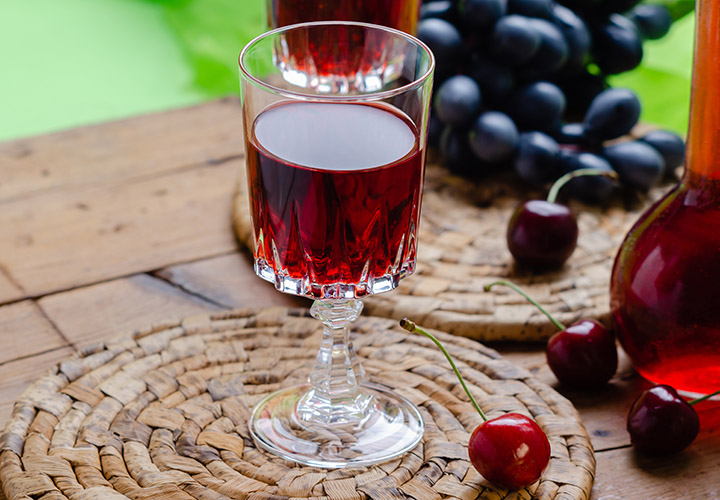
There is no single, authoritative way to make ratafia. The name itself covers a wide constellation of local practices, shaped by geography, available fruit, and family habit. In some areas it is made with sour cherries, elsewhere with black cherries or apricots; some recipes call for spices, others insist on absolute simplicity. The liquid base itself can vary: Some traditions rely on neutral alcohol, while others, particularly in central Italy, are built on red wine. Each version reflects a place and a way of living with time. To ask for the “correct” recipe is to misunderstand the nature of ratafia altogether.
What follows, then, is not an attempt to standardize or correct this tradition, but to describe one of its many expressions.
The focus through this story is on the version that incorporates red wine, as it is commonly prepared in Abruzzo, where I live. Along the eastern coast of central Italy, this is a region where preservation has always meant patience rather than intervention. In this context, ratafia is a quiet companion to the seasons, made when fruit is abundant and left to mature without hurry. It is a liqueur that carries with it the logic of the place it comes from: Measured, unassuming, and deeply rooted in domestic practice.

What is Ratafia and Where Does it Come From?
Beyond the household, ratafia has a history that is fragmented rather than linear, and for this reason difficult to pin down to a single place or moment. The word itself appears early in different parts of Europe, often in contexts that have little to do with drinking. One of the most persistent hypotheses links it to a Latin formula used to confirm agreements or seal pacts, a spoken gesture of closure and mutual consent. Over time, that formula seems to have migrated from legal and ceremonial language into convivial settings, where a shared drink marked the end of a meal or the conclusion of an encounter. Whether or not this etymology is definitive, it points to an important aspect of ratafia: Its symbolic role as much as its material one.
Historically, ratafia sits at the crossroads between learned and popular practices. Monastic communities, with their knowledge of distillation and preservation, played a role in refining fruit-based liqueurs, while rural households adapted these techniques to their own needs and resources. Long before refrigeration, alcohol offered a reliable way to stabilize fruit and carry it across seasons, and ratafia emerged as one of the most economical and versatile solutions. It required no specialized equipment, only time and a willingness to wait, which made it particularly well suited to domestic environments rather than commercial production.
As the idea of ratafia circulated, it was never standardized. Instead, it acted as a template: Fruit preserved in alcohol, sweetened to varying degrees, left to mature slowly. Each region interpreted this template according to its own landscape and habits, producing drinks that shared a name but not a fixed identity. In this way, ratafia survives not through authority or origin, but through use.
The Abruzzo Ratafia: Cherries, Land, and Climate
In Abruzzo, a green region east of Rome, ratafia is inseparable from cherries and from the particular conditions that allow them to develop slowly and intensely. Sour cherries, often preferred for their acidity and depth, thrive in a landscape shaped by altitude and sharp seasonal contrasts. Inland valleys, foothills, and small upland orchards experience cold winters and bright, dry summers, a combination that concentrates sugars and preserves a firm, aromatic flesh. These are not cherries bred for uniformity or long transport, but fruit that matures at its own pace, marked by irregular ripening and strong character. When used for ratafia, their natural balance reduces the need for correction, allowing alcohol and sugar to play a supporting rather than dominant role.
The land itself imposes restraint. Much of Abruzzo is mountainous or marginal, historically unsuited to large-scale monoculture. This has favored small orchards and mixed agriculture, where fruit trees coexist with vines, vegetables, and pasture. In such contexts, ratafia emerged less as a specialty than as a consequence: A way to preserve what is available in quantities too small for commerce but too precious to waste. The liqueur absorbs not only the fruit, but the logic of the place it comes from, where preservation has always been a matter of care rather than control.

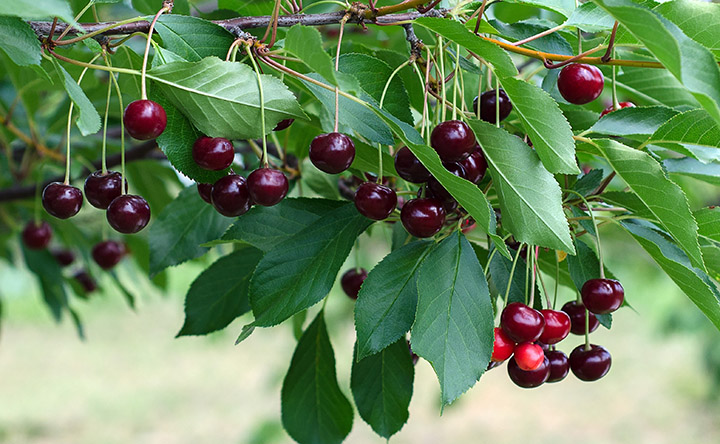
Climate completes this equation. The wide temperature swings between day and night, especially at higher elevations, enhance acidity and aromatic complexity in the cherries, while the dry air limits rot and allows for longer, cleaner macerations. During the months of rest, when the jars are left undisturbed, cool cellars and shaded storage slow down extraction and soften the alcohol’s edges. The resulting ratafia reflects these conditions with precision. It is not lush or exuberant, but measured and patient, carrying in its balance the imprint of a land where intensity is achieved through restraint rather than excess.
What Does Ratafia Taste Like and How is it Enjoyed?
In sensory terms, ratafia is typically a sweet liqueur, though rarely cloying. Its sweetness is balanced by the natural acidity of the fruit and, in wine-based versions, by the structure of the base wine itself. Aromatically, it tends toward ripe cherry, almond-like notes, and a gentle vinous backbone rather than overt alcoholic heat.
Alcohol content varies widely depending on the method and local tradition. Purely wine-based ratafia, such as the unfortified domestic Abruzzo version described here, usually falls in a milder range of 8–11% ABV. However, many commercial and traditional recipes achieve a more robust 16–20% ABV by fortifying the wine base with a measured dose of neutral spirit or grape brandy to aid in extraction and preservation. Spirit-based versions (as opposed to wine-based) often fall from 25–30% ABV, and can range higher. Despite this variability, ratafia is generally intended as a contemplative drink rather than a fortifying one.
It is most often enjoyed slightly chilled or at cool cellar temperature, particularly in summer months, and served in small glasses as a digestivo at the end of a meal.
The Recipe
A practical recipe for ratafia starts with a limited number of ingredients and clear proportions. To yield a final batch of roughly 7–7.5 gallons (26.5–28.5 L), use about 30 pounds (13.5 kg) of ripe sour cherries, 12–15 pounds (5.5–7 kg) of granulated sugar, and 5 gallons (19 L) of fully fermented dry red wine. Note that while this recipe calls for finished wine, versions of ratafia from other regions may use unfermented grape juice as well as a spirit in addition to sugar and cherries.
In Abruzzo, the wine of choice is traditionally Montepulciano d’Abruzzo. When selecting a substitute, the dominant characteristic to look for is acidity rather than power. A dry red wine with moderate alcohol, good natural acidity, and limited oak influence works best, as it supports the sweetness of the cherries without overwhelming them. Overly tannic, heavily oaked, or high-alcohol wines tend to dominate the final balance. Lighter styles such as Sangiovese, Barbera, or other acid-driven red wines will work well. The cherries should be aromatic and fully mature, as their acidity provides structure and balance. Spices are optional and traditionally restrained; in Abruzzo they are often omitted, though a small piece of cinnamon may be added if desired.
The cherries are washed, dried, and deprived of their stems and pits. While some Italians making ratafia at home will include the pits, you should not do this at home. Cherry pits contain amygdalin, which breaks down into hydrogen cyanide (a poison) when in contact with alcohol, creating a serious potential health hazard.
With the pits removed, place the cherries in a large food-grade glass or stainless-steel container with a capacity of at least 8–10 gallons (30–38 L). Sugar is added directly over the fruit, and the mixture is left to rest for several hours, or overnight, until the cherries begin to release their juice and the sugar starts dissolving. Once enough liquid has formed at the bottom, the wine is poured over the fruit until it is completely submerged. The container is then closed. Despite the presence of sugar and fruit, this process is not intended as a fermentation. No yeast is added, and alcohol production does not rely on yeast activity. Instead, the cherries macerate in wine and sugar, with extraction driven by time and alcohol from the wine rather than fermentation. Because this is a maceration rather than a fermentation, the container does not require headspace or an airlock; it is kept closed and opened only briefly during occasional agitation.
The jar is kept in a cool place out of direct light, traditionally a pantry or closet, for two to three months. During this time, it is gently shaken or turned every few days to ensure even extraction. As maceration progresses, the liquid darkens and takes on the cherries’ aroma and color. When the flavor feels balanced, the ratafia is filtered through cloth or a fine strainer and transferred to clean bottles.
The bottled liqueur is then left to rest in a cool, dark place for at least two additional months, allowing the alcohol to soften and the flavors to integrate. While ratafia remains strongly associated with seasonal, domestic production, today it is also made on an industrial scale. Commercial versions follow similar principles but rely on controlled processes and standardized inputs, offering consistency and wider availability, while inevitably reducing the subtle variations that characterize homemade ratafia.
Conclusion
Ratafia ultimately resists being reduced to a single definition, a fixed recipe, or a stable identity. Whether made at home or produced on a larger scale, it remains a liqueur shaped by time more than by technique, and by intention more than by precision. Its value lies not in complexity or rarity, but in the way it preserves a relationship with seasons, with waiting, and with small acts repeated without spectacle.
In Abruzzo, this quiet logic is particularly evident. Ratafia reflects a culture in which preservation has long meant restraint, and where flavor is allowed to emerge gradually rather than being forced. To make it is to accept delay and uncertainty; to drink it is to acknowledge that some traditions endure precisely because they move slowly. Ratafia is a modest reminder that continuity can still be built through patience, care, and a willingness to wait.
As home winemakers, patience is a trait we should all be used to already — making the reward of a post-meal glass of homemade ratafia easily within reach.