Wines of Austria
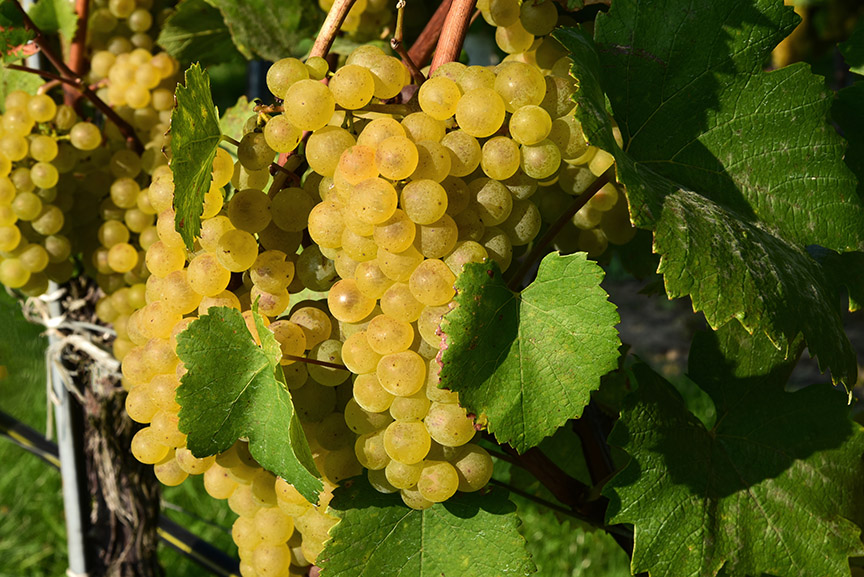
The Grüner Veltliner grape has such a catchy name that many American wine drinkers have likely heard of it and even sipped its savory, zesty flavors without necessarily knowing where this wine is from.
Versions of this signature Austrian white wine are available in wine stores across North America and are often included in restaurant wine lists. Several other grape varieties and their bottlings like Welschriesling, Blaufränkisch and Zweigelt — less well known outside Austria — also sometimes appear.
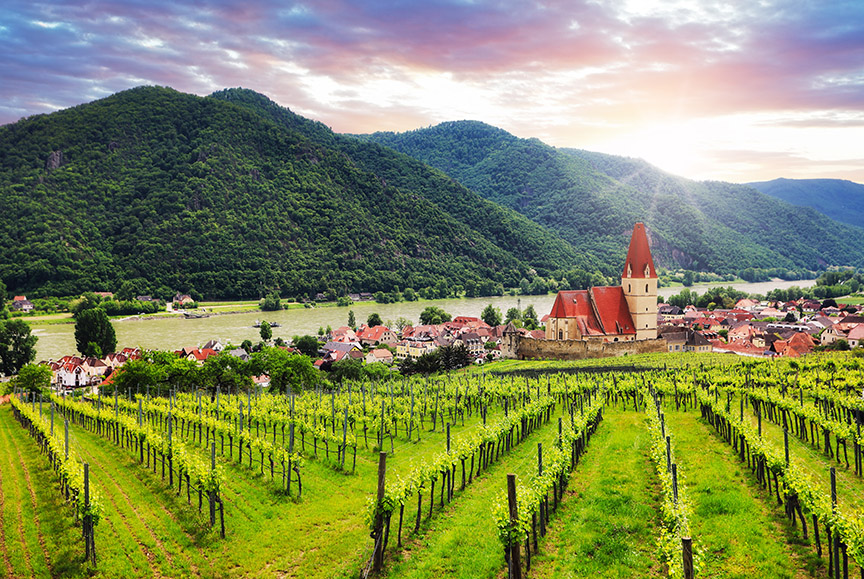
However, as the world’s wine drinkers and winemakers seek more diverse and complex wine options, Austria’s wine moment could be arriving. If that happens, Grüner Veltliner, or GV, will be leading the charge.
In Austria, GV is the most widely planted grape. According to the Austrian Wine Marketing Board there are nearly 14,300 hectares (over 35,000 acres) of it. And in the U.S. since the early 2000s, the number of GV plantings has slowly expanded. Vineyards of this grape can be found in California, including Napa and Santa Barbara, in Oregon, New York, and Michigan — to name a few areas.

Grüner makes an engaging and highly drinkable wine that few white grapes can match for its ability to pair with almost any food. The grape is high in acidity and can create very contrasting flavors including lime, white pepper, and cream. The wine can be light and lean or full-bodied with savory aromas. Some versions can age to become buttery and candied. It’s a very interesting prospect for a winemaker looking to expand his or her white horizons beyond those more predictable Chardonnays and Pinot Grigios.
Other Austrian grapes are also worthy of attention. Wine expert Jancis Robinson has raved that Welschriesling makes “superb sweet Botrytised wines” but it’s also versatile enough to make sparkling and dry table wine.
While Austria is best known for whites, its reds are also making an impact among wine experts these days.
There’s Blaufränkisch, a high-acid red wine with rich black fruit and peppery flavors that dominates in the Burgenland region of eastern Austria. The grape is also known as Lemberger when it pops up in vineyards across the United States, including in Pennsylvania, Washington, and Michigan.
There’s another leading red grape in Austria — which happens to be the most planted — called Zweigelt. This is a cross between Blaufränkisch and St. Laurent and it’s lighter than Blaufränkisch, often with a bright, tart, and fruity flavor similar to Pinot Noir.

These are probably the four leading local varieties among more than 40 different grapes that Austrians use to make wine. Before you seek out these grapes, hear what some professional Austrian winemakers have to share about how to use them and what to look out for.
Roland Minkowitsch Winery
Martin Minkowitsch has made the wine at Roland Minkowitsch Winery in Austria’s largest wine-growing region of Weinviertel for about a decade, but his family has made wine here for more than 400 years. The winery, close to the Slovakian border, is named after his grandfather, but was founded by the family’s Croatian ancestors in 1620.
“At that time, Croatia was part of Austria and its Austro-Hungarian empire,” says Minkowitsch.
Following a series of costly wars against the Turkish Ottoman Empire the area needed repopulating. “There were not many people living here, and they asked Croatian farmers to settle down in the east of Austria,” he says.
Minkowitsch grew up with tractors and spent a lot of time at the winery as a youngster, but winemaking wasn’t his first calling. He was working as a financial adviser and business consultant when, somewhat out of the blue, his uncle called him up with a life-changing proposition.
“One day, my uncle called me and asked me if I wanted to take over the winery,” says Minkowitsch. His uncle and aunt had no children and wanted to ensure the winery stayed in the family. Since then, Minkowitsch has made the wine.
With no regrets around that decision made 11 years ago, Minkowitsch runs the winery with an intelligent balance of traditional methods and modern winemaking know-how. For example, grapes are hand-picked and a 200-year-old basket press is still the only way he presses them. But there’s nothing quaint about this decision.
“It is a very old technique, but now in Austria colleagues are bringing it back,” he says. “We have a CO2 balance with this press.”
Experts say maintaining that balance is important for aromatics and for producing a wine that tastes fresh and vibrant — integral qualities for a Grüner Veltliner.
“We have low and gentle pressure on the grapes, and a lot of maceration at the beginning,” says Minkowitsch. This gentle pressure on the Grüner grapes continues for up to six hours, releasing the juice that runs into tanks for fermentation.
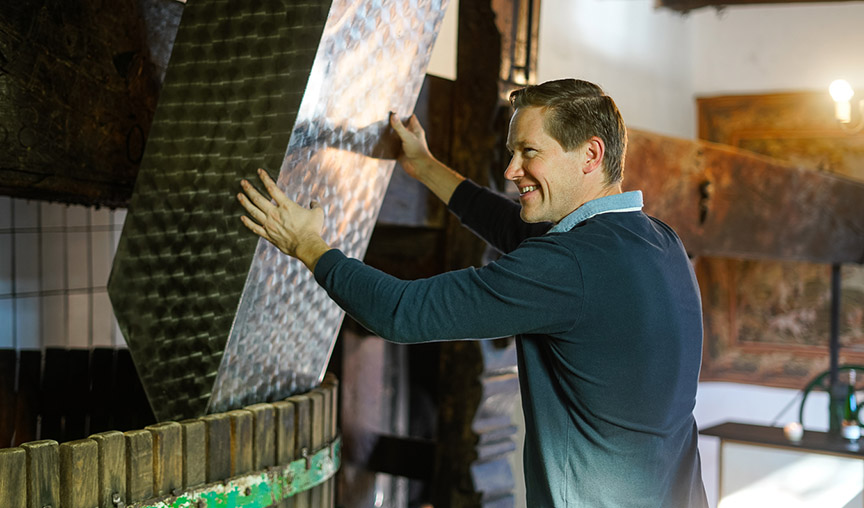
Oxygen exposure using a 200-year-old basket press
Another quality of the basket press method, says Minkowitsch, is the way it exposes the macerated grapes to oxygen. Ironically, concerns about how an old technique like this might overexpose the grapes to oxygen, resulting in oxidized wine, is probably one reason some commercial winemakers dismiss the basket press and stick to pneumatic presses.
“Critics of the basket press over the last decades have said that they cause oxidation and if the must has oxidation then the aromas evaporate,” explains Minkowitsch.
However, recent research has found most aromas are actually released later during the fermentation. “This is also what I see, because I have Grüner Veltliner that smells and tastes extremely typical,” says Minkowitsch.
Just as importantly, he says the way the basket press exposes the must to higher levels of oxygen actually raises its oxidative capacity and enables the must to better handle oxygen exposure during the winemaking process. “I think this is also a secret behind our quite long lasting Grüner Veltliner,” he says. “A few weeks ago, I opened a bottle from 1995, and it is in excellent shape; I think this is because of oxygen exposure right at the beginning.”
For fermentation, Minkowitsch adds a local yeast he knows well that he says is suited to this grape. However, he says every year the speed and longevity of the fermentation can be different. “The fermentation process can be difficult so it is good to have a yeast where I can be confident in a completed fermentation,” he says. Minkowitsch describes the yeast as a commercial, Grüner strain that is not readily available to winemakers in North America.
But if you are looking for a decent GV yeast, don’t be disheartened! One option that is often available in the U.S. in amounts suitable for home winemaking is Oenoferm Veltliner. This is a Saccharomyces cerevisiae yeast that, according to the manufacturer’s website, can create “highly typical Grüner Veltliner wines.”
Three styles of GV and a novel way to cool a tank
Minkowitsch most often ferments Grüner Veltliner in stainless steel tanks, but not always.
“Sometimes with riper Veltliners we go to 5,000-liter oak barrels that are more than 25 years old, so they are just for the structure,” he says.
He makes three types of Grüner. One of them is more classic with high acidity, a second is fermented in oak, and a third spends more time on its spent yeast cells.
Minkowitsch doesn’t worry about temperature control for the GV that he ferments in barrels but for the stainless steel version he uses a cooling technique that home winemakers could adapt. He rigs up a watering system that pours water down the outside of the tanks, which he says is common among Austrian winemakers. “It runs along the stainless steel and it is cooling because of the evaporation process,” he says.
Exact temperature control isn’t possible, but Minkowitsch doesn’t want to control everything. Instead, he tries to keep his GV fermentation in the range of 68–72 °F (20–22 °C).
“It is quite a warm fermentation, I think, but I just try to avoid it getting higher than 22 °C (72 °F),” he says.
Minkowitsch says GV’s biggest winemaking challenge in the vineyard is the need to reduce its naturally high yield to ensure a quality wine with good fruit concentration.
“In summer we go through the vineyards and cut down grapes on the floor so that you have more concentration in the grapes that are left on the vine,” says Minkowitsch.
In the winery, maintaining acidity levels can be tricky, but he says that is also heavily dependent on the harvest timing. One or two days late can mean the acidity just disappears.
“Grüner, when it is hot during the ripening process, loses its acidity quite fast. For this typical Grüner style in stainless steel you need the acidity and when you lose it, it is gone,” says Minkowitsch. He doesn’t like to acidify his wines.
For filtration, bentonite is used to remove solids and then he filters with a plate and frame.
Welschriesling, the dry and the sweet
Minkowitsch also makes wine from the white Welschriesling grape in an Italian style. This grape is grown in Austria but also across Hungary, Slovakia, and northern Italy.
“We think the origin of this grape is in Italy and in Austria the term “Welsch” means the others or the different ones,” he says. “So it is the other Riesling compared to Rhine Riesling.”
Unlike Riesling grapes, Minkowitsch says Welschriesling can cope well with higher temperatures because the berries are smaller and acidity levels are higher. He treats his Welschriesling grapes just like his GV. His relatively long pressing time of about six hours means there is enough maceration for the juice to release from these small grapes. His version for this wine is dry and tends to have apple and pear aromas.
“When it is dry you serve it like a table wine and it fits excellently with our Austrian cuisine, so pork and every kind of meat, noodles, and dumplings,” says Minkowitsch.
But many Austrian bottlings are sweet, late-harvest wines. This grape, says the Roland Minkowitsch winemaker, is very suitable for making sweet wine because of its uncanny ability to stay on the vine, even well into the winter months.
“The berries will not fall down, even if there is harsh wind,” he says. “That is why many sweet wines are made out of this grape. That is the secret,” he shares.
Rudolf Rabl Winery
Sixty-five miles west, in Austria’s Kamptal region, Rudolf Rabl Winery also produces an acclaimed Grüner Veltliner that comes from half of its 300 acres of grapes. The winery dates to 1750 and has remained in family hands since.
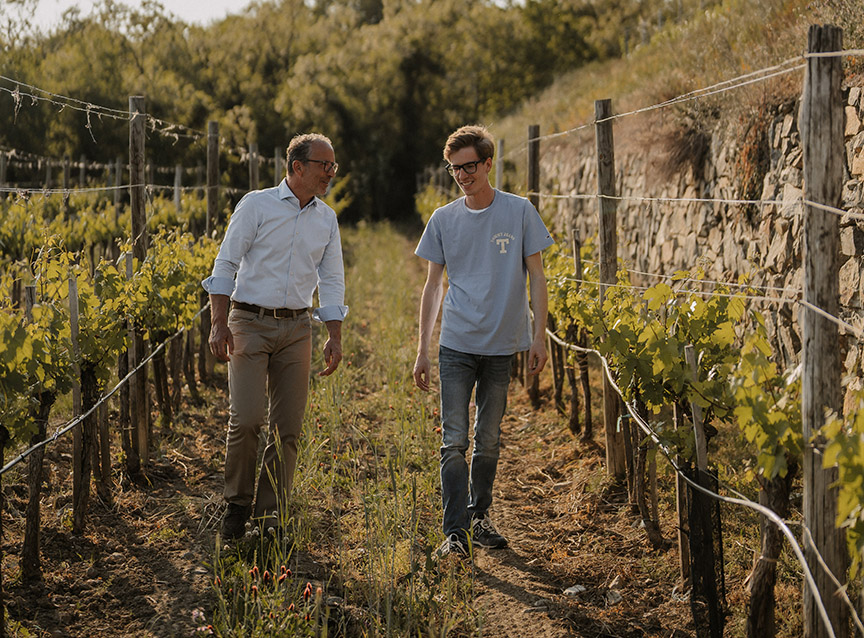
In 1986, the current patriarch Rudolf (Rudi) Rabl Jr. joined his father Rudolf Sr. at the winery and trained up in winegrowing. Rudi is very proud of what’s been achieved since, including recognition as the White Wine Maker of the Year at the International Wine & Spirit Competition in London in 2019 and 2021.
For him, skin maceration is very important in the winemaking process, including for GV.
“I’m not a big fan of whole grape pressing,” he says.
With Grüner, “Anything is possible”
Rabl says Grüner Veltliner is great from a winemaking perspective because of its versatility.
“The beauty of GV is that it offers such a wide range of different styles, influenced by the age of the vines, their origin, and leaf management,” he says. “Anything is possible, from light table wine to ice wine.”
Rabl believes Grüner should be expressive but not high in alcohol. The different versions of his GV can range up to 13.5% ABV, but the Kamptal DAC bottling (DAC is Austria’s answer to the French appellation system implemented in the early 2000s) is 11.5–12% ABV.
He says destemming and crushing is usually standard practice. “GV is very easy to destem, unlike Riesling, which we only crush and skin macerate,” says Rabl.
He uses closed pneumatic tank presses (a Scharfenberger Europress) that can be cooled so that skin maceration can be carried out in the press. The time left on the skins varies for different versions he makes, ranging from a minimum of three hours up to 12 hours overnight. Then, he has a thoughtful approach to adding yeast.
“We have a few favorite yeasts but only use one third of the recommended amount because, for me, it is important that the aroma influence of the yeast is not too strong; slow, continuous fermentation is key,” he says.
Rabl does use temperature control for his GV fermentation, keeping fermentation around 66 °F (19 °C).
Depending on the quality level of the wine, the fermentation process is different. “Village wines are fermented with wild yeast and after about three weeks, a selected yeast is added to ensure complete fermentation,” says Rabl.
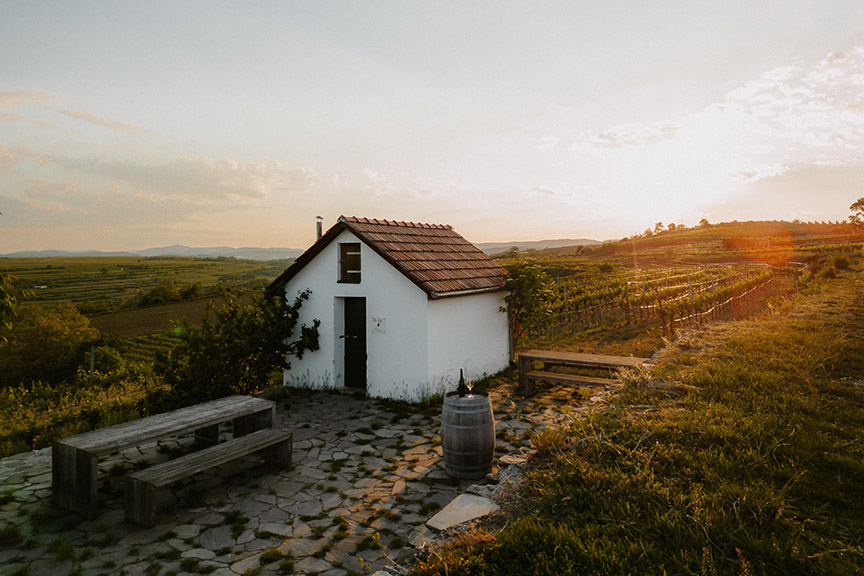
Single cru wines — some of Austria’s top-tier Grüner Veltliners — are also fermented with wild yeast but, under this classification’s rules, a cultured yeast can be added any time after eight weeks if it is needed.
For GV and all his other grapes, like Minkowitsch, he says the biggest winemaking challenges come before the grapes reach the winery.
“Due to global warming, foliage management is very different from what it was 30 years ago,” he says, “Today, it is important that the leaves provide shade for the grapes.”
For a winemaker seeking to take on GV, he says passion is key.
“One thing that is definitely clear to me is that if you can feel a soul in your wine, then you have made a wine with passion,” says Rabl.
Umathum Winery
Another family wine operation with a long history is run by winemaker Josef “Pepi” Umathum. Umathum Winery is in Austria’s southeastern Burgenland region, another area with centuries of winemaking pedigree. The Umathum family moved here from neighboring Bavaria, Germany, around 1760. Austria’s leading red grapes, Zweigelt and Blaufränkisch, are a focus here.
Umathum himself has made wine for four decades and says his winery has used organic agricultural practices since the 1970s and turned biodynamic in the early 2000s. The Burgenland winemaker, who describes his winemaking style as traditional, says biodiversity in the vineyard is “fundamental to get grapes with a rich and ripe taste, balanced acidity without too much sugar content.”
Zweigelt & Blaufränkisch wines
He says one of the leading Austrian reds made here, Zweigelt, “is smooth, fine, with peppery notes, sweet impressions on the palate, and elegant tannins.” Umathum loves this variety for its easy drinking and “cheerful” nature, artfully describing it “like a happy child with a bright smile.”
He grows this variety in iron-rich gravel soils and says it has an elegant, smooth body that tastes peppery and spicy.
Umathum describes the other red, Blaufränkisch, as full of personality and character. His version, he says, is full-bodied with “clear fruit, freshness, and spice” and fine tannins.
The Blaufränkisch grows on three different soils: Limestone, schist, and clay; from each of which a unique style is produce.
“The wine grown on clay is rich, with cool character, body on the palate and intensive tannins,” says Umathum. In contrast, the schist version has darker fruit, graphite aromas, and a long finish. The Blaufränkisch grown in soils with limestone is brighter red in color, he says, with fresh acidity and a lighter mouthfeel
All of Umathum’s Blaufränkisch are picked very late when the temperature outside is often below 41 °F (5 °C). The grapes are picked by hand and then undergo a careful selection process in the winery with an optical machine to help sort the grapes.
For his Blaufränkisch, the grapes are all destemmed and crushed, then cold soaked for three to five days in a fermentation tank kept to under 50 °F (10 °C). Given the outside temperatures, this is easy to achieve.
A preference for natural fermentations
“After that the fermentation starts naturally and we pump over up to twice a day using just a little bit of the juice,” he says. “Blaufränkisch has enough tannins that we don’t pump over too much.”
Umathum prefers a slow, natural fermentation. The Blaufränkisch is the last variety to be harvested and he says by this time in the season there is usually enough naturally occurring yeast around the cellar and winery to ensure a successful natural fermentation. If necessary, he will pitch a commercial strain.
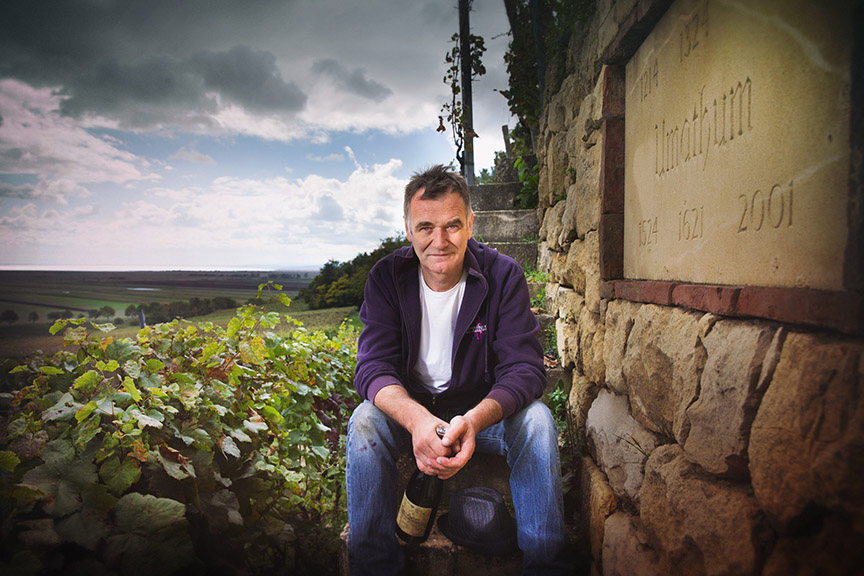
“If there are any problems, we will use a regional yeast called EGH Pannonia, which was selected by my friend Dr. Helmut Gangl, a biochemist from the village next to us,” he says.
This yeast is commercially produced by Lalvin, though it is only distributed in Central Europe at this time. Lalvin recommends a comparable substitute of Rhône 2056 to amplify the typicity of Blaufränkisch.
Umathum ferments Blaufränkisch between 77–82 °F (25–28 °C). This three-to-four-week process, ends with a malolactic fermentation and then the must is pressed.
“After pressing, the wine is stored in small barrique barrels up to two years,” he says. These are old barrels because he prefers his Blaufränkisch free from oak aromas.
The Zweigelt is also destemmed but only about two-thirds of the berries get crushed. This method allows for a balance between juice extraction and preservation of the grape skins, which can contribute to color, tannins, and complex aromas. Up to 30% of the stems are added to the fermentation tank to increase the structure.
A natural fermentation starts after about two days. The pumpovers are more intensive than for Blaufränkisch, taking place three times daily and using half of the tank’s juice.
The fermentation temperature also runs higher than for the other red, reaching 86 °F (30 °C).
“We use wooden fermenters, stainless steel, and also plastic boxes,” he says.
Umathum says his Zweigelt fermentations are finished after two weeks and then free-run wine is sent to large wooden barrels where it rests for one or two years. The press wine is bottled separately.
For both Blaufränkisch and Zweigelt they use a pneumatic press (usually at no higher than 1.2 bar) and also a vertical press, deciding which to use based on taste. Experts say pneumatic presses tend to extract flavors more gently with less harsh tannins.
His advice to a winemaker who wants to grapple with these Austrian varieties is pleasantly laid back: “Let your wines have all the time they need,” he says.
So there’s apparently no rush, but when you make the commitment to try making wine from these Austrian champion varieties, try and source locally-grown fresh grapes if you can — and Viel Glück (good luck)!
Explore International Wines with Danny Wood
Ready for more global wine insights? Check out these other profiles from author Danny Wood as he explores winemaking from around the world.