Malbecs Around the Globe
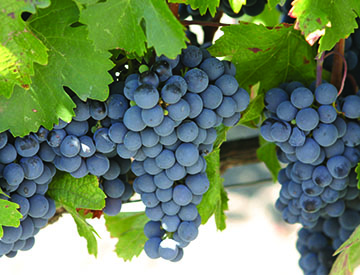
25 years ago, Argentina’s leading red grape, Malbec, was relatively unknown to Americans. Some wine lovers probably knew the grape from Bordeaux blends. A few aficionados may have tried an inky black and very tannic French wine called Côt, the original Malbec from the Cahors region.
However, a dramatic rise in Argentina’s wine quality and incredible export success catapulted Malbec from the relative backwaters of the wine world to vino stardom. According to Argentina Tourism and Wines, between 1995 and 2005 the value of the country’s wine exports increased by more than 300% with about 25% destined for the United States — most of it was Malbec.
Since then, exports have plateaued and in recent years slightly declined, but Argentine wine quality, led by Malbec, can be world class. Some of these Malbec wines approach the power of a Cabernet Sauvignon with concentrated dark fruits and tasty tannins. Others, with higher acidity, have the finesse of a Pinot Noir. In The Wine Bible, Karen MacNeil describes it best as, “distinct in character and spellbinding in flavor.”
The French region of Cahors has also upped its quality. Chile makes Malbecs and there are American plantings of the grape in states including California, Washington, Oregon, and Texas. There are also plenty of contrasting Malbecs within each country, depending on growing conditions and decisions made in the vineyard and winery.

So today the grape represents an exciting prospect for the home winemaker, especially right now. While you can wait to get your hands on American-grown Malbec in the fall, harvest season in the southern hemisphere is nearly upon us, running from February to May. If you can’t wait to put your knowledge into practice, it shouldn’t be hard to find some South American Malbec grapes. An internet search for “Grape Broker Argentine Chilean Malbec Grapes” will turn up some useful links.
A Pleasure to work with
To learn more about making Malbec wines, we interviewed Argentinian, American, and French Malbec vintners to learn more about their different techniques.
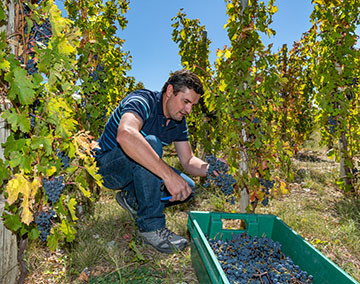
The first piece of good news: Malbec is generally a pleasure to work with in the winery.
“Winemaking with Malbec is straightforward,” says David Bonomi, Chief Winemaker for Argentina’s Bodega Norton, which owns five vineyards in Mendoza at the foothills of the Andes Mountains.
“Among the red varieties that I make wine out of, it’s probably the easiest. The color and aroma extraction in Malbec is easy,” adds the Argentinian, who has three decades of Malbec winemaking experience and was named one of Decanter magazine’s 2017 Top 10 Best Winemakers in South America.
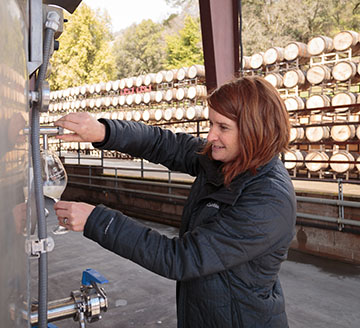
Joy Merrilees, Director of Winemaking at Shannon Ridge Family of Wines, in Lake County, California agrees with this sentiment.
“Yes, absolutely, it’s much easier than a Cabernet or Pinot Noir,” says Merrilees, who leads an all-female winemaking team. “It stands up to over-oxygenation, any yeast you throw at it, and it doesn’t produce a lot of hydrogen sulfide during the fermentation.”
In the French region of Cahors, Wine Consultant Simon Blanchard goes even further.
“If you make a simple wine with soft extraction you can still make good wine when Malbec is not totally ripe,” says the French vigneron with Derenoncourt Consultants.
“With Cabernet, if it’s not ripe it makes awful, heavy, harsh, and aromatically green wine,” he explains. “Malbec is very interesting because if it’s not really ripe you have flavors like Earl Grey black tea, like bergamot.” Blanchard makes Malbec biodynamically for two wine estates in Cahors, Château de Chambert and Château Cantelauze.
Malbec’s variety of styles are dictated by climate, harvest timing, winemaking techniques, and terroir.
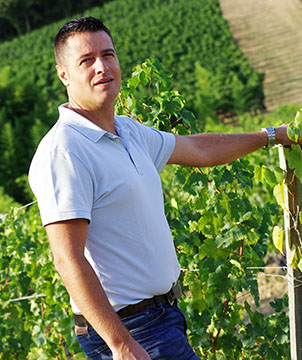
“For example in Chambert (where Château de Chambert is located),” says Blanchard, “you are directly on the limestone, there is not a lot of soil and the character of the Malbec changes totally and is more floral, fine, elegant, and acidic.”
Bonomi, from Bodega Norton, says there are two types of Argentine Malbecs that he likes.
“Those that are easy drinking, aromatic, and gentle on the palate. Then there are the more complex, elegant ones that develop for many years.”
Let’s find out how to make great tasting Malbec wines.
When to Harvest & What’s the Grape Chemistry
In Argentina’s Mendoza region, Ernesto Bajda makes wine for Bodega Catena Zapata. The winery’s owners, Nicolás Catena Zapata and his daughter, Laura, are often credited with doing more than anyone else to raise Malbec quality and promote it on the international stage. The family even founded Catena Institute of Wine to research Malbec and its terroir in Argentina.
Catena Zapata has seven vineyards at elevations ranging from 2,850 feet up to 5,000 feet. Bajda says the “wide spectrum of picking moments” for their Malbec start in February and end in April. Two decades ago they’d push the grape to get powerful wines by picking at 26 °Brix and 3.8 pH, but now they do things differently.
“Finally, we understand that picking early provides a clearer expression of the terroir.” They aim to harvest at 23.5 to 24 °Brix and a pH of 3.6 to 3.7.
Bajda says the lower sugar levels help later during fermentation because their native yeast doesn’t have to battle so much alcohol. The slightly high pH doesn’t seem to cause microbiological stability issues. (Generally, the recommended pH for a red wine is 3.4 to 3.6.)
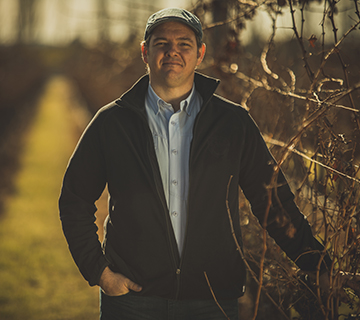
At Bodega Norton the vineyards are also in Mendoza and at comparable heights above sea level. For Bonomi, the great appeal of Malbec is its capacity to grow in such different terroirs and at such different elevations. For example, he could make a more powerful, full-bodied Malbec at their lower elevations where the climate is dry and hot. Up higher, where it’s still dry but relatively cool, his wines have higher acidity and more finesse.
Like Catena Zapata, Bonomi isn’t aiming for supercharged Brix levels.
“The harvest point I like for Malbec is 24.5 °Brix, pH 3.5 and acidity at 6.0 grams per liter,” he says. “This gives me the balance I need to get wines that are mature but fresh tasting.”
In California’s Napa Valley, Anna Monticelli’s Ilaria Malbec has a similar grape chemistry to the Argentinians. Her grapes come from the Coombsville AVA, a cooler Napa area due to San Pablo Bay.
“My numbers from this vintage were pretty typical for the Dr. Reid vineyard in Coombsville,” says Monticelli, who fell in love with Malbec after a trip to Argentina in 2007.
Her figures were 25.5 °Brix, 5.1 g/L titratable acidity, and 3.62 pH.
“I pick based off of flavor and phenological ripeness and let the vineyard dictate the numbers.”
Monticelli says she likes to create a big, full-bodied Malbec that is also layered, complex, and elegant.
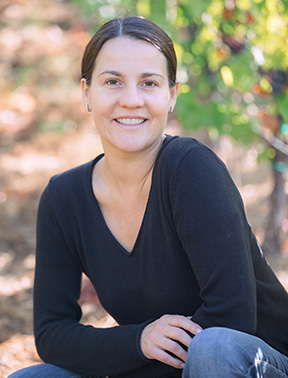
Further north in Lake County, where Malbec grows at a relatively high elevation of 1,800 feet, Joy Merrilees, at Shannon Ridge, makes a version of Malbec with more Brix and a higher pH.
“Right now I’m looking at the Malbec that came in this year,” she says, leafing through her notebook. “The Brix were at 26.4, the pH was 3.95, the TA was 5.3. And we added 1.5 grams per liter of tartaric at the beginning of fermentation (to bring down the pH, which came in high for a wine).”
She says the elevation helps to give their wines “more stuffing” from tannins and color and a fruit-forwardness at the beginning of the palate.
In Cahors, Derenoncourt Consultants don’t have any chemistry figures to share. “We only taste the berries and that’s how we choose the harvest date,” says Blanchard.
Early in veraison, he says the Malbec’s skin is harsh tasting and the pips (seeds) are very bitter. He says the major changes that make the grape ready to harvest all happen in October, in the space of one week, when the diurnal difference in temperature can be dramatic.
“At the end of the maturity cycle (the grape) will start to get a bit soft and then one week later it will be perfect. By that time it’s October, the color is very dark, the tannins are very soft, and the pips are nutty, crispy, and crunchy. And when it’s like that we decide to harvest,” explains the Frenchman.
Don’t Crush Me
When Malbec grapes arrive at their wineries, all the winemakers interviewed first destem. Only Monticelli crushes them — but very gently.
“The first, most important thing,” says Blanchard, “is to respect the fruit. There is no crusher. Never.”
He compares looking down on the destemmed berries in his tanks to seeing an open box of caviar.
Malbec grape berries are generally bigger and juicier than Cabernet berries. None of the winemakers choose to use enzymes to help the grapes release their juice.
“The extraction of color and aroma in Malbec is easy,“ says Bonomi. “It’s almost the opposite with Cabernet Sauvignon.”
Blanchard agrees but differs from his Malbec-making colleagues by sometimes adding stems. Depending on the vintage — but especially if the season was hot — at Château de Chambert they add between 10 and 30% whole clusters. He says the stem tannins help bring freshness with notes of licorice and spice to the wine.
Cold Soak
Then comes the possibility of a cold soak. For Shannon Ridge there’s no cold soak before fermentation. Monticelli and the Argentinian winemakers cold soak 3–4 days to extract color and aroma.
But in France, Blanchard uses a much longer maceration period that, including primary fermentation, lasts between 16 and 18 days with stems and from 20 to 25 days without stems.
The fermentation styles for our winemakers are all slightly different from each other.
Bodega Norton has the longest, coolest Malbec fermentations.
“Our fermentation temperature is between 75 and 78 °F (24–26 °C),” says Bonomi. “We use a yeast inoculation for our Malbecs designed for early drinking, and for our age-worthy wines we have a native yeast.”
Their fermentations take between 15 and 20 days.
Ilaria Wines and Shannon Ridge both aim for peak temperatures of 82 °F (28 °C) and use jackets to control the temperature.
The temperature-controlled ferments at Chateau de Chambert and Catena Zapata are the highest, both hitting 86 °F (30 °C).
Catena Zapata’s top wines are fermented by native yeasts (they inoculate for bigger volumes). Bajda says their native yeasts are different strains of Saccharomyces and non-Saccharomyces and even include some Brettanomyces. Brett is considered a wine fault by many winemakers but he says they consider very low levels of it part of the life of their terroirs. They don’t let its negative characters — this yeast can produce aromas of a farmyard and sometimes full baby diapers — spoil the wine. Catena Zapata controls Brett by adjusting sulfite levels according to pH. “If the fermentation runs normally, then Brett is not an issue,” Bajda says.
Their primary ferments take place in a variety of vessels including French barrels and macrobins, and they complete in 6 and 8 days. Yeast nutrients, including organic yeast products and some diammonium phosphate (DAP), are used when necessary.
At Chateau de Chambert a natural fermentation is allowed to take place during the 16 to 25 day maceration period. Then they press and allow a malolactic conversion to take place in big, used wooden tanks that range from 1,000–3,500 liters (265–925 gallons) in size.
The two Californians inoculate their primary fermentations.
“My favorite yeast is D254 because it has a high alcohol tolerance, moderate nutrient requirements, tendency towards intense fruit concentration, and full mid-palate,” says Monticelli.
Picking at 26.4 °Brix in Lake County, Merrilees also keeps alcohol tolerance in mind when selecting a yeast. “We use a strain called Zymaflore XPure from Laffort,” says Merrilees. “It’s known for high aromatics and also it’s a good fermenter because we do pick at higher Brix, so it’s alcohol-tolerant.”
Unfortunately, Laffort’s Zymaflore XPure yeast is only available in commercial-scale 500-g bags. The Shannon Ridge winemaker says Red Star’s Premier Cuvée is a comparable yeast that’s sold in 5-g sachets suitable for home winemaking.
At Shannon Ridge, Ilaria, and Catena Zapata the malolactic conversions all start naturally and are usually over by the middle of winter.
“If they get into January or February and the malic hasn’t moved at all then we’ll go ahead and add some malolactic bacteria and nutrient to get it going,” says Shannon Ridge’s Merrilees. “But most of the time, just by leaving (the wine) in used barrels, the wines will go on their own.”
Malolactic bacteria usually lurk in used barrels, leftovers from previous malolactic conversions.
For Catena Zapata’s higher altitude vineyards, where the pH is lower and the acidity is higher, they choose not to do a malolactic conversion.
“Press the Crap Out of It”
When it comes to pressing the grapes, Shannon Ridge stands out.
“We press the crap out of it, to be frank!” says Merrilees with a laugh. “Most of our presses go up to 2 bar and we probably take it to 1.8.”
She says using a higher pressure works well because you can always reduce the pressure or strip out undesirable extractions later in the process. What you can’t do later, she says, is add phenolics that you are missing in the wine because you didn’t press them out.
“We usually just let the cycle finish out. We’re mostly looking for yield,” says Merrilees. “We try to get at least 175 gallons (660 L) of juice per ton.”
In contrast, at Bodega Norton the pressing is done at under 1 bar and at Ilaria a little over 1.
“We first drain and separate the free run,” says Monticelli. “We then do two press fractions in our Bucher bladder press. It’s a short and gentle 50-minute press cycle and we go up to 1.2 bars.
Sulfites
All our Malbec winemakers make relatively low sulfite additions to their Malbec wines.
Catena Zapata’s philosophy is to add the least possible SO2 during the winemaking. After bottling and 24 months of aging the total SO2 is around 70 ppm. However, Bajda says the winery is decreasing sulfite levels as much as they can and trialing commercial bottles with no sulfites. He describes the results of these trials as “very interesting.”
At Bodega Norton they add 30 ppm SO2 when they destem the grapes and maintain that level through to bottling. “We’ve drastically reduced our SO2 use in recent years,” says Bonomi.
At Shannon Ridge they add 50 ppm at the destemming machine, “Which seems a little bit high,” explains Merrilees. “But we’ve done some studies over the years where a lot of that SO2 becomes part of the wine matrix and allows the tannin, anthocyanins, and other molecules to bind to that and stay in solution rather than dropping out.”
Her fellow Californian, Monticelli, adds the same 50 mg of sulfite at the crush pad and aims for a level of 30 ppm free SO2 through bottling and the barrel aging. (Not all of the sulfite protects the wine. Free SO2 is the component that actually guards the wine against oxidation and spoilage organisms).
At Chateau de Chambert there are no sulfite additions unless there is a problem. If there is a problem, a little sulfite is added at bottling.
“And after one year we usually rack it and finish in a concrete tank,” says Blanchard. “There’s no filtering or adding of chemicals.”
Low pH promotes microbial stability and is part of the reason Blanchard can leave out sulfites. The Malbec grapes from high on the Chambert plateau are growing in microbiologically healthy limestone soils, he says. “The pH there is very low, like a white wine. It’s crazy! You can see some pH levels around 3.3 or 3.4. So it’s very easy to have a clean wine with this kind of pH.”
Before bottling at the Chateau, there’s no fining and, unless turbidity (the amount of suspended components in the wine) is high, usually no filtering of the Malbecs. “In general, after three years of aging, the wines are very clean,” says Blanchard.
Unlike some biodynamic winemakers, Blanchard isn’t guessing or basing this conclusion on taste alone. “In the biodynamic world some people say, ‘I’ll leave it to nature to do the work,’ but I think it’s very important to monitor each stage,” he explains. “At Chambert, we use a microscope to see the evolution of the microbiology in the wine and the health of the bacteria. So if there is a problem we can use sulfur to correct it.”
Most of our protagonists don’t use fining agents — chemicals like bentonite — to settle, smooth, or microbiologically stabilize their Malbecs.
“With Malbec it just doesn’t really produce high levels of tannin naturally so it usually doesn’t need any fining whatsoever,” explains Merrilees.
For fining and clarification, Monticelli relies on the natural settling of her Malbecs during the aging process in-barrel.
“I do a rough 1 micron filter to clean up the wine at bottling,” she adds.
Shannon Ridge use a cross-flow filter for their Malbec wines before bottling. Merrilees says this is mainly because they’re a big commercial operation, and home winemakers shouldn’t need to filter.
“If you have the time to rack and let it age in barrel, Malbec is one of those wines that, as long as it’s stable, and you don’t really need to use a lot of SO2 to complete it, or to stabilize it, and as long as it’s completely through MLF, then you can bottle it with little to no filtration.”
Bonomi agrees, saying Bodega Norton doesn’t use filtration. “For us,” he says, “time and racking are our pillars for stabilizing our wines.”
By contrast, at Catena Zapata they are open to trialing all forms of filtering, including by cross-filter, depending on the state of the wine.
Bajda says they’re informally studying the impact of sterile filtering (some winemakers believe it strips out phenolics) on wines that are now 6 years old by comparing them to wines of the same age that weren’t filtered in this way.
“The sterile filtered bottles taste better!” says Bajda in a surprised voice as he casts this stone in the ongoing argument over the impact of filtering on wines.
Aging
The Malbec aging process is also differently deployed by each of our five Malbec winemakers.
Blanchard’s Malbecs are usually aged in a combination of large, used wooden tanks and then finished in concrete vessels. The whole process can take three years.
At Catena Zapata, Bajda says they use all kinds of oak with different toasting levels. “We want the barrels to be another part of the complexity,” he says.
Bonomi’s top Malbecs are aged for 12 months in 225- or 600-liter (60- or 160-gallon) French barrels. Their mid-level “crianza” Malbecs are aged in small concrete vessels.
The Americans have a preference for French oak.
“All French oak,” says Monticelli. “The Malbec gets about 50% new (oak), depending on vintage.”
Merrilees utilizes French oak and some used American barrels and likes them at a medium to medium-plus toast level.
“With the Malbec we only do maybe 15% new wood, not a whole lot. We really think the Malbec shows nicely on its own and doesn’t need to be overpowered by oak,” she says.
Another reason why, for the home winemaker who does not employ barreling and wants to make a classy dry red, Malbec may be the perfect answer in either the spring or fall harvest.