Symphony: 40 Years in the Making
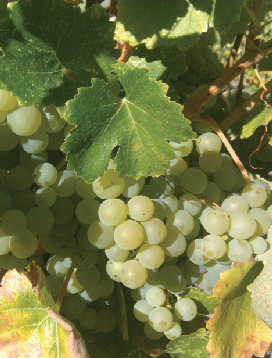 Some years ago, I was judging at a local home winemaker wine competition and during one of the discussion sessions after we had evaluated this particularly interesting white wine with hints of Muscat, a fellow panelist hedonically described the wine as a “symphony in his mouth.” Now I have heard fellow judges talk about a “party in the mouth” but this was different. So I started being a little quizzical as to the meaning of this phrase, and prodded him with further questions; was the “symphony” being performed by professional or amateur musicians? My sarcastic humor was met with a blank expression as if I should have been able to interpret what it meant. Probably something positive to say about the wine I’d guess, but we never got there because the blank expressions turned to laughter when the identity of the grape variety was revealed — Symphony! There really was Symphony in his mouth!
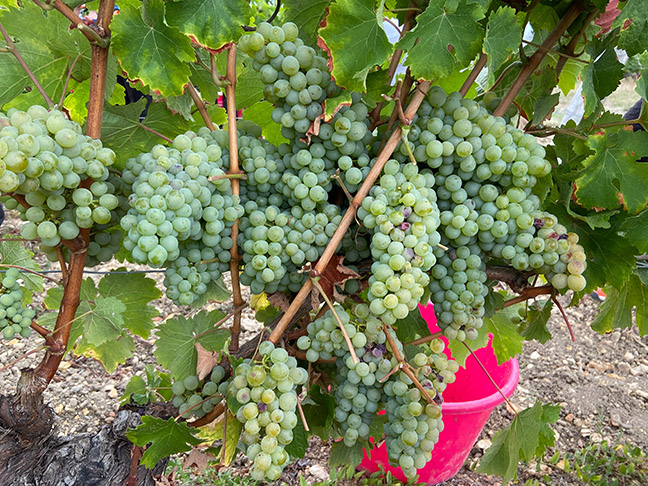
Symphony is a white grape bred by the late Dr. Harold Olmo, a grape breeder working in the Department of Viticulture and Enology at UC-Davis. It is a cross of two vinifera varieties, Muscat of Alexandria and Grenache Gris (Garnacha Roja). Longtime “Varietal Focus” readers know my views on the grape breeding process. I stand by saying it is a tough business to be in. First the goals of the breeding need to be established, then you evaluate hundreds, if not thousands, of seedlings, then at some point you see if the trait was achieved and you decide if the grape makes a good wine. Many breeding programs fail at this last junction; the failure due to poor wine quality, or in some cases, the inability for the new variety to catch on.
Symphony was first released in 1982, which lends a story in itself as to the trials grape breeders go through to invent new varieties. Dr. Olmo specialized in developing grape varieties that were more adaptable to the hot summers of California’s Central Valley with — under the mantra of the time — high yields in respect to tons per acre. The original cross between the two varieties took place in 1940. That flower produced 94 seedlings that were grown up. During the vintages of 1948 and 1949, mini-wines were made to see if they produced wines of any quality. The plant consistently rated high and was then set up in a field trial at two sites, the cooler Napa Valley and a site near Fresno, California, deep in the hottest part of the Central Valley of California. While wines from both sites were viewed positively, the work at the Fresno-area site showed that Dr. Olmo’s cross fulfilled his research mission. More field trials occurred in both the 1960s and 1970s, with the first application for a patent occurring in 1981, over 40 years later!
Today, large-scale commercial Symphony production is pretty much unique to California. In 2015, 38,875 tons were crushed, up from 30,000 tons crushed in 2014. Anecdotally, the vintage year 2015 was supposed to have lower yields overall, which brings up another interesting fact. Those varieties actually developed for California agriculture by Olmo and others were generally up in 2015, while the mainstream varieties (Chardonnay, Cabernet Sauvignon, etc.) were down. After now five years of drought, maybe these grape breeders were on to something.

Modern day Symphony grape acreage area is stagnant, with only 1,687 acres reported producing in 2014. But when you think about it, for 2014, the grape averaged a whopping 18 tons per acre! I had the opportunity to talk to one of the major Symphony producers recently about the grape and its yields, and their cropping average is 12 to 14 tons per acre.
Commercial Symphony wines, made as a varietal, have not really caught on. I see it incorporated into many blend compositions that run across my desk. The most notable varietal labeled wine is produced by Ironstone Vineyards in Murphy’s, California, with most of the fruit being grown in the Lodi, California area. This wine, called Obsession is made in a light, crisp, yet sweet style, so much that the grape was known for in its early trials. It is planted elsewhere in California and also New Mexico and Virginia. The most unusual report of Symphony is from the Big Island in Hawaii where the first vines were planted in the early 1980s. Symphony wine had headed the Volcano Winery white wine lineup almost exclusively until 2006. I visited this winery once and recall the wines as very refreshing; it was humid that day and a crisp sip of Symphony was just what I needed.
In my experience with the grape, the dry white wines it produces are a bit thin with respect to mouthfeel, but definitely exhibit the Muscat character. This thinner mouthfeel is likely the reason there was a tendency for the best wines produced from Symphony to be of sweeter styles. In an interesting contrast to the field trials during which grapes averaged 24–25 °Brix, my personal experience has found Symphony grapes around 20–22 °Brix. Field cropping levels are the most likely reason for this difference.
A colleague of mine likes to refer to grapes by their ease of processing. At one time, Pinot Noir was the worst. After he designed some equipment specific to my purposes and I put some Barbera to the test, the equipment gave some fits and he declared that “Barbera is the new worst grape to work with!” I dare to tell him about Symphony. Truth be told, Symphony can be a difficult grape. Given its Muscat background, it is a pulpy grape by nature, similar to other Muscat or Muscat-like grapes. So while I only first made Symphony during the last harvest, I started making wines from Muscat-based grapes about 10 years ago, and the learning curve has been ongoing.
Grapes with high pulp need some tender loving care in the de-juicing stage. Their juice and wonderful aromatics have to be maximized without too much skin contact, which can lead to higher pH levels due to increased potassium expression from the skins. Even with the most sophisticated presses, you need to exercise patience.

I first started out destemming and crushing into a basket press. The yields were dismally low, in the order of about 60 gallons (225 L) per ton. The resultant cake was never dry, rather taking on a more gelatinous texture. I next decided using a pressing aid such as rice hulls would help improve the yields. The improvements were marginal, increasing the yield to about 80 gallons (300 L) per ton. We purchased a brand new 22-hectoliter membrane press, with multitudes of options with respect to press cycle programming. My first attempts were slightly idealistic in that I felt the answer would be whole cluster pressing. Once again, I was wrong and yields actually went down!
I feel I nailed it in one respect and failed it in another in 2014 with a press load of Muscat of Alexandria. We had just received a free sample of Scottzyme Cinn-Free (a purified pectinase with very low cinnamyl esterase activity, which helps reduce the formation of vinyl phenols). We crushed the grapes, sprayed the enzyme solution over the fruit as we pumped it to the press, and started our standard white juice program. Sadly, the press malfunctioned about 30 minutes into the cycle and we had to wait four hours for the service technician to arrive. There the grapes sat, enzymes chewing away at the skins and since the juice channels were stuck in the up position, there was no way to capture any of the free run juice. When service arrived, they diagnosed and repaired the problem and we were on our way. Juice yields then increased dramatically — it topped at over 150 gallons (568 L) per ton. That’s how we nailed it. We failed in that with all the skin contact, we had a post de-juicing pH of greater than 4.0.
As 2015 rolled around we were scheduled to receive Symphony for the class projects. We really nailed it on all fronts this time, with great juice yields and chemistries. We only had to bump the acidity about 0.5 g/L. The result was a very light and refreshing, low-alcohol wine. I give credit to the many years of working other similar grapes to helping me get it right with Symphony the first time around.
For the 2016 harvest we are going to take a page from the history books and work backwards, revisiting the bladder-basket press once again. Between enzyme use, rice hulls, and an internal vertically positioned bladder, we are going to nail this!
Fortunately the reader does not have to wait until 2017 to see if we were successful! The ability to make Symphony wine has been made easier in its incorporation into wine kits. The kits are optimized and recipe-driven, so success is a more likely result.
Compared to the mainstream varieties, Symphony has only some dedicated, outgoing wine drinkers who like trying different things. But Symphony has developed its own niche market, albeit tiny. My mother loved the Ironstone Vineyards Obsession wines, and a handful of small wineries are making these varietal Symphony wines. To the benefit of home winemakers, the extra fruit not destined to the blends in the larger winery tanks in the Central Valley of California winds up in kits; to further the endeavors of those home winemakers who are interested in starting their own orchestra.
Symphony Wine Recipe (5 gallons/19 L)
This is a simple way to make Symphony from juice concentrate. Juice concentrates generally are adjusted for pH and acidity so no further adjustments are necessary. Depending on the kit manufacturer, directions may vary slightly. Consult the manufacturer’s specification included with the juice. Ingredients Symphony Juice Concentrate, ~68-70 °Brix (5 cans, 46-oz. pack aging). This product is readily available through online or local home winemaking suppliers from California Concentrate. 3.5 gallons (13 L) distilled/de-ionized, or chlorine-free water 5 grams Lallemand QA23 yeast 10% potassium metabisulfite (KMBS) solution. Weigh 10 grams of KMBS, dissolve into about 50 milliliters (mL) of distilled water. When completely dissolved, make up to 100 mL total with distilled water. 5 grams Go-Ferm (or equivalent yeast starter) 10 grams Fermaid K (or equivalent yeast nutrient) 5 grams Di-ammonium Phosphate (DAP) Other equipment or needs 6-gallon (23-L) food-grade plastic bucket for fermentation. 5-gallon (19-L) carboy Inert gas (nitrogen, argon or carbon dioxide) Ability to warm about 4 gallons (15 L) of water to 60–65 °F (15–18 °C). Ability to maintain a fermentation temperature of 55–58 °F (13–15 °C). Ability to hold wine at 38–40 °F (3–4 °C) while settling. Thermometer capable of measuring between 40–110 °F (4–43 °C) in one degree increments. Pipettes with the ability to add in increments of 1 mL. Step by Step 1. Clean and sanitize all your winemaking tools, supplies and equipment. 2. Warm water to about 65 °F (18 °C). You will use 3.5 gallons (13 L) to dilute the concentrate. 3. Add five cans of juice concentrate, using the warmed water to completely dissolve remaining concentrate in the can. Mix well. This can be done in the bucket or a pot on the stove. In the end, you will have about 5.5 gallons (21 L) of juice in the bucket at about 22.5 °Brix. 4. Mix into the juice the Fermaid K or equivalent yeast nutrient. 5. Prepare yeast. Heat about 50 mL distilled water to 108 °F (42 °C). Measure the temperature. Pitch the yeast when the suspension is 104 °F (40 °C). Sprinkle the yeast on the surface and gently mix so that no clumps exist. Let sit for 15 minutes undisturbed. Measure the temperature of the yeast suspension and of the juice. You do not want to add the yeast to your cool juice if the temperature of the yeast and the must temperature difference exceeds 15 °F (8 °C). To avoid temperature shock, acclimate your yeast by taking about 10 mL of the juice and adding it to the yeast suspension. Wait 15 minutes and measure the temperature again. Do this until you are within the specified temperature range. Do not let the yeast sit in the original water suspension for longer than 20 minutes. When the yeast is ready, add it to the fermenter. 6. Initiate the fermentation at room temperature (~65–68 °F/18–20 °C) and once fermentation is noticed, (~24–48 hours) move your fermenting wine to a location where the temperature can be maintained at 55–58 °F (13–15 °C). 7. Take a Brix reading two days after fermentation starts. When it is approximately 15 °Brix, dissolve the DAP in as little water required to completely go into solution (usually ~20 mL) and add it directly to the carboy while stirring thoroughly to mix it in well. 8. Normally you would monitor the progress of the fermentation by measuring Brix. One of the biggest problems with making white wine at home is maintaining a clean fermentation. Entering the carboy to measure the sugar is a prime way to infect the fermentation with undesirable microbes. So at this point, the presence of noticeable fermentation is good enough. 9. Leave alone until bubbles in the airlock are about one bubble per minute — usually about two to three weeks. Measure the Brix every 2–3 days. 10. The wine is considered dry, or nearly dry, when the Brix reaches -1.5 °Brix or less. Add 3 mL of fresh KMBS (10%) solution per gallon (4 L) of wine. This is equivalent to an addition of approximately 40 ppm. Transfer to the 5-gallon (19-L) carboy and lower the temperature to 38–40 °F (3–4 °C). 11. After two weeks, test for pH and SO2. Adjust as necessary to attain 0.8 ppm molecular SO2. (There is a simple SO2 calculator at www.winemakermag.com/guide/sulfite). Check the SO2 in another two weeks, prior to the next racking, and adjust while racking. HINT: Rack to another sanitized 5-gallon (19-L) carboy, or your bucket. In the case of the latter, clean the original carboy and transfer the wine back to it. This is done at about 4–6 weeks after the first SO2 addition. Once the free SO2 is adjusted, maintain at the target level by monitoring every 3–4 weeks. 12. Fine or filter if desired. 13. At about three months you are ready to bottle. Be sure to maintain sanitary conditions while bottling. Once bottled, you’ll need to periodically check your work by opening a bottle to enjoy with friends.